


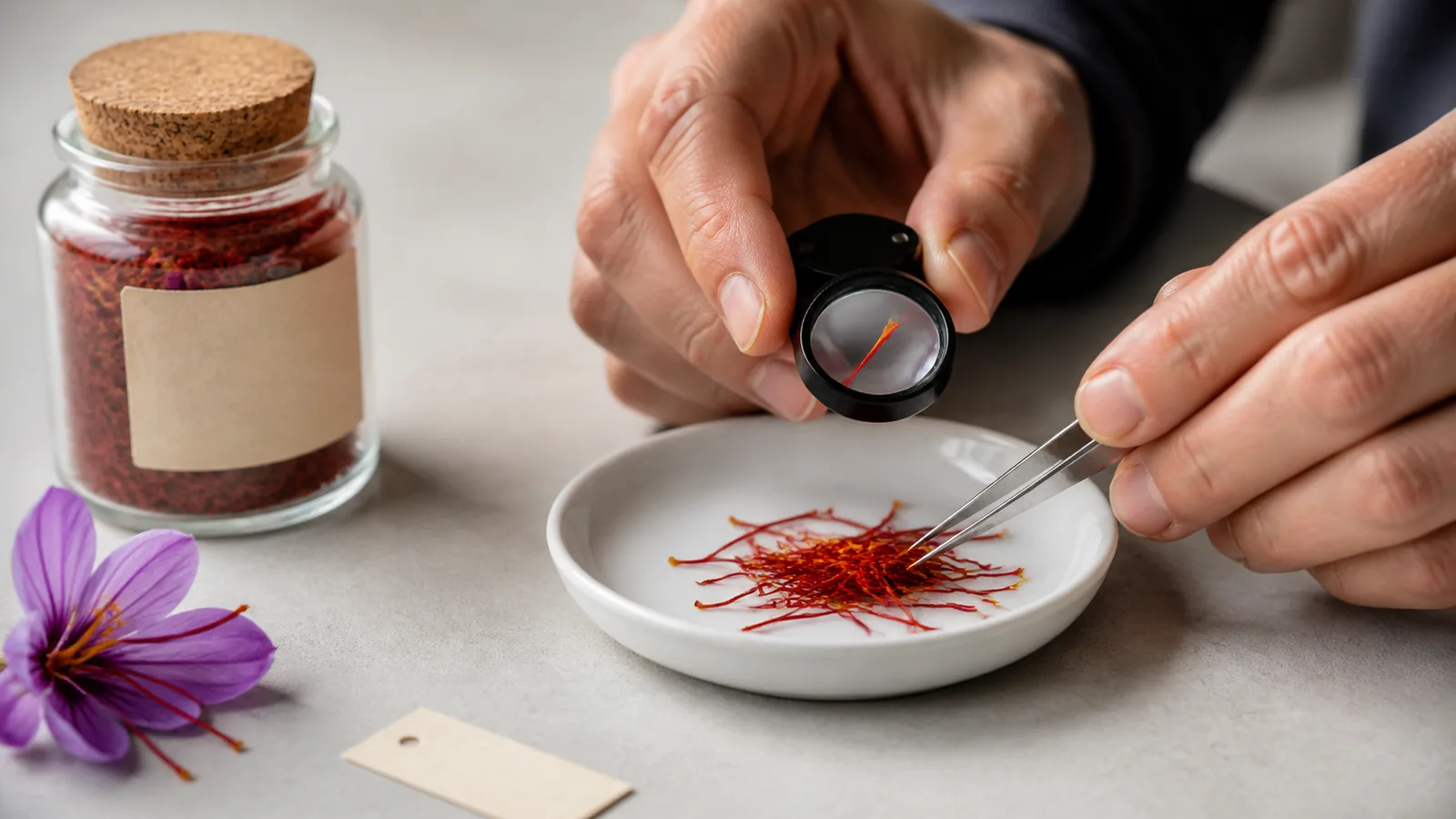
How to Identify Healthy Saffron? Start by defining “healthy” correctly. For saffron, it should mean genuine Crocus sativus stigma that is clean, properly dried and honestly labelled. It does not mean that a thread’s colour, smell or shape can promise a health benefit.
A buyer can spot warning signs at home, especially when examining whole threads. No kitchen trick can certify purity, though. Added plant material, undeclared dyes, excess moisture and false origin claims may require microscopy, chromatography, DNA testing or other laboratory methods. The safest approach combines sensible visual checks with a traceable seller, intact packaging and independent test evidence.
What genuine saffron is
Saffron is the dried stigma of the saffron crocus. Each flower has three red-orange stigma branches. A genuine whole filament is usually narrow at the lower end and broader toward the upper, receptive end. Under magnification, that wider tip has a trumpet-like shape and a fine papillate or toothed edge rather than the smooth edge of a flat strip.
Colour varies within a real thread and between commercial grades. Some grades contain almost entirely red stigma; others retain part of the orange or pale style. A little style is not proof of fraud—it changes the grade and colouring strength. Perfectly uniform neon red, identical flat strips or visible dye concentrated on the surface deserve closer attention.
What the old phrase “saffron blades” describes
The phrase “saffron blades” appears in older translated guides, including the former version of this article. It means saffron threads or filaments, not a separate botanical structure. Recognising that translation helps explain several search results and some confusing buying advice.
The earlier text also called one form “screwed girl.” This was a literal mistranslation of dokhtar-pich, often sold in English as bunch saffron. The stigmas and styles are kept together and tied as a small bundle, showing a red-to-pale colour transition. It is a traditional presentation, not automatically the “best” grade. Buyers comparing bunch, pushal, sargol or negin saffron should look at the specification and intended use rather than assume one local name proves quality.
Common ways saffron is adulterated
High value and a complex supply chain create an incentive to substitute or bulk out saffron. The US Food and Drug Administration gives the straightforward example of expensive saffron being extended with cheaper plant stems. European Commission investigations have also found undeclared plant material and unauthorised dyes in herb and spice samples.
Substitution can take several forms:
- safflower or calendula petals cut to resemble threads;
- dyed corn silk, other plant fibres or paper-like strips;
- yellow stamens or pale saffron styles coloured red;
- turmeric or other plant powders mixed into ground saffron;
- added mineral material or moisture to increase weight; and
- synthetic colourants used to strengthen a weak-looking sample.
The historical article listed tartrazine, Orange II, amaranth, Ponceau 4R and quinoline yellow among colours reported in saffron fraud. Modern reviews also discuss Sudan dyes and other colourants. A consumer cannot identify a particular dye safely by eye, and a bright result in water is not enough to name it.
Seven useful checks before you buy or use saffron
1. Prefer whole threads when authenticity matters
Powder removes most visible structure, making substitution easier to hide. ISO notes that fraud is more common in powdered saffron because less expensive material can be blended into it. Powder can still be legitimate, but it places more weight on batch records and testing.
2. Examine several threads, not one
Look for natural variation and the characteristic widening near the upper end. Genuine threads are not manufactured copies, so they will not all have precisely the same length and edge. A phone macro lens or simple magnifier can help reveal shape; it cannot detect every botanical or chemical adulterant.
3. Read the label as carefully as the saffron
Useful packaging identifies the product form, net quantity, packer or responsible business, country or region of origin where claimed, lot or batch, and storage guidance. A verifiable lot is more meaningful than decorative words such as “premium,” “royal” or “organic” without certification.
4. Check the pack and storage condition
A damaged seal, condensation, damp clumps, insects, mould or a musty odour are reasons not to use the product. Saffron should be protected from moisture, heat and light. Excess water is not only a storage problem; it can also make a sold weight misleading.
5. Treat aroma and taste as supporting clues
Genuine saffron has a distinctive aroma and a bitter taste, but sensory descriptions vary and weaken with age or poor storage. Added fragrance can imitate aroma, while a genuine older lot may smell faint. Never taste an unknown sample simply to authenticate it.
6. Be sceptical of an implausibly low price
A very low price can signal dilution, old material or a misleading quantity, but price alone proves nothing. Efficient sourcing, grade, style content, pack size and market conditions all affect cost. Compare the price per gram and the evidence attached to the lot.
7. Ask what the test certificate actually covers
A certificate should name the sample or lot, laboratory, date, methods and results. A generic PDF belonging to another batch does not authenticate the pack in hand. ISO 3632 provides specifications and test methods for dried saffron in filament, cut-filament and powder forms. The current specification is ISO 3632-1:2025; the test-method part is ISO 3632-2.
Why popular home tests are not proof
The previous article repeated seven home or classroom tests. Some may show an obvious anomaly, but none should be used as a purity certificate.
The paper-press test: an oily stain can indicate added oil or another substance, yet the absence of a stain does not prove a thread is saffron. Many plant substitutes are not oily.
The water-colour test: genuine saffron releases water-soluble colour. The speed depends on thread form, temperature, agitation and prior damage. Dyed substitutes can also colour water, so “slow release” or “the thread stays red” is only a clue.
Smell, taste and colour: natural variation, storage and age affect all three. The former claim that a bright red colour and a particular smell establish authenticity was too definite.
Gasoline, concentrated sulfuric acid, a butane flame and chloroform: do not perform these tests at home. They introduce fire, corrosive-acid and toxic-solvent hazards, and the visible reaction is easy to misread. Burning an unknown dyed product can also create harmful fumes.
The charcoal solution test: the old procedure used measured saffron powder, distilled water and activated charcoal to remove natural colour before looking for a remaining dye. Without controlled reagents, filtration, references and trained interpretation, it is not a reliable consumer test.
Naming these obsolete methods preserves the subject of the original guide while removing instructions that could injure a reader. If the product is suspicious, keep the unopened pack, receipt and lot information; contact the seller or relevant food authority rather than experimenting with chemicals.
What a laboratory can determine
Quality and authenticity overlap, but they are not identical. ISO 3632 methods assess properties such as moisture and the strengths associated with colour, aroma and flavour. In established spectrophotometric work, aqueous extracts are measured around 440 nanometres for crocins, 330 nanometres for safranal-related absorbance and 257 nanometres for picrocrocin-related absorbance. The old article’s reference to colour at 443 nanometres was close to this principle but not the current standard wavelength.
A high colour-strength result does not by itself rule out every substitution or false origin claim. Control laboratories may combine visual or microscopic examination with HPLC or mass spectrometry for chemical markers and dyes, infrared or Raman spectroscopy, elemental analysis, and DNA methods for undeclared plant species.
The European Commission’s 2021 coordinated control programme used multiple techniques rather than one shortcut. Eleven percent of the saffron samples in that particular market survey were considered suspicious. That result describes the samples and markets studied; it is not a claim that 11% of every country’s saffron is fraudulent.
A practical decision when a sample looks wrong
Do not rely on one dramatic sign. Compare the thread structure, packaging, lot evidence, storage condition, price and the seller’s response. A sample with flat dyed fibres and no traceable lot raises several independent concerns; a genuine-looking filament in an anonymous pack still leaves origin and laboratory quality unproven.
For ordinary cooking, buying sealed whole threads from a responsible supplier is the most useful first step. For wholesale purchase, export, product formulation or a disputed lot, request sampling and analysis from a competent laboratory. That is the honest answer to How to Identify Healthy Saffron?: use visual clues to decide what needs scrutiny, then use traceability and appropriate tests to reach a conclusion.
Sources
- ISO 3632-1:2025 — specification for dried saffron and ISO 3632-2 — test methods.
- US FDA: economically motivated adulteration and the saffron example.
- European Commission JRC: coordinated herbs and spices authenticity study and JRC detection methods.
- Peer-reviewed microscopy study of genuine saffron stigma and look-alike materials.
- Peer-reviewed comparison of morphology, chromatography and DNA barcoding for saffron authentication.

![Exporting Saffron to Turkey + Price Guide [Complete 0 to 100]](https://img.rowhanisaffron.com/20260827003933/saffron-export-turkey-quality-inspection.webp)



