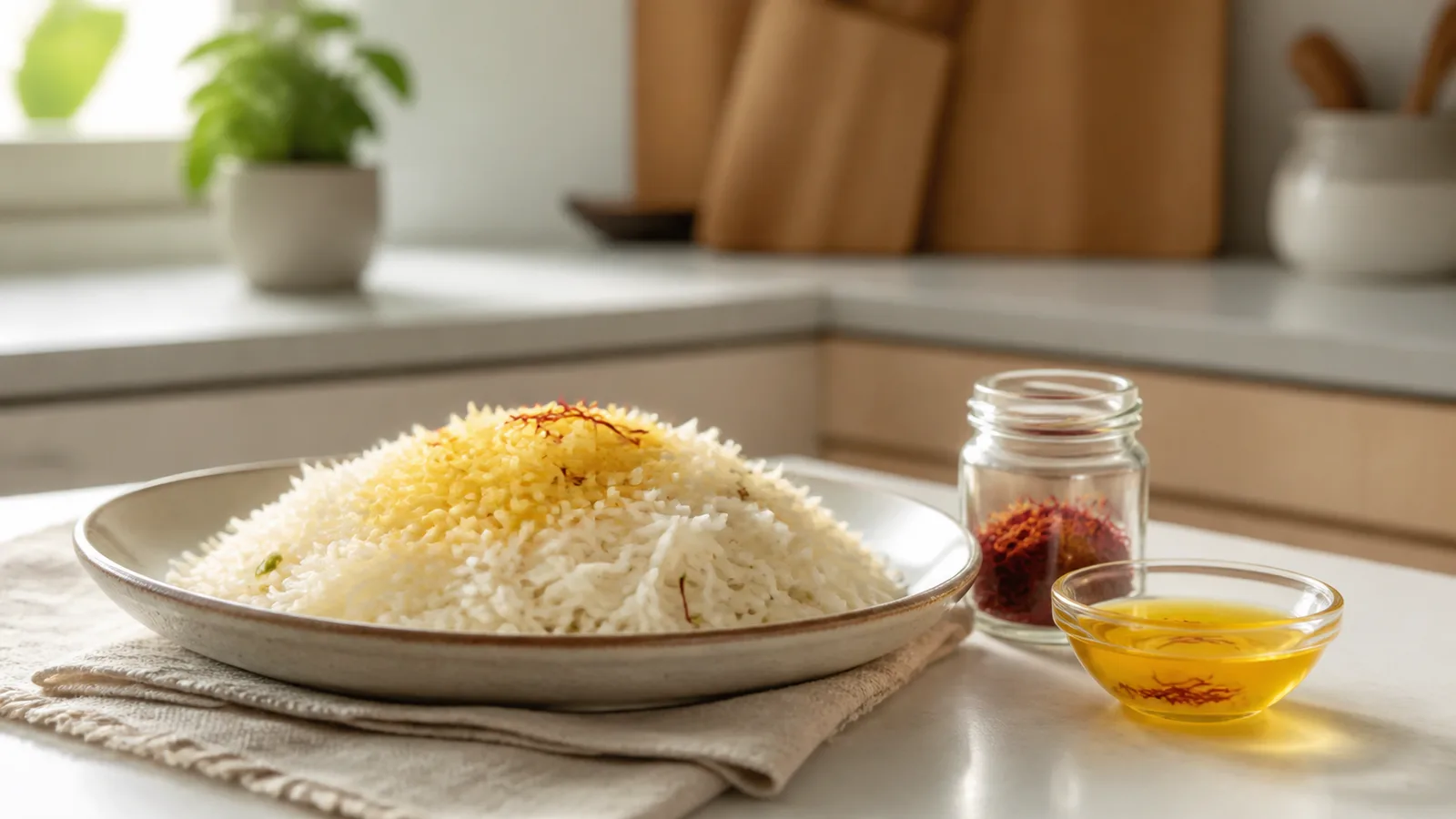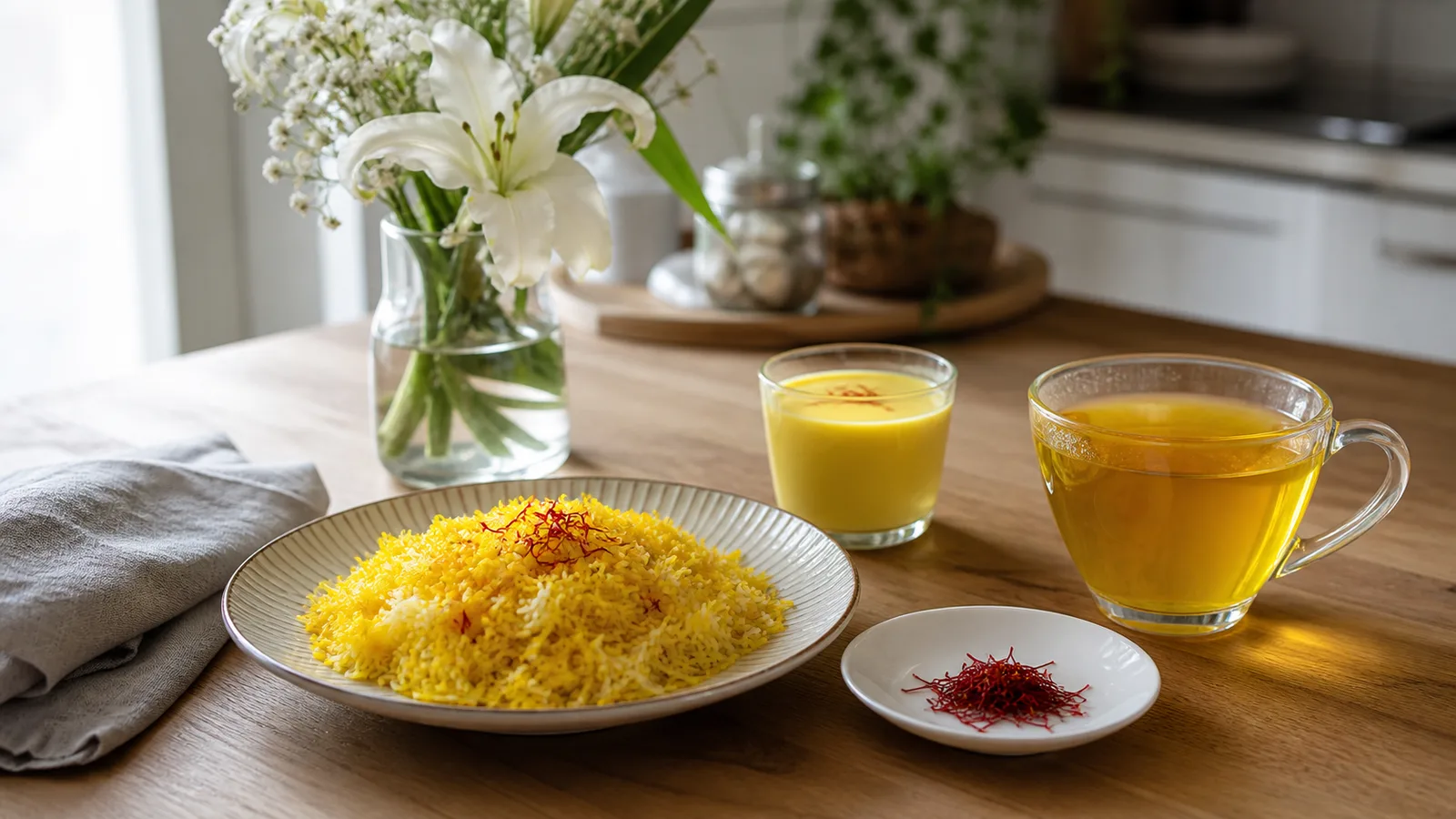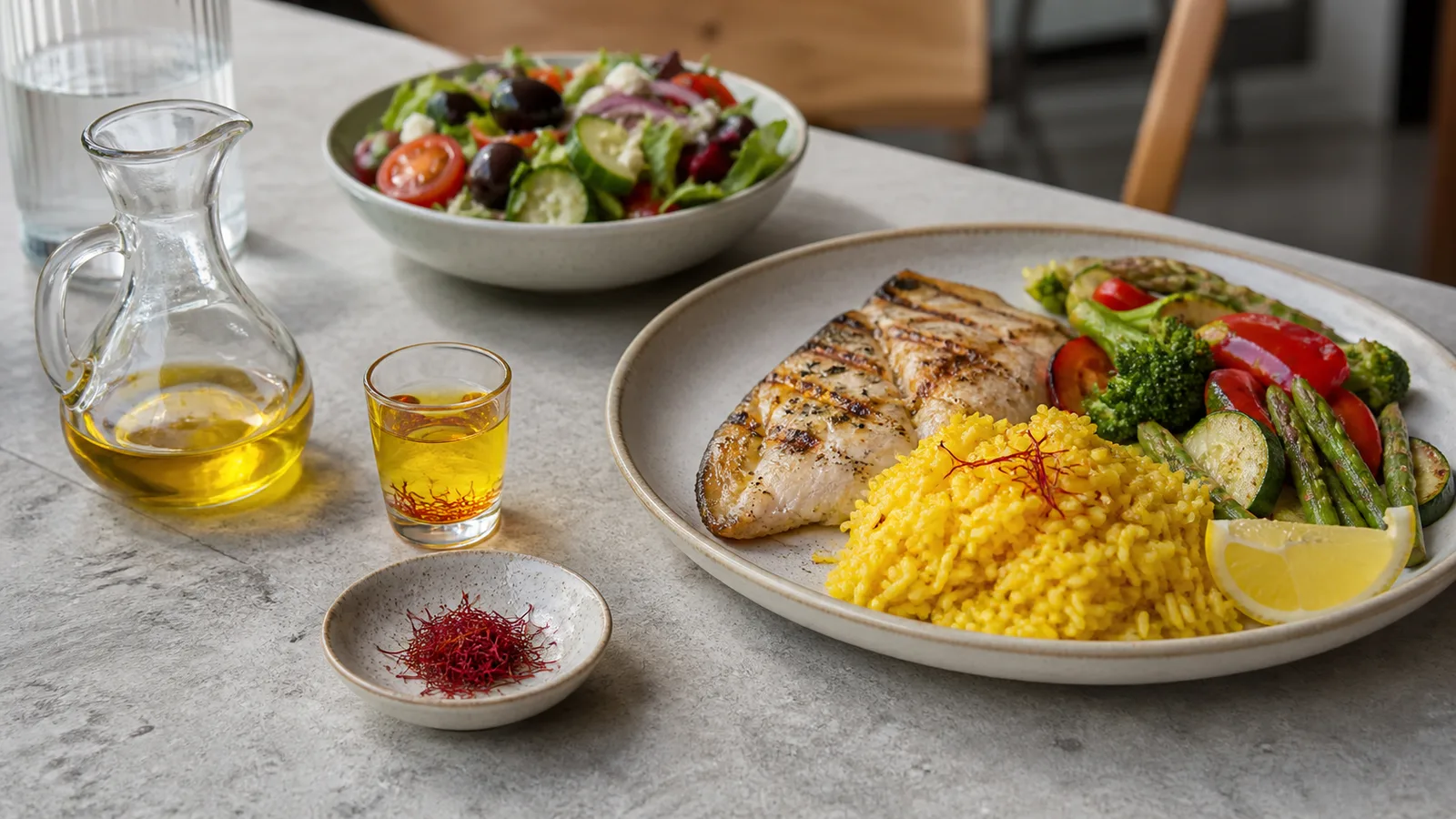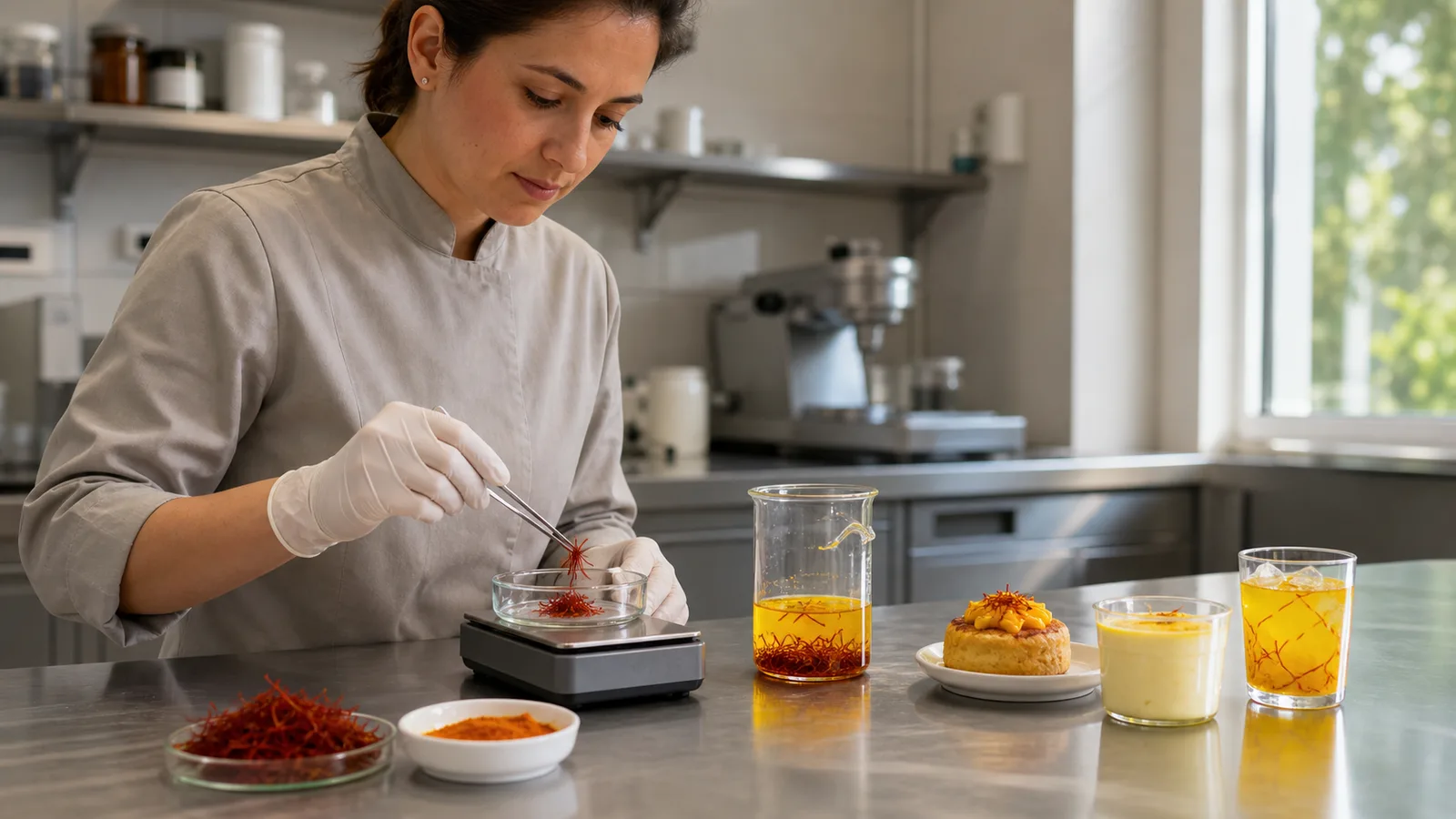
Application of saffron in the industry begins with food: the dried stigmas of Crocus sativus provide colour, aroma and flavour in products ranging from rice and bakery goods to dairy, confectionery and drinks. Saffron also has established historical use as a textile dye, while extracts and flower by-products are being studied for supplements, pharmaceutical research, cosmetics and new materials.
These applications are not interchangeable. A food spice, a standardised research extract, a cosmetic ingredient and a textile bath need different specifications, safety evidence and processing controls. The common industrial challenge is to preserve an expensive, variable botanical material while proving what is in each lot.
The saffron industry starts with the flower
Saffron belongs to the Iridaceae family. It is a perennial, stemless plant, commonly about 10–30 centimetres tall, that grows from a rounded corm roughly 3–5 centimetres across. A corm may produce one to four flowers, while five to eleven narrow leaves, often around 1.5–3 millimetres wide, appear around flowering or soon after.
Each purple flower has six tepals and three yellow stamens. The commercial spice is made from its three red stigma branches, which are separated and dried. The style, stamens and tepals are different raw materials. A manufacturer must therefore define both species and plant part rather than buy a vaguely labelled “saffron extract.”
Saffron cultivation in Iran stretches back for centuries and is closely associated with dry-summer regions and the Khorasan provinces. FAO currently describes Iran as the global production leader, accounting for about 85–90% of output, with much of the cultivation in Khorasan Razavi and South Khorasan. Smaller industries also operate in countries including Greece and Italy. Older industry profiles used “more than 90%”; the exact share varies with crop year and reporting method.
Food and beverage applications
Saffron performs two jobs at once in food. Water-soluble crocins give a yellow-to-golden colour, while volatile compounds led by safranal contribute aroma; picrocrocin contributes bitterness. The balance changes with origin, drying, storage, light, heat and the way the ingredient is prepared.
Common food applications include:
- rice, grain and savoury dishes;
- bread, cakes, biscuits and other bakery products;
- ice cream, custards, cheese and other dairy foods;
- chocolate, confectionery and desserts;
- tea, syrups and non-alcoholic drinks;
- soups, sauces and prepared meals; and
- selected meat and poultry preparations.
In the United States, FDA lists saffron under 21 CFR 73.500 as a colour additive for foods generally and exempts it from batch certification. “Exempt” does not mean unregulated. The ingredient must meet its identity and purity requirements and be used under the listed conditions; the finished food still needs lawful ingredient labelling and good manufacturing practice.
The earlier article described margarine, cheese, sausage, snacks and beverages as examples. Whether a specific product can use saffron, how it must be declared, and whether an extract qualifies under the same rule depend on the jurisdiction and formulation. Notably, FDA lists saffron oleoresin separately as delisted, so a manufacturer should not assume every saffron-derived concentrate shares the spice’s status.
Formulation: getting colour and aroma into the product
Whole threads are attractive in premium foods but disperse slowly. Powder spreads more evenly yet is more vulnerable to oxidation and substitution. A controlled aqueous infusion can distribute crocins; prolonged heat and exposure to oxygen or light may reduce colour and aroma. The best addition point therefore depends on the process, not on one universal recipe.
Before scale-up, a formulator should define:
- the required colour and sensory profile rather than a decorative thread count;
- thread, powder or extract identity and the permitted regulatory category;
- dispersion, holding time and heat exposure;
- lot-to-lot colour strength, moisture and aroma targets;
- microbiological, pesticide, heavy-metal and adulteration controls; and
- packaging that limits light, humidity and oxygen.
A small pilot is essential. Saffron can behave differently in water, fat, dairy protein, acidic drinks and baked dough. More spice does not always produce a cleaner flavour, and its colour can be obscured by other ingredients.
Supplements and pharmaceutical research
Saffron’s crocins, crocetin, picrocrocin and safranal have prompted extensive laboratory work and a growing number of human trials. Research has examined mood, cognition, sleep, metabolic markers and other outcomes. This makes saffron relevant to nutraceutical development and pharmaceutical research, but it does not turn the culinary spice into an approved treatment for every studied condition.
An industrial research ingredient needs much tighter definition than “saffron.” Developers must state whether they use stigma powder, an aqueous or solvent extract, crocin-rich material or an isolated compound; specify marker levels and contaminants; establish stability; and connect each production batch to the material evaluated for safety and efficacy.
The former text mentioned Alzheimer’s and Parkinson’s diseases. Some small studies and reviews explore cognitive outcomes, but saffron is not a substitute for diagnosis, medication or specialist care. Traditional claims for digestion, appetite, spasms, diabetes, hepatitis and saffron water for jaundice are also not enough to establish an industrial health claim. Jaundice can signal liver, gallbladder, blood or pancreatic disease and needs medical evaluation.
Cosmetic and personal-care applications
Saffron and its floral by-products appear in research on cosmetic colour, fragrance and skin-related formulations. A cosmetic developer still needs an exact INCI identity, a safe use level, stability data, microbial control, impurity limits and evidence for every claim. A lab antioxidant result does not support language that a cream treats acne, ageing or disease.
Colour stability is a practical limitation. Crocins are valuable partly because they are water-soluble, but exposure to formulation pH, light, oxygen and heat can change them. Saffron’s natural aroma is equally sensitive and may not survive an aggressive process or compete well with another fragrance system.
Traditional textile dye and conservation work
Saffron has long coloured silk, yarn, manuscripts and ceremonial materials. Its brilliance and cost gave it cultural importance, but the same high raw-material cost limits routine modern textile production. Water solubility, fibre type, mordant, pH and light exposure influence the result.
For a new textile, the dyer should test wash and light fastness rather than assume “natural” means permanent. For historic objects, conservators use analytical methods and reversible decisions; they do not simply recreate an old bath and apply it to original material.
Using the rest of the saffron flower
Only a small part of each flower becomes spice, leaving large quantities of purple tepals, yellow stamens and style. This creates a credible circular-economy opportunity. Reviews describe anthocyanins, flavonoids and other compounds in the floral residues and investigate them for food, cosmetics, perfumery, packaging and materials.
Potential is not the same as commercial readiness. A by-product stream needs clean collection, separation from soil and diseased material, rapid stabilisation, contaminant testing, extraction yield, toxicology and a lawful end use. Readers interested in the botanical distinction can see our guide to the parts and uses of the saffron flower.
The chemistry behind saffron applications
Saffron is chemically complex, and values vary with sample and method. The following groups explain much of its industrial behaviour:
- Carbohydrates and glycosides: older summaries described sugars as more than 20% of saffron’s weight, although the result depends on sample and analytical basis. Glycosidic structures help make several important colour compounds water-soluble. The query term “glycorid” appears to be a misspelling or translation error, not a recognised saffron compound class.
- Mineral fraction: older analyses reported ash in oxide-equivalent terms such as potassium oxide (K₂O), sodium oxide (Na₂O), phosphorus compounds and chlorides. Modern reports usually quantify elements or ions directly; those old labels do not mean the spice contains added industrial oxides.
- Vitamins and minor nutrients: thiamine (vitamin B1) and riboflavin (vitamin B2) have been reported, but saffron’s normal culinary quantity makes it an impractical primary vitamin source.
- Lipids and sterols: minor fractions can include plant sterols such as sitosterol and campesterol.
- Pigments: crocins are the dominant water-soluble carotenoid derivatives in the stigma. Lycopene, alpha-carotene and beta-carotene may occur in the wider carotenoid profile. Anthocyanins are especially relevant to the purple tepals and should not be presented as the main stigma colour.
- Picrocrocin: this colourless bitter glycoside has the formula C16H26O7; older references give a melting point near 156°C and values around 4% in fresh material. Percentage depends on the material and analysis.
- Safranal: the volatile compound most associated with saffron aroma has the formula C10H16O and develops in relation to drying and storage.
- Crocin: the name covers related crocetin glycosides; the often-quoted C44H64O24 formula describes a major crocin molecule rather than every pigment in the sample. Historical composition ranges of roughly 9–15% should not be used as a certificate for an untested lot.
Quality control is an industrial application too
ISO 3632-1:2025 specifies requirements for dried saffron in filaments, cut filaments and powder, while ISO 3632-2 supplies test methods. Spectrophotometric quality work examines absorbance associated with colour, aroma and bitterness; additional microscopy, chromatography, spectroscopy or DNA methods may be needed for authenticity and undeclared plant material.
Quality control should begin before the laboratory. A useful chain records farm and harvest, drying batch, lot splits and combinations, storage, sampling, test results and every pack made from the lot. Without that chain of custody, a strong result on one sample cannot authenticate another shipment.
That is the broadest application of saffron in the industry: not simply adding an expensive red thread, but designing a controlled route from flower to a food, research ingredient, cosmetic, dye or by-product material whose identity and purpose remain clear.
Sources
- FAO: Iran’s saffron production share and value-chain quality work.
- US FDA: regulatory status of saffron as a food colour and FDA colour-additive inventory, including saffron oleoresin.
- ISO 3632-1:2025 — saffron specification.
- Peer-reviewed review of saffron compounds, commercial quality and by-products.
- Peer-reviewed review of saffron floral residues for food, pharmaceutical and cosmetic applications.
- Clinical review of saffron and cognitive outcomes cited in the former article.