


Urmia University marked the first saffron harvest from a 400-square-metre indoor cultivation hall three months after the centre was established. The original headline called it “European saffron,” but the project described in the report was aeroponic or soilless saffron, not a European variety.
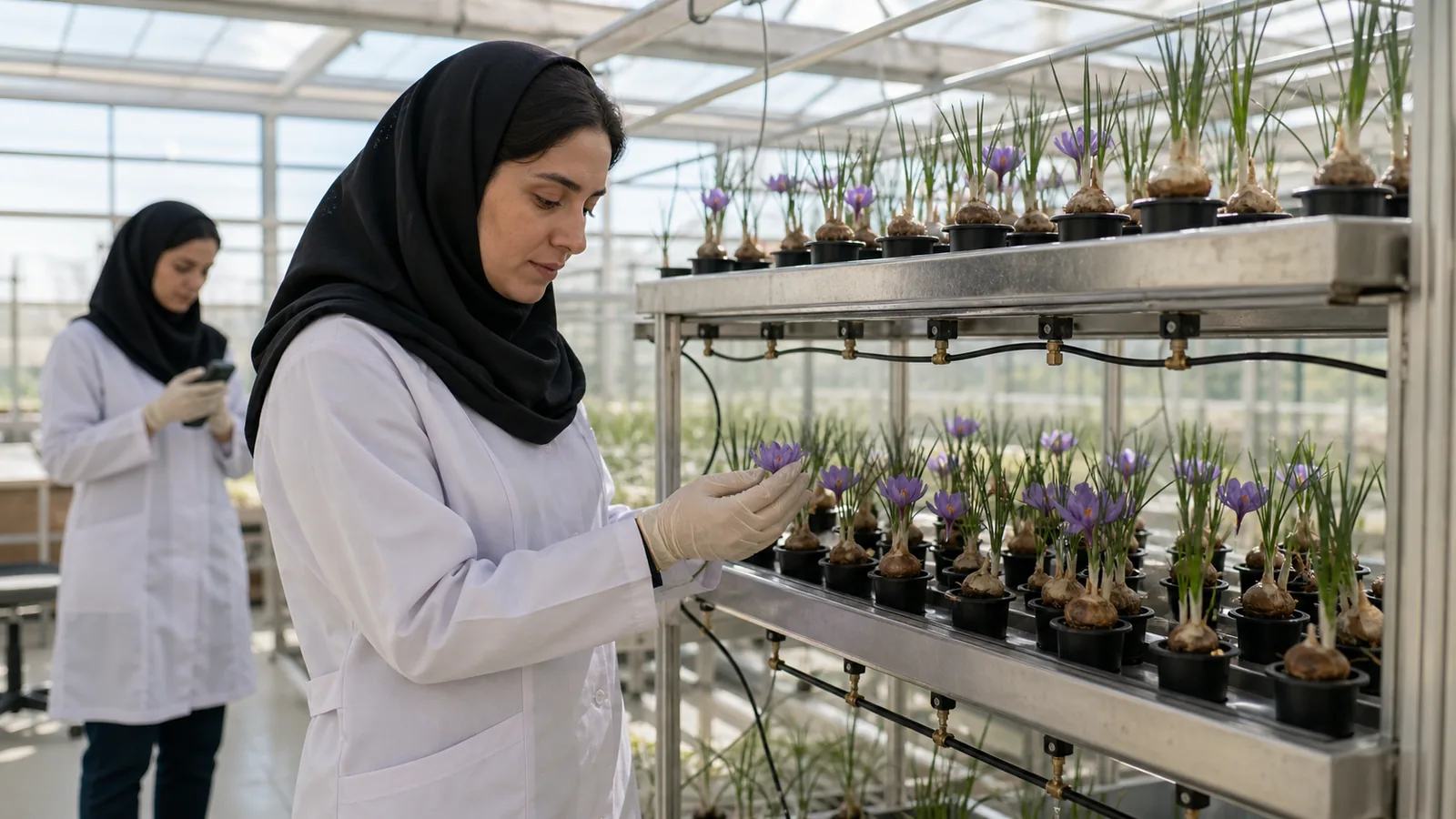
What opened at Urmia University?
The university inaugurated an indoor saffron cultivation centre in the presence of its president and board members. Rahim Hobbenaghi, then president of Urmia University, said the complex had been formed through a university collaboration three months earlier and had reached its first harvest cycle.
The stored translation called it the “European Saffron Cultivation Center (Air Cultivation).” The body makes the intended term clearer: the system was described as aeroponic cultivation, sometimes translated literally as “air cultivation.” There is no evidence in the report that the corms were a European saffron variety.
That correction matters because origin and production method are different things. Saffron can be grown in a controlled room using corms from an Iranian field. Calling the crop European would imply a geographic or varietal identity that the article does not establish.
How aeroponic saffron cultivation works
Hossein Pourali described the project as cultivation without soil. In an aeroponic system, corms are supported in racks or trays while their roots receive controlled moisture and nutrients, commonly as a fine mist. The aerial environment can be managed for temperature, humidity, light and airflow.
Aeroponics does not mean the plants use no water. It means they are not rooted in ordinary field soil and their water delivery is controlled. The old article’s phrase “without the use of water and soil” is therefore too absolute.
Research on sensor-controlled hydroponic saffron cultivation shows the kind of monitoring a contained system requires. Temperature, humidity, light, pH, nutrient concentration and water conditions must be measured; moving a corm indoors does not remove its biological needs.
The 400-square-metre cultivation hall
The first phase used a hall covering 400 square metres. Indoor racks can place more corms within a building footprint than a single flat field layer, but floor area alone does not reveal the productive growing area. Rack levels, spacing, corm size and the share that flowers must be known before comparing the hall with hectares of farmland.
The centre’s nominal capacity was reported as 20 tonnes of saffron corms and more than 20 kilograms of dried stigmas in each cycle. Those were design-capacity figures, not measured results from the first harvest. At face value, they imply more than one kilogram of dried saffron per tonne of loaded corms, but the article does not provide the actual corm load, flower count or dry harvest for that opening cycle.
Corm selection is especially important. Larger, healthy corms are generally more likely to flower than small or damaged ones, and their preconditioning affects emergence. A controlled-environment study of soilless saffron production over two crop cycles selected uniform corms and found that temperature and irrigation changes materially affected yield and quality.
Where the saffron corms came from
Pourali said the centre sourced its saffron corms from Khorasan Razavi and South Khorasan, Iran’s established production regions. The Urmia facility was therefore testing a new growing environment for Iranian planting material, not introducing an unnamed European crop.
The project also established a five-hectare field near the indoor centre. Its longer-term plan was to produce replacement corms locally rather than continue sourcing all planting stock from Khorasan.
That field component is important. Saffron is propagated through corms, and a system focused only on forcing flowers indoors still needs a reliable corm cycle. A commercial plan must account for corm multiplication, disease inspection, storage, dormancy, flowering preparation and what happens to the corms after the indoor harvest.
The Lake Urmia water-saving claim
Hobbenaghi presented saffron as a possible alternative crop for the Lake Urmia basin and said the approach was intended to reduce water consumption by 40%. The article does not provide a baseline crop, measurement period or method behind that percentage, so it should be treated as the project’s stated target rather than a verified result.
The wording “reduce water consumption by 40% in Lake Urmia” also needs clarification. The cultivation hall was not drawing water from the lake for saffron. The policy concern was agricultural water use within the wider basin, where changing crops or irrigation systems may affect demand.
A valid comparison would measure the complete production cycle: water used to raise the corms, condition and flower them indoors, produce replacements, clean the system and manage any nearby field. Reporting only the mist or irrigation used during a short flowering phase would overstate the saving.
Guaranteed purchase and employment plans
The university president said guaranteed purchase would be considered during the development phase so participating farmers would not have to worry about selling the product. This was a proposed market-support feature. The report does not identify a buyer, contract price, grade standard or signed guarantee.
Employment was reported as 10 direct and 60 indirect jobs. As with the capacity and purchase plan, those numbers need a defined phase. Direct work could include cultivation, climate control, flower handling and drying; indirect work might cover corm supply, equipment, transport or marketing. The article does not say whether all 70 positions already existed at first harvest.
For growers, a credible purchase arrangement would need written quality specifications, a transparent price basis, delivery timing and a party responsible for payment. A controlled harvest can still face market risk if those details remain informal.
What the first harvest did—and did not—prove
The first harvest showed that the Urmia University centre had moved from installation to flowering within three months. It also connected a 400-square-metre indoor hall, Khorasan corms and a nearby five-hectare field in one development plan.
It did not, on the evidence published, prove 20 kilograms of stigma output, a 40% full-cycle water saving, or the commercial operation of a guaranteed-purchase scheme. Those remained capacity, policy or expansion claims that would require measured results.
The most accurate reading of “Harvesting of European saffron at Urmia University was key” is therefore straightforward: harvesting of aeroponic saffron at Urmia University began. The project explored controlled, soilless production as a possible water-conscious alternative for the Lake Urmia basin while planning local corm production and farmer support. Its value lies in the trial and the data it could generate, not in treating every launch-day target as an achieved outcome.

![Exporting Saffron to Turkey + Price Guide [Complete 0 to 100]](https://img.rowhanisaffron.com/20260827003933/saffron-export-turkey-quality-inspection.webp)



