


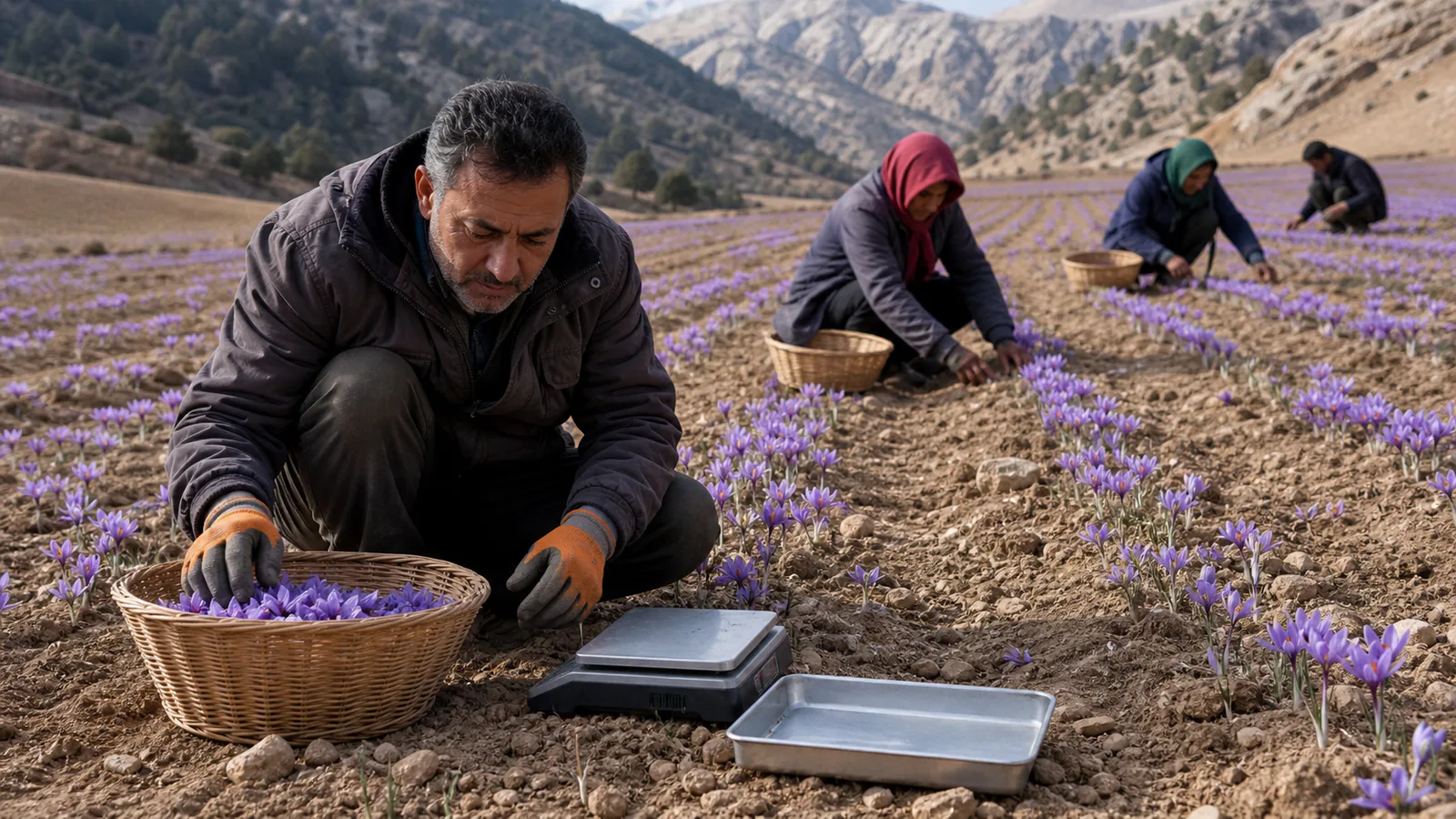
A historical saffron harvest in Rabar city was forecast at about 120 kilograms of dried saffron from 33 planted hectares. The season ran from mid-November to mid-December, and more than four new hectares had been added. A separate family project in Borazjan, Dashtestan, used 250,000 corms in a controlled soilless greenhouse and expected about three kilograms.
These projects represent different production systems. Rabar reported open-field city area and a seasonal forecast; Dashtestan reported a first local controlled-environment project with no final harvest result. Their totals, water claims, and economics should be evaluated on their own denominators.
What Rabar’s 33-hectare harvest report established
Iman Karim Ghasemi, identified as director of Rabar’s Agricultural Jihad office, said flower picking began in mid-November and was expected to continue until mid-December. He forecast about 120 kilograms of dried saffron.
The city had 33 hectares planted, including more than four hectares added in the new cultivation period. If all 33 hectares were productive and the forecast was achieved, the implied average would be about 3.64 kg/ha.
The source does not identify productive versus establishing area, field ages, moisture basis, final dry weight, or farm-level distribution. The 3.64 figure is therefore an implied forecast across planted land, not a measured yield for every field.
The increase from 100 to 120 kg was a forecast
Rabar’s previous-year production was reported at 100 kilograms of dried saffron. The next season’s 120-kilogram expectation would represent a 20% increase if the final harvest reached that amount and both figures used the same drying and area definitions.
Some of the change could come from the newly added hectares rather than higher yield on existing fields. A useful follow-up would separate mature and new area, compare the same farms, and publish the final dry weight.
The mid-November to mid-December calendar is also historical. Temperature, elevation, irrigation, corm condition, and field age can shift flowering, so future labor and drying plans should follow the crop rather than an old date alone.
Rural and home-business facilities supported new area
The report said Rabar’s agricultural office paid 1.1 billion rials in sustainable rural-employment facilities and 150 million rials in home-business facilities to applicants growing saffron and medicinal plants. It associated about four hectares of saffron with those facilities.
That records a reported funding intervention, but not its financial performance. The source does not give recipient count, loan or grant status, lender, interest and fees, security, term, repayment, disbursement date, default, farm costs, or sale receipts.
The four hectares linked to support are close to the “more than four hectares” newly added, but the article does not explicitly prove they are identical parcels. They should not be double-counted or assumed to have achieved the 120-kilogram forecast.
Water and employment were reasons for expansion
Ghasemi linked saffron’s growth in Rabar to drought, a shift toward crops with lower water requirements, family income, and jobs. Those are the program’s stated motivations. The article does not measure water applied, groundwater pumping, prior crops, labor hours, wages, or net household income.
“Lower water” is comparative, not water-free. A defensible crop-switch assessment needs total water per hectare and per kilogram of saleable saffron, rainfall, energy used to pump water, prior land use, and whether total cultivated area expanded.
The finalized account of Sirjan’s saffron area and Tanguyeh proposal applies the same distinction between a water-saving goal and a measured farm result.
Dashtestan’s first reported soilless greenhouse project
Mansour Nozari, identified as Dashtestan’s agricultural director, described the Borazjan project as the city’s first soilless saffron greenhouse. It was run by the Samsami family after training and a three-month family effort.
The English source is garbled in places, but its technical outline is clear enough to preserve: a controlled structure, mist or spray irrigation, layered cultivation to raise corm density per floor area, and separation of the flowering environment from direct sunlight.
Ali Samsami said the project used 250,000 saffron corms and expected three kilograms of dried saffron. Dividing three kilograms by 250,000 gives 0.012 grams, or 12 milligrams, per planted corm if every corm is included in the denominator. The source gives no corm size distribution, flowering percentage, usable floor area, energy, nutrient, labor, disease, or final yield data.
Soilless saffron is possible, but system details matter
Controlled and soilless saffron cultivation is not imaginary. A peer-reviewed glasshouse study of soilless saffron found that environmental control could shift flowering time and examined yield and quality under defined substrates and microbial treatments. A later multilevel hydroponic study tested corm preconditioning, density, temperature, light, and controlled irrigation.
Those experiments do not validate the Dashtestan project’s output or economics. They show why the missing details matter: corm diameter and mass, preconditioning temperature and duration, flowering percentage, flowers per corm, stigma dry weight, rooting and leaf phase, nutrient solution, humidity, sanitation, disease losses, energy, and corm recovery for the next cycle.
“Soilless” also does not mean that the plant can be treated as a one-month product without replacement-corm consequences. A system focused only on flowers may draw on reserves already stored in the corm; a renewable production cycle must account for vegetative growth, light, roots, and daughter-corm performance.
Water claims need litres and output—not spray alone
The Dashtestan article calls low water use through spray irrigation an advantage. It provides no meter reading or comparison with an open field. A misted or recirculating system may control delivery, but pumps, evaporation, drainage, cleaning, cooling, and corm renewal still belong in the balance.
Water efficiency should be reported as total litres per cycle, per square metre of actual floor and growing surface, per flowering corm, and per kilogram of saleable dried saffron. Reused water, discharge, nutrient concentration, and sanitation losses should be shown separately.
Layering raises biological density per unit of floor, which can make a floor-area comparison look strong. It does not remove the capital, energy, labor, disease, and replacement-corm costs carried by each layer.
Direct sunlight and saffron quality are separate questions
Sedigheh Ghasemi, identified as head of the central Dashtestan Agricultural Jihad center, said harvesting away from sunlight protected color and aroma. Light exposure can matter after harvest, but the source does not show a controlled comparison of its greenhouse saffron.
A peer-reviewed post-harvest experiment found that storage duration and temperature affected saffron pigments, aroma-related compounds, color, and microbial load. That supports rapid, controlled flower handling. It does not establish that a dark flowering room automatically produces superior saffron.
Quality should be tested on dried, traceable lots. The record should include picking time, delay to separation, drying temperature and duration, final moisture, storage protection, laboratory method, and analytical results rather than relying on appearance or the absence of sunlight alone.
The quoted 220-million-rial price was not a business case
The entrepreneur said saffron would be packaged after separation and offered for sale, and quoted a market price above 220 million rials per kilogram. This was a historical statement. No year-specific transaction, grade, form, buyer, package size, payment, or sold quantity is documented.
At three kilograms, multiplying the forecast by a quoted headline price would give gross potential revenue—not profit. A business case must subtract corms, structure, racks, irrigation, controls, cooling or heating, electricity, nutrients, sanitation, labor, separation, drying, testing, packaging, finance, losses, and corm replacement.
The article also says the product would be packaged; it does not confirm that three kilograms were harvested, passed specification, sold, or paid for.
How to compare Rabar and Dashtestan fairly
Rabar’s strongest data are land area, prior dry production, and a new-season forecast: 33 hectares, 100 kilograms previously, and about 120 kilograms expected. Dashtestan’s strongest data are project scale and intended output: 250,000 corms and three kilograms expected in a controlled system.
A fair comparison needs final dried output, quality, water, energy, labor, cost, sale receipts, and the productive asset that remains after harvest. For Rabar, that asset is the multi-year field and its corm stock. For the greenhouse, it includes corm health and the ability to repeat the cycle.
Until those results are published, the defensible conclusion is limited: Rabar reported an expanding open-field saffron sector with a 120-kilogram forecast, while Dashtestan reported an ambitious first local soilless project. Neither historical figure guarantees current yield, water savings, price, or profit.

![Exporting Saffron to Turkey + Price Guide [Complete 0 to 100]](https://img.rowhanisaffron.com/20260827003933/saffron-export-turkey-quality-inspection.webp)



