


Iranian saffron played a small but memorable part in London’s £1,100 Glamburger: Canadian lobster was poached in saffron before being layered over a rich beef-and-venison patty. The 2014 creation was promoted as the world’s most expensive hamburger by RecordSetter, although that title needs historical context today.
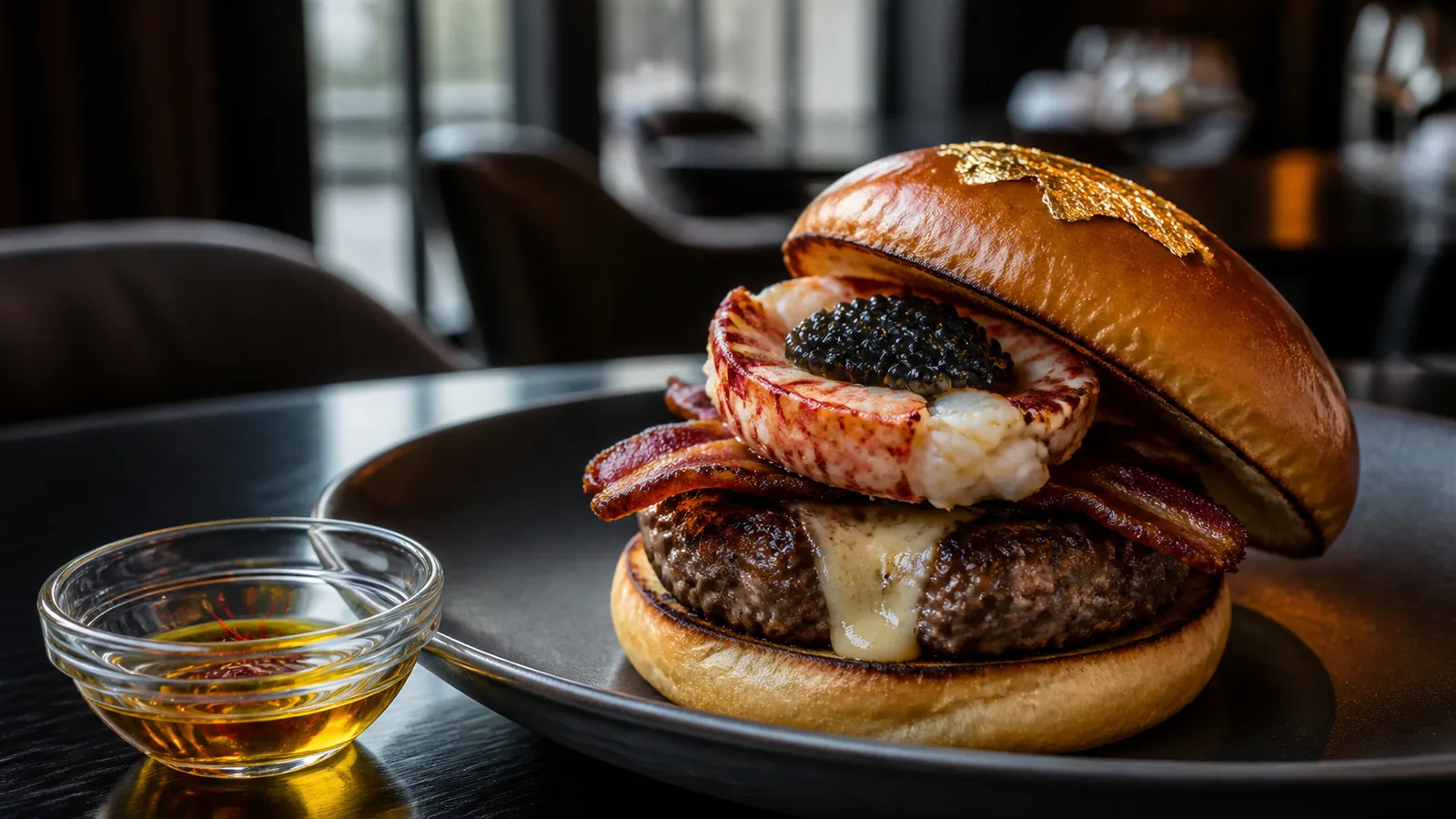
A £1,100 burger in Chelsea
The Glamburger was created at Honky Tonk, an American-style restaurant in Chelsea, London. Chef Chris Large developed it with Groupon to mark the company selling its five-millionth food-and-drink voucher in the UK. The partnership offered one person the chance to try the burger for free.
Its listed price was £1,100. Reports published at the time converted that to roughly $1,600–$1,770, depending on the date and source. The original article also described it as close to five million tomans, but that is a historical conversion, not a meaningful present-day price.
Large reportedly spent three weeks sourcing ingredients and working through different combinations. The goal was less an everyday restaurant order than a publicity dish built from conspicuously expensive foods.
Where the Iranian saffron appeared
The saffron was not simply scattered over the finished bun. It was used to poach Canadian lobster, giving the shellfish a saffron-infused cooking liquid before it joined the other toppings. That detail matters because the stored article had mistranslated this part as smoked Himalayan fish and a Canadian crab.
Using saffron in a warm liquid is a sensible way to distribute its colour and aroma. Threads need time and moisture to release their character; placing them dry on top would make the spice more decorative than integrated. In the Glamburger, Iranian saffron had a clear culinary job despite being surrounded by more visually dramatic ingredients.
What was inside the Glamburger?
The verified RecordSetter entry for the Glamburger gives a more precise ingredient list than the old translation. Its centrepiece was a patty made with 220 grams of Kobe Wagyu beef and 60 grams of New Zealand venison. Black-truffle Brie sat inside the meat so that it melted into a soft centre during cooking.
The patty was seasoned with smoked Himalayan salt. On top came the Canadian lobster poached in Iranian saffron, maple-syrup-coated streaky bacon, Beluga caviar and a hickory-smoked duck egg covered with edible gold leaf.
The bun was treated just as extravagantly. It used Japanese matcha with cream mayonnaise and carried another layer of edible gold. A mango-and-champagne jus and grated white truffle completed the dish.
Several mistakes in the older text become clear against this record. “Cap Vago” was Kobe Wagyu beef; the expensive black mushroom was truffle; the chef was Chris Large, not Chris Lordge; and the Canadian ingredient was lobster rather than crab. Correcting those names makes the story easier to understand without changing its central point.
Was it officially the most expensive hamburger?
RecordSetter recorded the £1,100 Glamburger on 24 September 2014 under its “Most Expensive Burger” category. That appears to be the “Records Center” certificate described in the original post. It should not be confused with Guinness World Records, which used different categories and had other expensive-burger records.
The phrase “the most expensive hamburger in the world” is therefore best read as a 2014 claim tied to RecordSetter, not a permanent title. Records change, categories differ, and a larger burger made for many people is not directly comparable with a restaurant-sized portion for one diner.
For a current benchmark, Guinness lists the most expensive single-portion hamburger as the €5,000 Golden Boy, sold at The Daltons in the Netherlands in June 2021. That later record does not erase the Glamburger story; it places the 2014 headline in its proper time.
Why combine so many luxury ingredients?
Most of the price came from rarity, labour and spectacle rather than the basic idea of a hamburger. Wagyu beef, venison, lobster, caviar and truffles already command high prices. Gold leaf made the cost visible, while the long ingredient list gave the promotion something striking to photograph and discuss.
That does not mean every ingredient automatically improved every bite. Caviar, smoked egg, sweet bacon, truffle, matcha, mango, champagne, saffron and lobster each bring a distinct flavour. Combining them well would demand restraint, particularly because saffron and white truffle both have aromas that can be overwhelmed.
The burger’s value as a marketing event was easier to measure. Groupon had a milestone to celebrate, Honky Tonk gained international attention, and the unusual recipe spread far beyond the restaurant’s Chelsea dining room.
What the story says about Iranian saffron
Among ingredients selected to signal luxury from several countries, the chef chose Iranian saffron for the lobster. It was neither an unnamed yellow colouring nor an ornamental afterthought. Its origin was part of the description, and its role depended on the spice’s ability to perfume a delicate cooking liquid.
The Glamburger was an extravagant one-off promotion, not a guide to making an everyday meal. Still, it offers a useful lesson: saffron earns its place in a dish when it is used with purpose. A small, properly infused amount can contribute colour and aroma without needing to be piled on top for show.
So the accurate version of the story is more interesting than the garbled one. In 2014, Chris Large created a £1,100 RecordSetter burger at Honky Tonk for a Groupon campaign. Its Canadian lobster was poached in Iranian saffron, and the rest of the build brought together Wagyu beef, venison, truffle, caviar, smoked duck egg and edible gold. It was once promoted as the world’s most expensive hamburger; today, it remains a vivid example of Iranian saffron appearing in an international luxury dish.

![Exporting Saffron to Turkey + Price Guide [Complete 0 to 100]](https://img.rowhanisaffron.com/20260827003933/saffron-export-turkey-quality-inspection.webp)



