


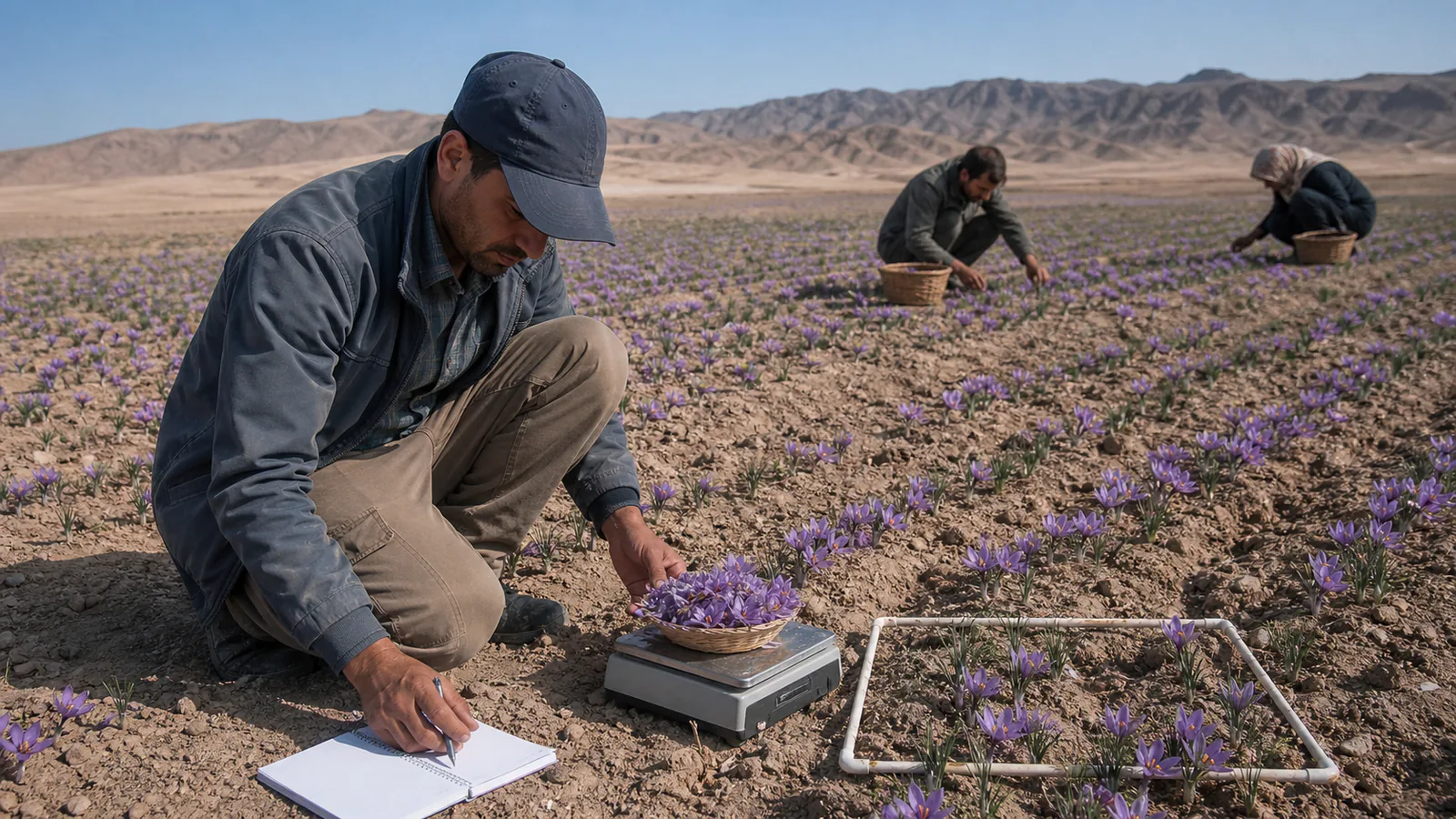
The often-quoted figure of more than 5 kg of saffron per hectare from Sirjan farms was presented as an attainable yield for well-managed fourth-, fifth-, and sixth-year fields—not the average result of the reported harvest. A completed Sirjan season covered 35 hectares, produced more than 100 kilograms, and averaged about 3 kg/ha. Earlier reports show the planted area growing from 25 to 30 hectares before later reaching about 50.
Together, the three historical accounts describe expansion, a completed harvest, and a mature-field target. Keeping those stages separate resolves several apparent contradictions and gives growers a more realistic picture than treating every number as if it came from one year.
What Sirjan’s 5 kg/ha figure really meant
Ahmad Masoudi, identified as director of Sirjan’s Agricultural Jihad office, said a properly timed and managed field could exceed five kilograms per hectare in its fourth through sixth years. The article linked that potential to Sirjan’s climate and to timely planting, crop care, and harvest.
It did not report a completed citywide average above five kilograms. That distinction matters: a mature-field potential is not a promise for a new plot, and it should not be used as the sole basis for a farm budget.
Field age can affect stigma yield, but it is not the only control. A three-season saffron field experiment found that corm size and planting density interacted with field age and that the best density differed in younger and third-year fields. Sirjan growers would also need to account for soil, water quality and timing, temperature, corm health, weeds, disease, drying, and measurement method.
The completed harvest averaged about 3 kg/ha
A separate Sirjan report said harvesting had finished on 35 hectares at an average of three kilograms per hectare. That arithmetic gives 105 kilograms, consistent with the same article’s statement that city production exceeded 100 kilograms.
The report also announced a 20% production increase. It does not supply the previous season’s exact final weight, so the percentage cannot be independently checked from that source. It should remain an attributed historical comparison rather than a current growth rate.
More than 50 operators were involved, and about 200 people were said to have worked during the harvest period. The source does not define workdays, hours, wages, or whether the count represents unique individuals, so it is evidence of seasonal labor demand—not 200 permanent jobs.
How Sirjan’s planted area expanded
An earlier expansion report said five new hectares raised Sirjan’s saffron area from about 25 to 30 hectares, a 20% increase. It placed much of that growth in northern villages and the Paris district.
That season, harvest was due to begin on 6 November across 25 productive hectares. Officials forecast 90 kilograms, compared with 60 kilograms in the preceding year. Ninety divided by 25 gives an implied forecast of 3.6 kg/ha, but the final harvested weight was not supplied in that article.
The move from 60 to 90 kilograms is a 50% forecast increase, while the cited 20% referred to planted area. Those percentages describe different measures and should not be substituted for one another.
A later account put Sirjan at about 50 hectares, most in the area variously transliterated in the English sources as Hamshahr, Hamashahr, or Homshahr. It also named Balvard, Paris, Malek Abad, parts of the suburbs, and Zeidabad as climatically and geologically suitable. The spelling variants do not prove that three separate “Hamshahr” places were intended.
Planting and harvest dates varied between reports
The 50-hectare account gave a planting window from the second half of September through the end of October and a harvest window from the second half of November to early December. The expansion report named 6 November as its planned harvest start.
The completed-season source went earlier still, saying picking began in mid-October. Because the articles do not identify a common year, field elevation, weather sequence, or the same farms, those dates cannot be turned into one fixed Sirjan calendar.
Growers need field observations and locally qualified advice. Flowering can shift, and once flowers open, picking and stigma separation require enough labor to handle the daily volume without avoidable quality loss.
Revenue above four billion rials was not profit
The completed-harvest report estimated income above four billion rials. It does not give the amount sold, grade mix, sale date, buyer, payment status, or whether “income” meant gross revenue. It also supplies no production costs.
For that reason, the figure cannot establish farm profitability. A net-return calculation would need corm, land preparation, irrigation, labor, field care, drying, testing, storage, packaging, finance, transport, rejected product, and the actual paid price for each grade.
The number is also historical and denominated in rials; it should not be converted into a current price signal without the transaction date and exchange-rate basis.
The Tanguyeh Dam proposal remained a plan
Masoudi said officials were pursuing saffron on more than 120 hectares downstream of Tanguyeh Dam where horticultural land and worn orchards faced water restrictions. The report describes discussions with local agricultural representatives and a decision to replace crops.
It does not show that 120 hectares were actually converted, that orchards were removed, or that participating farms later saved water or earned more. Those remain proposed scale and intended outcomes.
Before conversion, each site would need agronomic, water, household-income, and market assessment. Removing an orchard is a consequential, long-lived decision. A saffron plan should compare total annual water and pumping, establishment cost, years to mature output, labor peaks, buyer access, and downside scenarios—not just crop-level reputation.
FAO’s official description of Iran’s qanat-based saffron system supports the broad point that saffron can suit water-scarce settings. It does not prove savings on a Sirjan parcel. The same evidence rule applies to the nearby Anar and Mehriz crop-replacement reports.
Finance referrals did not become timely loans
The 50-hectare article said 76 applicants were referred to the Agricultural Bank for facilities in the preceding year, but they did not obtain the finance in time for the planting window. A referral is therefore not an approved loan, and an approval after planting can fail to meet the crop’s seasonal need.
No lender terms, amount, interest or fee, security, repayment schedule, recipients, disbursement date, or outcome are supplied. Future guidance should publish those details and align application, approval, and payment with land preparation and corm purchasing.
The source also contains an ambiguous employment statement translated as more than 10,000 “people a day” through direct and indirect work. Given the reported 50-hectare scale and the separate 200-person harvest figure, it cannot safely be treated as 10,000 unique daily workers. The original unit and method would need verification before reuse.
Processing capacity was the stated local constraint
The completed-harvest source called the absence of processing industries Sirjan growers’ only difficulty. That is too broad to establish every farm’s constraints, but it preserves a useful local concern: the crop still needs rapid separation, controlled drying, safe storage, testing, lot traceability, packaging, and a buyer.
A credible response begins with data. Sirjan would need daily flower throughput, separation time, drying capacity, contamination and rejection records, laboratory turnaround, storage losses, buyer specifications, transport time, and facility utilization outside the short season.
Depending on volume and distance, the best response might be training, shared dryers, cooperative collection, contract testing, or a dedicated facility. The historical article does not provide enough evidence to choose among them.
What a current Sirjan update should measure
A useful update would publish planted and productive hectares by field age, final dried weight, moisture basis, quality results, and the number of farms included. It should reconcile the mature-field potential above five kg/ha with the completed three kg/ha city average rather than presenting one as proof of the other.
Water volume, labor hours and wages, costs, grade-specific sale receipts, finance timing, processing losses, and the actual status of the Tanguyeh proposal would test the economic and resource claims.
Until those records are available, the sound conclusion is limited: Sirjan’s historical crop expanded through several snapshots; one completed 35-hectare harvest exceeded 100 kilograms at roughly three kg/ha; and more than five kg/ha was a mature, well-managed field target. None of those figures guarantees a current farm result.

![Exporting Saffron to Turkey + Price Guide [Complete 0 to 100]](https://img.rowhanisaffron.com/20260827003933/saffron-export-turkey-quality-inspection.webp)



