


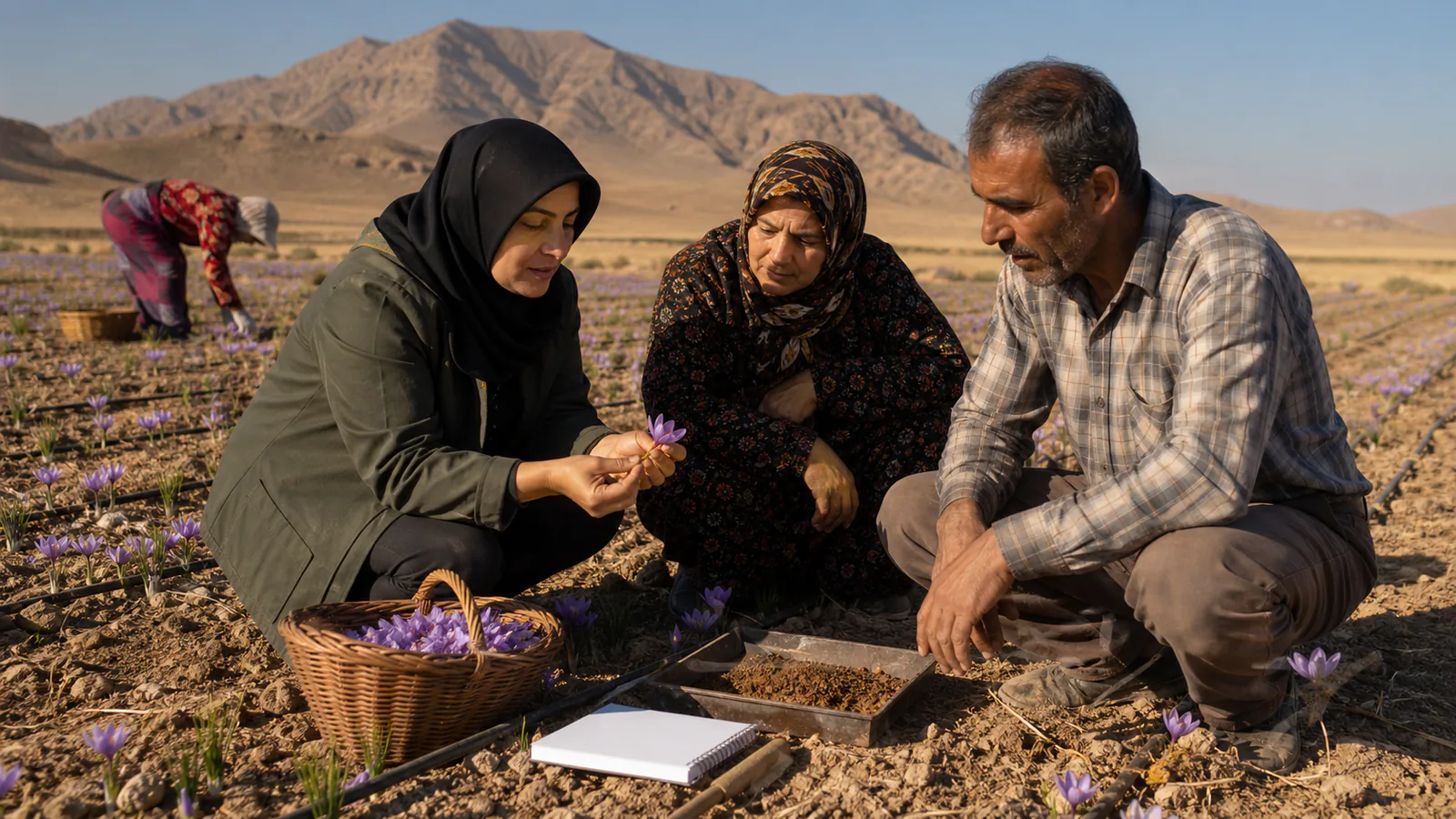
A historical Anar agriculture report recorded about 40 kilograms of saffron from 15 hectares, an implied average near 2.67 kg/ha. Local officials presented saffron as one option for reducing pressure on groundwater and said growers received training. A related Anar workshop drew more than 10 prospective growers, while a Mehriz report forecast more than 250 kilograms from about 50 hectares.
The two city reports come from different provinces—Anar in Kerman and Mehriz in Yazd—and should not be combined into one harvest. Their value is comparative: both show how water scarcity encouraged saffron promotion, but only field-level water, yield, cost, and market records can show whether changing crops delivered the promised benefit.
What Anar’s 40 kg saffron harvest represented
Masoudi, identified as Anar’s agricultural director, said farmers harvested approximately 40 kilograms from 15 hectares in the reported year. The article presents the result as completed rather than forecast.
Dividing 40 kilograms by 15 hectares gives about 2.67 kilograms per hectare. Because both numbers are rounded and no field-level table is supplied, that should be treated as an approximate city average.
The report does not state field age, number of farms, dry-weight method, moisture, grade, or whether all 15 hectares were productive. Those details are necessary before an individual grower uses the city result as a budget assumption.
Why saffron was promoted as an alternative crop
Masoudi linked the planting program to regional water stress and a policy of replacing crops with higher water requirements. The intended outcomes were lower groundwater extraction and higher farmer income.
Those are policy goals, not outcomes measured in the article. The report gives no before-and-after water volume, pumping data, prior crop, land-use change, farmer margin, or rebound effect from expanding cultivated area.
Saffron’s cool-season cycle and summer dormancy can reduce competition with some summer crops, but “low water” is relative. Establishment, flowering, leaf growth, and daughter-corm development still depend on water, soil, climate, and management.
The Anar workshop added practical detail
The assigned workshop source named Abbas Mehran as Anar’s agricultural director and said a dedicated planting-and-harvesting session was held at the local Jihad Keshavarzi office. More than 10 interested participants received instruction and had questions answered.
Its title calls saffron a replacement for rice. The body, however, refers more generally to changing the cultivation pattern away from water-demanding products. It does not document how many rice hectares, if any, were converted to saffron.
The workshop confirms that local support included a specific training event, not merely a general claim that classes existed. It does not show how many attendees later planted, what they harvested, or whether their farms became profitable.
What useful saffron training should cover
A planting-and-harvest workshop is most useful when it goes beyond a generic calendar. For Anar’s conditions, participants would need locally qualified guidance on site drainage, soil and water testing, healthy corm selection, planting density and depth, irrigation timing, weed and disease monitoring, flower picking, stigma separation, drying, storage, and batch traceability.
Farm economics should be part of the same training. Growers need realistic corm, labor, water, drying, testing, packaging, finance, and replacement costs plus a written buyer specification and payment terms.
Attendance is an input. The meaningful follow-up is whether participants adopt safe practices, record yield and quality over several years, use less water in total, and earn a viable net return.
Mehriz forecast more than 250 kg from 50 hectares
Bahram Haghighat, identified as the head of Mehriz’s agricultural plant-production department, said about 50 hectares were under saffron and that more than 250 kilograms might be harvested in the reported year.
That forecast implies more than five kilograms per hectare if the full 50 hectares were productive. The article also announced a 20% increase, but it does not supply the prior-year harvest or final current-year result. The increase and weight should therefore remain forecasts or official expectations, not verified outcomes.
Mehriz lies on the desert edge along the Tehran–Bandar Abbas transit corridor. That geography helps explain the report’s water-scarcity framing but does not by itself establish field suitability or buyer access.
Support in Mehriz included finance referrals and advice
Haghighat said the agricultural office supported growers with introduction letters for facilities and technical advice. The surviving text does not identify the lender, amount, currency, interest or commission, collateral, repayment period, eligibility, or number of recipients.
A referral letter is not the same as approved finance, and approved finance is not proof of a successful field. Current applicants need the written cost of borrowing and a conservative multi-year cash-flow plan.
Technical advice also needs to be plot-specific. Anar’s 2.67-kg/ha implied result and Mehriz’s >5-kg/ha forecast cannot be explained by city names alone; field age, density, water, soil, weather, corm health, and post-harvest handling may differ.
Anar and Mehriz cannot be ranked from these reports
Anar supplies an apparent completed harvest: about 40 kilograms from 15 hectares. Mehriz supplies an expected harvest: more than 250 kilograms from approximately 50 hectares. Comparing 2.67 kg/ha with more than five kg/ha would mix a result with a forecast.
The Mehriz article also lacks the final dry weight and the Anar article lacks field-age distribution. Without matched years, methods, and quality results, the figures do not prove that one city is more productive.
The useful comparison is procedural. Anar provides a completed city total and a specific training event; Mehriz provides an expansion expectation and details of finance referrals and technical support.
Water savings must be measured at farm and basin scale
Replacing a water-demanding crop can reduce pumping only if the new crop’s actual irrigation is lower and the saved water is not used to expand another field. Gross “water need” labels do not capture this rebound risk.
Official FAO documentation of Iran’s qanat-based saffron system shows that saffron can support livelihoods under severe water scarcity while still relying on managed irrigation. The system’s value comes from the crop, local knowledge, and water governance together.
A credible Anar or Mehriz assessment would record irrigation source, salinity, application depth, dates, rainfall, productive area, and yield, then compare total water and net return with the previous crop over the same period.
Field age can explain part of the yield difference
Saffron is a multi-year crop. Young fields often produce fewer flowers, while corm multiplication can increase output in later years until crowding, competition, or disease reduces performance.
Research on 110 Iranian saffron farms found that cultivation age and corm density affected technical efficiency. A city expanding new hectares may therefore show a lower average even when its mature fields perform well.
Both reports need age-stratified data. Without it, the 20% growth claim could reflect more land, older fields, better yield, or a combination.
Quality and market readiness matter after harvest
Neither report gives drying methods, moisture, purity, grade distribution, testing, storage, realized price, or buyer specifications. Yet those factors determine how much of a crop becomes saleable value.
Training and finance should connect the field to prompt flower handling, controlled drying, clean storage, batch identity, and a buyer who rewards the required specification. More kilograms do not guarantee more income if quality or market access is weak.
For another dry-region comparison where forecast yield, market context, and irrigation claims required separate treatment, see the integrated Fars and South Khorasan yield report.
What the combined Anar and Mehriz record shows
The Anar destination supports a historical harvest of about 40 kilograms from 15 hectares, an implied 2.67 kg/ha, a groundwater-reduction policy, and continuing workshops. Its assigned Anar source adds the specific office workshop with more than 10 prospective growers and clarifies the crop-pattern program.
The Mehriz source adds approximately 50 hectares, a >250-kilogram forecast, an announced 20% increase, finance-introduction letters, technical advice, and desert-edge context.
The articles do not prove rice was replaced, water extraction fell, income rose, the Mehriz forecast was achieved, or one city outperformed the other. Those questions require final harvest, water, quality, cost, finance, and buyer data. The reports establish why the programs began; future records must show whether they worked.

![Exporting Saffron to Turkey + Price Guide [Complete 0 to 100]](https://img.rowhanisaffron.com/20260827003933/saffron-export-turkey-quality-inspection.webp)



