


Sabzevar’s saffron harvest fell from a reported 6,500 kilograms to 5,500 kilograms in one season, while average yield declined from 4.5 to 3.5 kilograms per hectare. Local officials described the change as roughly 20% and linked it to drought, water shortages, and cultivation decisions made without secure water resources.
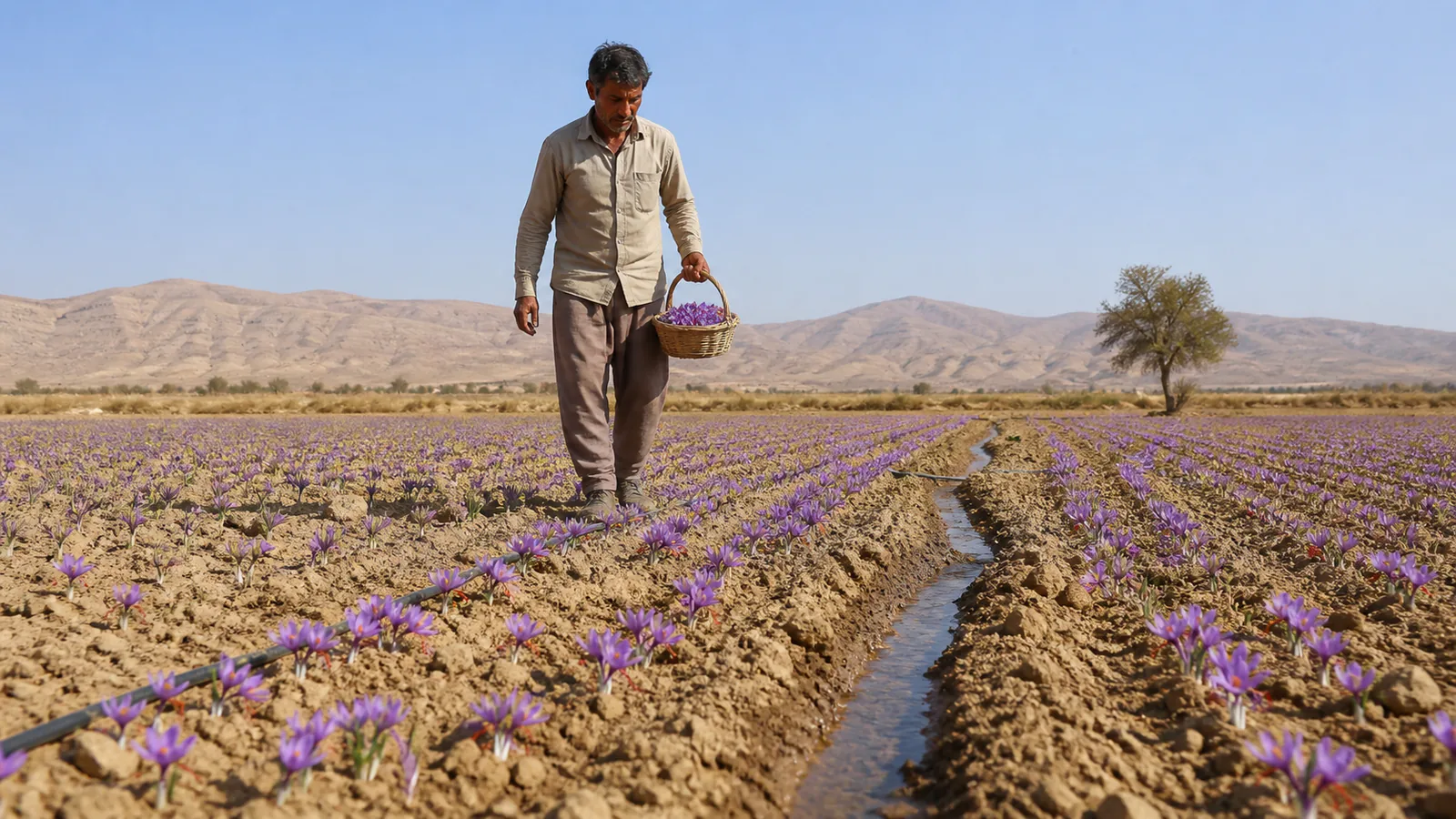
A separate report from another season had forecast more than 10 tonnes and described support purchases, four quality-price grades, packaging centers, and a broader medicinal-plant initiative. The contrast is useful, but the forecast and the later lower harvest must not be treated as measurements from the same season.
The reported 20% reduction in Sabzevar’s saffron harvest
Mansour Barghamdi, director of Sabzevar Agricultural Jihad, reported that production had moved from 6.5 tonnes in the previous year to 5.5 tonnes in the current year. That is a reduction of about 15.4% when calculated from the rounded totals.
The yield figures show a larger change: 4.5 kilograms per hectare in the previous season and 3.5 kilograms in the current one, a reduction of about 22.2%. The headline’s 20% is therefore a reasonable rounded description of the yield loss, but it is not an exact calculation from the rounded production totals.
This distinction does not make the report unusable. It tells readers that the figures were public estimates, not a single audited dataset with unrounded values.
Area and yield tell different parts of the story
The report placed Sabzevar’s saffron area at 1,500 hectares, including 1,100 hectares in the district translated as the county’s sixth sector. If every one of the 1,500 hectares had produced 3.5 kilograms, the theoretical total would be 5,250 kilograms, close to the reported 5,500 kilograms.
Differences can arise because some acreage is newly planted or non-productive, yields are rounded, or farms are measured at different stages. Area indicates how much land is assigned to saffron; yield indicates dried saffron per hectare. Production depends on both.
| Measure | Earlier season | Lower season |
|---|---|---|
| Total production | 6,500 kg | 5,500 kg |
| Average yield | 4.5 kg/ha | 3.5 kg/ha |
| Reported cultivated area | Not stated in the comparison | 1,500 ha |
Drought and the 4,000-cubic-metre water figure
Barghamdi said saffron growers needed about 4,000 cubic metres of water per hectare. The translated original incorrectly says farmers need that volume “of saffron”; the surrounding passage clearly refers to water.
He attributed the production decline to continuing drought, water shortages, and limited suitable land. He also warned that some farmers planted because saffron looked profitable without first confirming the water available for the full cultivation cycle.
The 4,000-cubic-metre number is an attributed local estimate, not a universal requirement. Soil, rainfall, irrigation method, field age, climate, and timing all matter. A grower should build a field plan around measured local water availability rather than a national rule of thumb. Our saffron cultivation guide provides the wider sequence to discuss with a local agronomist.
The season with a forecast above 10 tonnes
In a separate Sabzevar briefing, the same official forecast that the harvest could exceed 10 tonnes. The source does not give enough shared date or acreage detail to reconcile that projection directly with the later 5.5-tonne report.
Several explanations are possible—different crop years, wider reporting boundaries, changes in productive acreage, weather, or a forecast that was not realized—but the evidence here cannot select one. The honest conclusion is simply that the reports describe different seasonal expectations and outcomes.
Support purchasing and four quality grades
The higher-forecast report said a support-purchase program had started at the beginning of the season. Farmers could deliver saffron through rural cooperative centers after calibration and validation checks.
Prices were reported across four grades, from 8.2 million to 10.5 million tomans per kilogram. Those are historical nominal prices. They should not be converted into a current quote without the crop year, exchange rate, grade specifications, and purchasing rules.
The grading step is as important as the price range. A four-tier program only works fairly if samples are tested consistently, growers can understand the result, scales are calibrated, and payment follows promptly.
Packaging capacity in Sabzevar
Barghamdi identified three specialized saffron packaging centers in the area, alongside other businesses that packed saffron with a wider range of spices. Local packaging can retain more value near the farm, but only if facilities protect saffron from moisture, contamination, light, and inaccurate weights.
Packaging also connects harvest quantity with the customer. A weak crop puts less product through local facilities; a large crop can overwhelm them if grading, storage, and sales have not expanded at the same pace.
The medicinal-plants pilot
The source also said Sabzevar had been selected as a national pilot for medicinal-plant cultivation and referred to a tourism-oriented conversion or processing-chain facility beginning work. The translated description is too vague to specify the plant’s exact design or current status.
Its relevance to saffron is the idea of a complete local value chain: cultivation, processing, packaging, education, and visits that connect people with the crop. That opportunity should be evaluated through real capacity and demand, not assumed from the word “pilot.”
What Sabzevar’s two reports show together
One report presents ambition: a harvest above 10 tonnes, organized purchasing, graded prices, packaging, and investment in medicinal plants. The other presents the constraint: 5.5 tonnes, lower yield, drought, and growers planting without secure water.
The combined lesson is practical. Sabzevar’s saffron economy cannot be judged by acreage or one optimistic forecast alone. Reliable production requires water planning and field performance; reliable income requires transparent grading, prompt purchasing, storage, packaging, and buyers. When those pieces grow together, a strong harvest creates value. When they do not, more planted land can produce a smaller crop.

![Exporting Saffron to Turkey + Price Guide [Complete 0 to 100]](https://img.rowhanisaffron.com/20260827003933/saffron-export-turkey-quality-inspection.webp)



