


Zanjan saffron cultivation had expanded beyond 46 hectares in the historical provincial report covered here. About half of that land had reached the productive stage, while newer fields were still establishing. Related programs in Ahar, Lorestan, and Tehran show how other provinces were testing or expanding saffron beyond its traditional Khorasan base.
The four reports come from different years and measure programs at very different scales. Their acreage, output, cost, and yield figures are historical snapshots, not current provincial totals or promises of what a new field will produce.
Zanjan saffron cultivation: 46 hectares and 50 kilograms
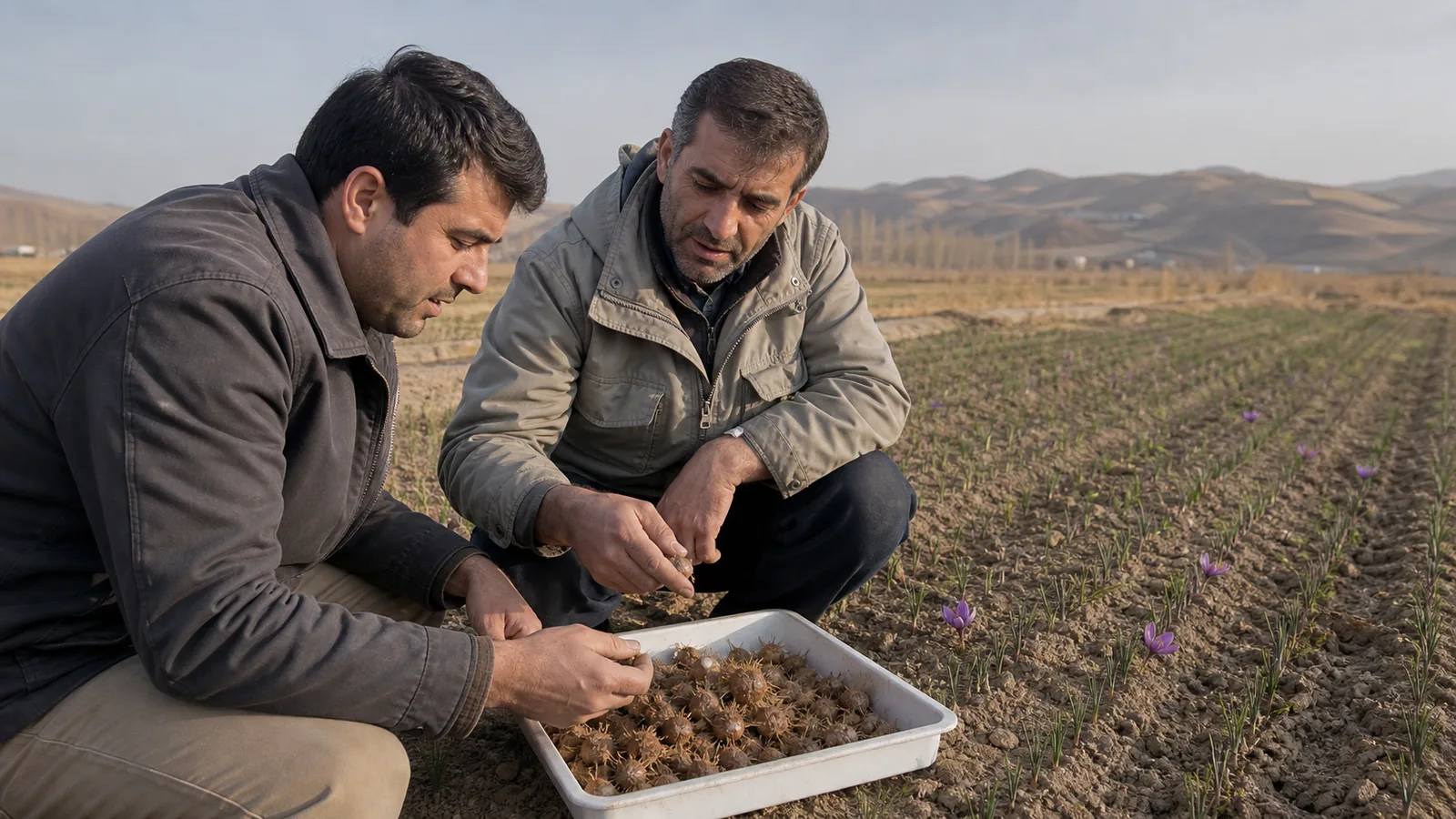
Behnam Ojaqloo, then head of horticultural affairs at Zanjan’s agricultural organization, said the province had more than 46 hectares planted with saffron. More than 23 hectares were in the fruiting stage. Another 23 hectares had been planted in the prior year and had not yet entered full production.
Reported output was about 50 kilograms. Dividing that by the roughly 23 productive hectares gives about 2.2 kilograms per hectare, close to the official’s stated average of 2.1 kilograms. He expected established fields to reach about 3 kilograms per hectare in later years, but that was a projection rather than a guaranteed yield.
Young saffron plantings often differ from mature fields because corm size, planting density, field age, soil, weather, irrigation, disease, and harvest handling all affect the result. Province-wide output also cannot be calculated by multiplying all 46 hectares by the productive-field average when half of the area was not yet yielding normally.
How Zanjan obtained healthy saffron corms
A local support farm or company was described as coordinating saffron production from planting through harvest. One of its main responsibilities was obtaining planting material—called “onions” in the translation but correctly known as corms.
The corms were sourced from the Khorasan provinces. Supply was considered sensitive because buyers needed fields free from significant pest and disease problems. Support organizations searched for suitable source farms, purchased healthy material, and distributed it to Zanjan growers.
The translated article says each hectare needed “4 to 5” corms but omits the unit. It may have meant a weight or another bulk measure; without the original unit, the number is not usable as planting guidance. The same report placed the historical cost of corms and associated establishment work between 25 million and 30 million tomans per hectare.
Ahar’s first two hectares in East Azerbaijan
Ahar’s program began at the opposite end of the scale. Governor Karim Abedi announced that saffron had been planted for the first time on just over two hectares of the city’s agricultural land.
The planting formed part of a crop-pattern reform rather than a stand-alone saffron industry. Peppermint and barberry were also named as alternative crops, and officials planned to assess whether Crocus sativus should be extended to more land.
The source includes unrelated road, water, tourism, bazaar, and hotel projects. Those items do not help a reader understand saffron cultivation and are not carried into this article. The useful contribution is the first small agricultural trial and its role in diversification.
Lorestan’s 15-hectare revival program
A faculty member at the Lorestan Agricultural and Natural Resources Research Center reported 15 hectares under saffron. The centre had worked with agricultural extension staff on revival projects for about ten years and described average harvests in research and extension farms as good, although the source gives no yield figure.
The official pointed to wild crocus growing naturally in Lorestan as evidence that the climate could support saffron. That observation is useful for identifying plants adapted to local seasons, but “wild saffron” can refer to several Crocus species. Its presence alone does not prove that commercial Crocus sativus will produce a profitable dried spice on every Lorestan site.
Lorestan saffron was also praised for color, aroma, and taste. No laboratory results, grade measurements, or comparative tasting data accompany the claim, so it remains a local quality assessment rather than a verified national ranking.
The report placed national saffron area at about 41,325 hectares and annual production between 150 and 180 tons. Those figures imply a broad average of roughly 3.6–4.4 kilograms per hectare. They belong to the source’s historical period; later reports elsewhere on the site give much larger national acreage, illustrating why dates matter when comparing production statistics.
Tehran province: 180 hectares and about one ton
Abbas Ali Ameri, then a plant-production official in Tehran province, reported approximately 180 hectares of saffron across the province’s cities and an annual harvest near one ton. The rounded totals imply about 5.6 kilograms per hectare.
Ameri said provincial researchers were studying greenhouse cultivation before recommending wider development. That is an important distinction: research was underway, but the source does not report a completed commercial trial, water balance, energy requirement, disease result, or cost comparison.
He also described Tehran saffron as comparable with products from leading provinces and said some companies had developed export capacity. The quality statement is attributed because no test data is provided. Export readiness likewise means that firms had an avenue to sell; it does not establish how much saffron was actually exported.
Agricultural offices and the provincial research centre offered advice to growers considering the crop. That kind of site-specific guidance matters because a province-wide average cannot tell an individual farmer whether one field has the right soil, drainage, temperature pattern, water quality, and labour supply.
How to compare the four regional programs
The area figures show four different stages of development:
- Ahar: a first trial on just over 2 hectares;
- Lorestan: 15 hectares after a decade of research and extension work;
- Zanjan: more than 46 hectares, with about half newly planted; and
- Tehran province: 180 hectares producing a reported one ton.
They should not be ranked by acreage alone. A trial can be valuable even when small, and a large planted area can underperform if fields are young or poorly matched to the crop. Useful comparisons require the same year, mature productive area, dried yield, grade, water use, costs, and sale value.
What the combined reports establish
Zanjan’s program had moved from initial planting into early commercial production, supported by corm sourcing and grower interest. Ahar was testing saffron as one part of crop diversification. Lorestan was using research and extension to revive a small industry. Tehran operated at the largest reported scale and was examining protected cultivation and export pathways.
Together, the reports show that expanding saffron production in Iran is a process, not an acreage announcement. Healthy corms, suitable fields, multi-year yield records, verified quality, training, and a real route to market determine whether a regional program lasts.

![Exporting Saffron to Turkey + Price Guide [Complete 0 to 100]](https://img.rowhanisaffron.com/20260827003933/saffron-export-turkey-quality-inspection.webp)



