


A historical Bafgh report announced a 20% increase in saffron harvest, reaching 250 kilograms of dried saffron. It described 60 planted hectares, including 50 bearing hectares, and connected the result with a larger area, mild autumn weather, timely irrigation and field management.
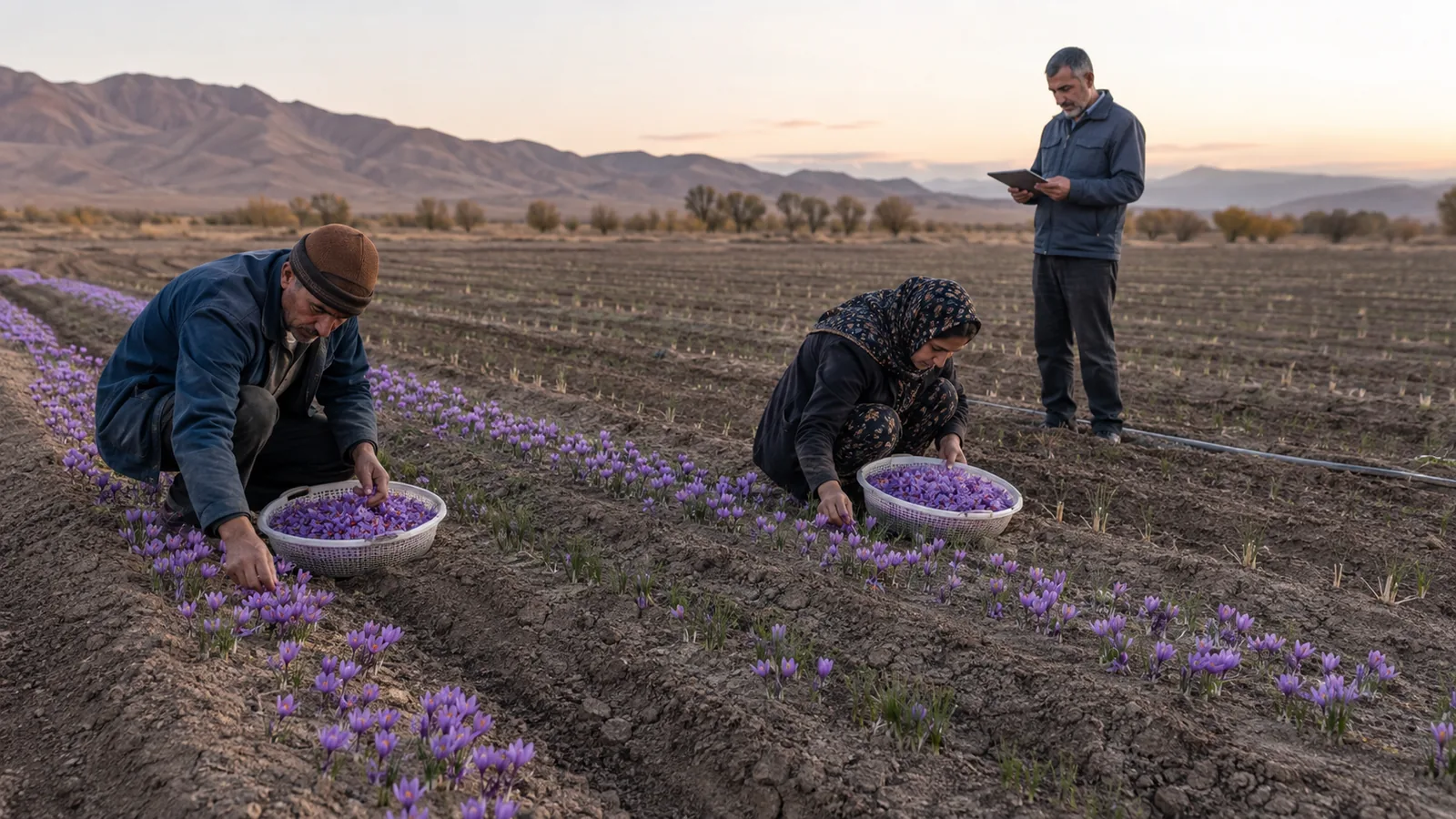
The 20% increase and 250-kilogram harvest
Hamid Askari Bagherabadi, identified as the director of Bafgh’s Agricultural Jihad office, reported the 20 percent increase. The page’s original meta description supplies the missing production total: 250 kilograms of dried saffron for the season.
If 250 kilograms was exactly 20 percent above the comparable previous result, that earlier harvest would have been about 208 kilograms. This is an arithmetic estimate, not a second figure quoted by Askari.
Sixty hectares planted, fifty bearing
The report placed saffron cultivation across 60 hectares of Bafgh land. It described 50 hectares as “fertile” and 10 as “not fertile yet.” Bearing and non-bearing are clearer terms: the latter area appears to have been newly planted or not yet producing a commercial flower crop.
Dividing the reported 250-kilogram harvest by 50 bearing hectares gives 5 kilograms per hectare. Using all 60 planted hectares would give about 4.2 kilograms, which is why area definitions matter when comparing yields.
The Sabzdasht area figures
Forty-five of the 60 hectares were assigned to Sabzdasht village in the English translation, with the remainder attributed to “Sabzdasht city.” The repeated name may refer to different local administrative levels, but the surviving text does not identify them precisely.
The safe conclusion is that cultivation was concentrated in the wider Sabzdasht area. The remaining 15 hectares should not be assigned to another locality without a reliable source.
What may have supported the larger harvest
Askari named several contributing factors: expansion of the cultivated area, mild autumn weather, suitable fertilisation, timely irrigation and weed control. These factors operate together, and the report does not isolate how much of the 20 percent increase came from each one.
Field age also matters. Ten non-bearing hectares can raise the planted total before they make the same contribution as mature beds, while favourable flowering weather can alter output from the existing area.
Saffron is not a waterless plant
The old translation calls saffron “a plant without water.” That is incorrect if read literally. Saffron requires water; its advantage in Bafgh was that much of the irrigation schedule fell outside the peak summer demand of trees and other crops.
Askari said saffron leaves dry in summer and the crop does not need irrigation again until autumn in the local system being described. Dormancy reduces summer demand, but growers still need a field-specific plan for autumn emergence and later growth.
Why irrigation timing matters
The article also mentions winter irrigation, showing that the schedule did not end at flowering. Water supports leaves and daughter corm development after the visible harvest, and decisions need to reflect rain, soil and the condition of the bed.
An official agricultural report from another Iranian production region estimated annual saffron water use at about 3,000 cubic metres per hectare. Such measured, dated estimates are more useful than describing any crop simply as waterless.
Corm multiplication and bed life
The source says the saffron “onion” propagates one year after planting and continues producing for more than 10 years. The correct term is corm. A planted mother corm forms daughter corms, which support future cycles of leaves and flowers.
How long a bed remains productive depends on density, soil, disease pressure and management. More than ten years is a historical local claim, not a rule that every field should remain undisturbed for that long.
Fertiliser and herbicide claims need care
Proper nutrition and weed management can support production, but the report gives no product, dose, timing or soil result. Its reference to herbicides is not enough to recommend any chemical treatment.
Official agricultural guidance has advised that soil should be tested before saffron fertilisation. Weed controls likewise need to match the species, growth stage and locally approved use.
More than 450 farmers
Askari said more than 450 farmers were active in planting and harvesting saffron. The machine translation mistakenly turns his surname into “the commander of the army”; this is not a second speaker or a military role.
Across a short flowering season, that grower base represents significant local knowledge and labour. The figure refers to participants in the saffron activity, not necessarily 450 separate full-time farms.
Training and input distribution
The local Agricultural Jihad office distributed fertilisers and pesticides and held training courses intended to expand cultivation and improve yield. Training can be especially important when new land enters production and recommendations must be adapted to local water and soil.
Input distribution alone does not prove good use. Clear labels, qualified advice, application records and follow-up observation determine whether an intervention helps the crop without creating unnecessary cost or residue risk.
Bafgh is in Yazd Province
Bafgh is the centre of Bafgh County in Yazd Province, Iran. The 2016 population figure retained by the original page is 45,453 for the city context.
A broken final sentence mentions “the number of cities in South Khorasan,” but it supplies no number and conflicts with the page’s Yazd geography. It appears to be stray translated text and is not evidence that Bafgh belongs to South Khorasan.
How to read the historical Bafgh result
The clearest account is a 250-kilogram dried harvest, 20 percent above the comparable prior result, from 50 bearing hectares within 60 planted hectares. That corresponds to 5 kilograms per bearing hectare.
The report attributes the increase to area, weather, irrigation, nutrition and weed management and records more than 450 participating farmers. Its useful evidence is preserved while waterless-crop language, mistranslated titles and unspecific chemical advice are corrected rather than repeated.

![Exporting Saffron to Turkey + Price Guide [Complete 0 to 100]](https://img.rowhanisaffron.com/20260827003933/saffron-export-turkey-quality-inspection.webp)



