


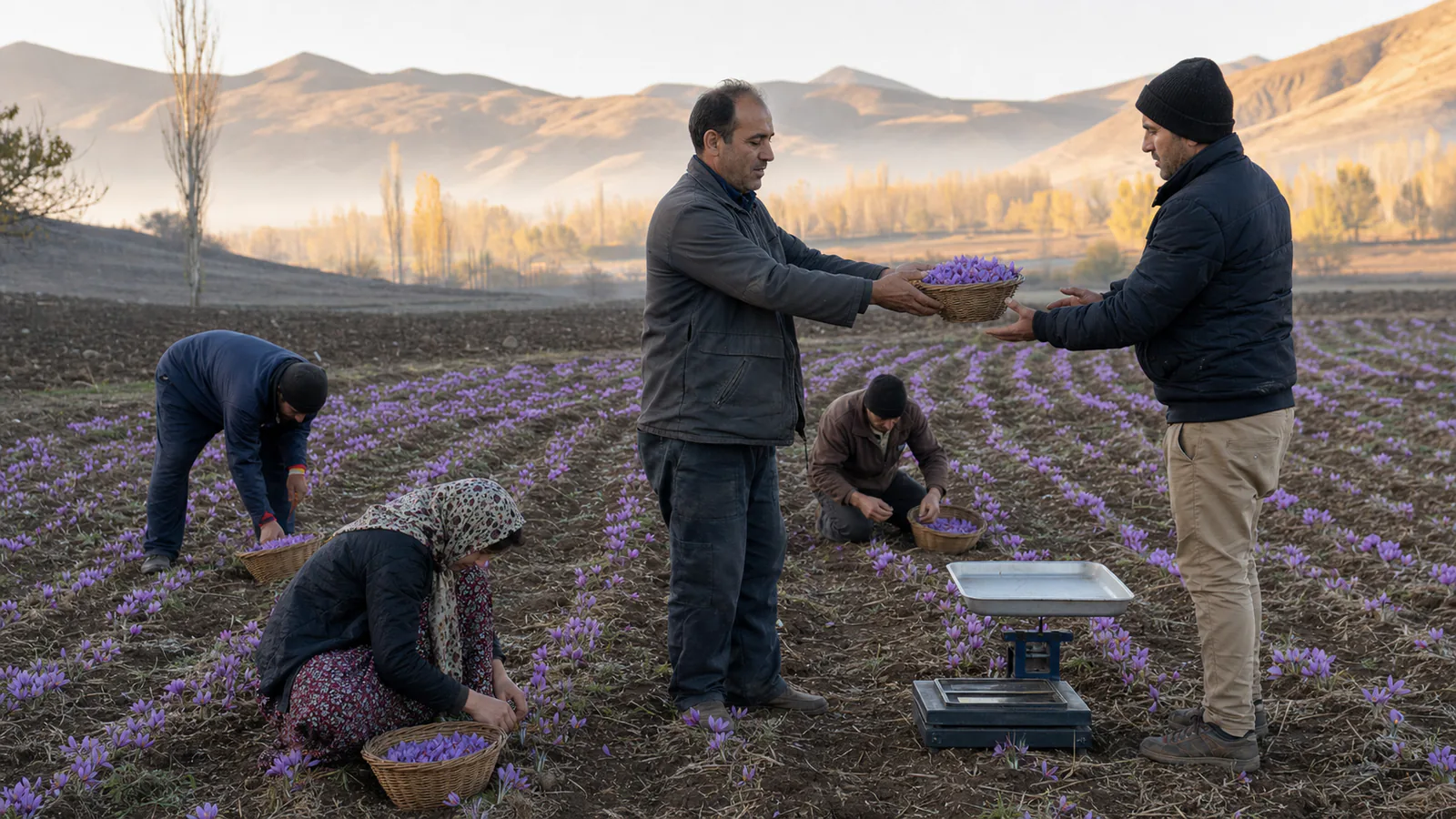
A historical Nahavand report forecast about 16 kilograms of saffron from six hectares, an implied average near 2.67 kg/ha. An earlier season produced more than 15 kilograms from five hectares in November. That earlier result implies just over 3 kg/ha, slightly above the local official’s general two-to-three-kilogram range.
The figures are best read as two snapshots, not as one continuous dataset. The sources do not identify a common harvest year, the same farms, field ages, dry-weight method, or final result for the six-hectare forecast.
What the six-hectare Nahavand report meant
The destination title and existing search description identify six hectares and a forecast of about 16 kilograms of high-quality saffron. Ahmad Bagheri, identified as director of Nahavand’s Agricultural Jihad office, said growers following expert advice could expect roughly two to three kilograms per hectare.
Six hectares at 2.67 kg/ha would produce about 16 kilograms, so the title, metadata, and stated range are arithmetically consistent. The stored body did not provide a final six-hectare weigh-in or laboratory quality results. Sixteen kilograms should remain a forecast, and “high quality” needs batch evidence.
The report associated saffron fields with the Khazal area and a village rendered as Farsban. The earlier source spells the second place Farhestan. Without a local geographic reference, the spelling difference should be treated as uncertain transliteration rather than proof of two separate production areas.
An earlier harvest exceeded 15 kg from five hectares
In the assigned source, Bagheri said more than 15 kilograms were picked from five hectares during November. Unlike the six-hectare number, that statement was framed as a completed harvest.
The minimum arithmetic is just over three kilograms per hectare because both the total and the quotient use “more than.” This sits marginally above the same official’s two-to-three-kilogram guidance and could reflect rounding, stronger fields, a different area denominator, or the use of a city total.
No farm-level results, moisture basis, grade, or weighing method are supplied. The difference is too small to justify a claim that Nahavand had broken through a new yield level.
Field age was one reason yields were expected to rise
Bagheri said the most productive and economic period was generally the third through seventh year. This was local guidance, not a universal guarantee that every field peaks for the same five-season window.
A three-season field experiment found that stigma yield changed with field age and that the preferred corm size and density combination differed between younger and third-year fields. It supports treating age, corm stock, and density together.
Soil, irrigation, temperature, weeds, disease, nutrition, daughter-corm crowding, and post-harvest handling can also change saleable dry yield. The finalized Kurdistan and Lorestan saffron comparison likewise separates young-field output from mature-field expectations.
The local planting figures were specific—not universal
The historical Nahavand guidance called for about 1.6 tonnes of saffron corms per hectare, 15 centimetres between planting positions, 30 centimetres between rows, and a depth of 10 centimetres. The English text also refers ambiguously to groups of five, three, and single corms.
Those numbers preserve the local recommendation, but they are not enough to design a field. A grower would need corm count and size distribution, planting pattern, soil texture and drainage, machinery width, water quality, field history, disease inspection, and the intended life of the stand.
A weight rate alone can hide very different populations. Large corms and small corms do not produce the same count per hectare or the same first-season flowering response.
Manure should follow soil and food-safety controls
The source says well-rotted animal manure was strongly needed in the first year. It gives no application rate, analysis, composting method, pathogen control, salinity, soil test, or nutrient budget.
“More” is not a safe prescription. Organic amendment should be mature, suitable for the site, and applied from soil and nutrient evidence. Growers also need to consider salts, weed seeds, contamination, application timing, worker hygiene, and any buyer or food-safety requirements.
Future local guidance should state the material’s analysis and rate, the target soil condition, and how results will be monitored rather than repeating a blanket first-year instruction.
Harvest timing and labor were seasonal
The earlier account placed the main harvest from November into December as temperatures cooled. It said more than 15 people worked in planting and harvesting, rising to about 40 on harvest days.
That describes a short labor peak, not 40 permanent jobs. The article does not give workdays, hours, wages, gender or household distribution, safety conditions, or whether the same people were counted across days.
For planning, farms need a daily flower-volume estimate, enough pickers for the morning field work, and a separate clean team for prompt stigma separation and drying. A city total should add unique workers and paid hours rather than summing repeated daily attendance.
Water and profitability were policy arguments
Both Nahavand accounts promoted saffron as a lower-water, high-value alternative to crops with heavier water requirements. The earlier source also mentions relatively low pest pressure and says farmers were satisfied with profitability.
None of those outcomes is quantified. There is no water volume, prior-crop baseline, pesticide record, production cost, sale price, grade, or net return. They should remain stated reasons for local adoption rather than proven results for every farm.
A useful comparison would record total irrigation and rainfall per hectare and per kilogram of saleable saffron, pumping energy, all establishment and annual costs, labor, rejected product, and actual paid price over several seasons.
Nahavand’s wider crop context
Bagheri placed saffron within a broader diversification program. The source says close to 50 hectares were used for saffron and various herbs, naming clearly recognizable crops such as artichoke, damask rose, garlic, and chicory alongside several poorly translated names.
That 50-hectare figure appears to cover the group of crops, not saffron alone. It should not be added to the five- or six-hectare saffron snapshots.
The same report recorded 5,500 hectares of food and medicinal coriander and more than 11,000 tonnes of seed. The implied average is just over two tonnes per hectare. Coriander was far larger by area than saffron and helps explain why officials discussed saffron as one part of crop diversification rather than Nahavand’s dominant crop.
What a current Nahavand report should publish
A current update should give the harvest year, final dried weight, productive and establishing hectares, field age, corm count and size, moisture basis, grade, and farm-level range. It should clarify the Farsban/Farhestan place name and distinguish saffron area from the broader herb total.
Water, labor, costs, paid prices, and saleable quality would test the policy claims. Planting guidance should include the soil, corm, disease, and nutrient evidence behind the local spacing and 1.6-tonne rate.
Until those data are available, the defensible conclusion is modest: Nahavand recorded more than 15 kilograms from five hectares in one completed season and later framed about 16 kilograms from six hectares as a forecast. Both figures fit the area’s two-to-three-kilogram guidance closely enough to preserve, but neither is a current guarantee.

![Exporting Saffron to Turkey + Price Guide [Complete 0 to 100]](https://img.rowhanisaffron.com/20260827003933/saffron-export-turkey-quality-inspection.webp)



