


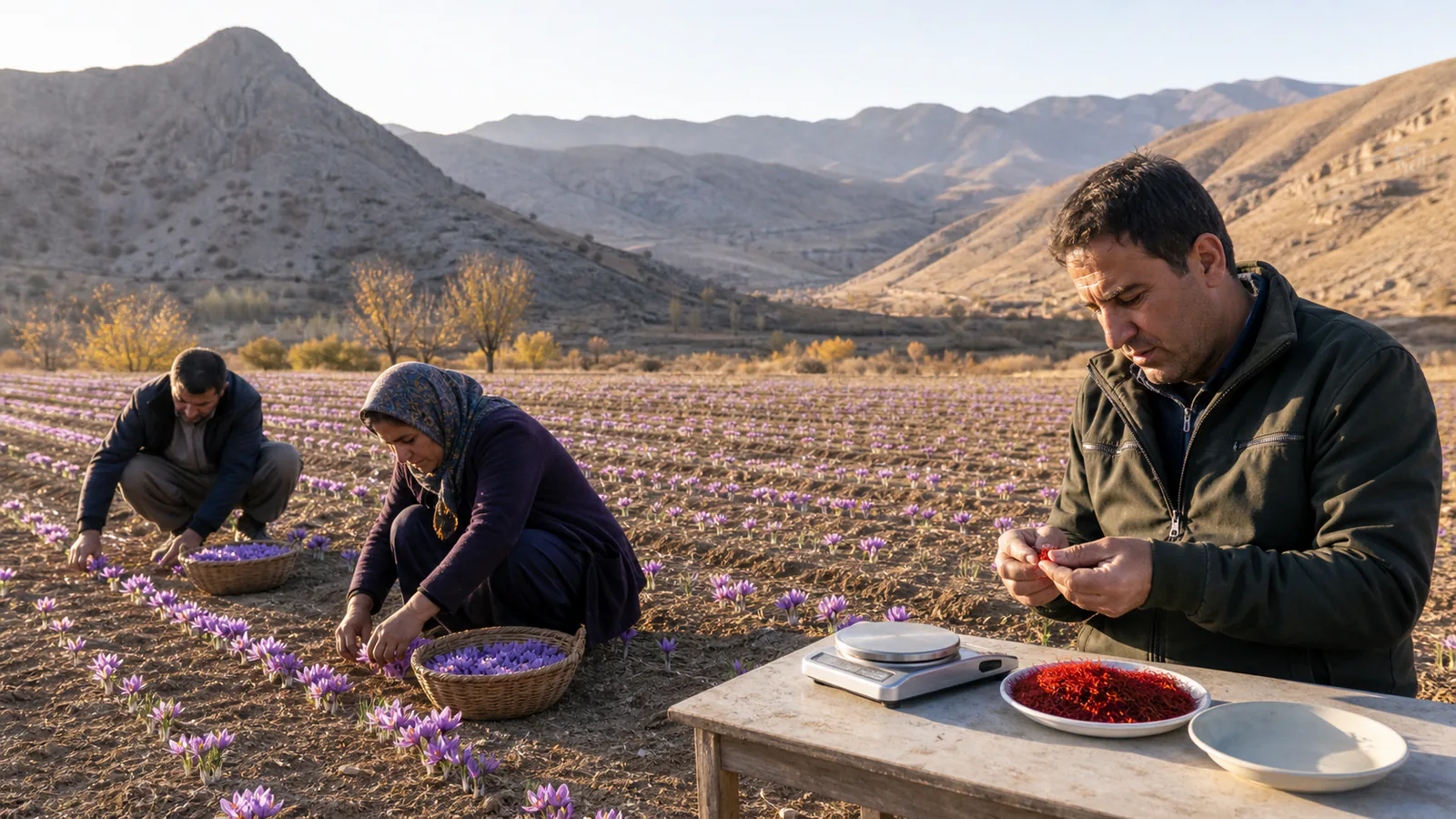
A historical report forecast a saffron harvest in Kurdistan of more than 22 kilograms, led by Dehgolan, from a province-wide crop that included about 23 productive hectares. The same report recorded 60 growers and 42.05 hectares planted in total. A separate Lorestan report described a completed 425-kilogram harvest from 50 hectares, providing a useful regional comparison but not a like-for-like ranking.
The figures need context. Kurdistan’s crop included many young, nonproductive fields, while Lorestan’s report did not give field ages or the number of growers. Production status, area basis, measurement method, and harvest year all matter before two provincial totals can be compared.
What the Kurdistan saffron harvest report recorded
Zahed Hajimirzaei, identified as the horticultural-affairs director of Kurdistan’s Agricultural Jihad Organization, said 60 farmers were cultivating saffron in the province. He put planted area at 42 hectares and 500 square metres, or 42.05 hectares.
Of that area, the report described about 23 hectares as productive and 19 hectares as not yet productive. Those components total 42 hectares rather than 42.05, a small 0.05-hectare difference that may reflect rounding. No farm-level schedule is supplied to resolve it.
The announced harvest was more than 22 kilograms. The wording was forward-looking, so the number should remain a forecast unless a final weigh-in from the same season can be found. Dividing the minimum forecast by the reported 23 productive hectares gives a lower-bound implied yield just above 0.96 kg/ha. Using all planted land would give just above 0.52 kg/ha, but that denominator includes fields the report itself called nonproductive.
Dehgolan led the reported provincial total
Dehgolan had the largest stated saffron area at eight hectares. Bijar followed with more than seven hectares, and Sarvabad with more than six. Together, those three named areas accounted for at least 21 of the province’s 42.05 planted hectares.
Dehgolan was also expected to supply nine kilograms, the largest named share of the provincial harvest. The article does not say how much of its eight hectares was mature or productive, so nine divided by eight should not be presented as a reliable field yield.
No city-level weights are given for Bijar or Sarvabad. Nor does the source list the other counties that make up the remainder. Keeping those gaps visible is more useful than constructing a precise-looking provincial breakdown from incomplete data.
Young fields help explain Kurdistan’s low early yield
Hajimirzaei said many of Kurdistan’s saffron growers were in the early years of production and expected output to rise as the plants reproduced. He suggested a mature yield range of five to seven kilograms per hectare.
That range is an official expectation, not a result demonstrated by the report. Field age can influence flower and stigma yield, but corm size, planting density, soil, irrigation, temperature, nutrition, weeds, disease, and harvest handling also affect the outcome. A three-season field experiment at Ferdowsi University of Mashhad found that stigma yield changed with field age and that the best corm density differed between younger and third-year fields. Its results support treating age as one variable rather than promising that every field will reach a fixed yield in its third year. See the published field-age and corm-density study.
For a meaningful follow-up, the province would need to report productive area by field age, dry stigma weight, grade, and the same fields’ results over several seasons. Without that denominator, a rising provincial total could reflect maturing fields, new hectares, different weather, or several changes at once.
Lorestan reported 425 kg from 50 hectares
In the assigned Lorestan source, Ishaq Taheri Moghaddam, identified as head of the provincial Agricultural Jihad Organization, announced that 425 kilograms had been harvested from 50 hectares after the season ended. Unlike Kurdistan’s forecast, the figure was presented as a completed harvest.
The arithmetic gives an implied average of 8.5 kg/ha. That sits inside the same official’s stated range of seven to ten kilograms per hectare. The internal consistency is useful, although the report does not provide field-level weights, moisture, field age, sampling, or laboratory records.
Lorestan’s 50 hectares should not be compared only with Kurdistan’s 42.05 hectares and treated as a simple productivity contest. Kurdistan identified 19 hectares as not yet productive, whereas Lorestan gave no equivalent split. The reports also may describe different seasons and production systems.
Why the two provincial figures differ
On the available evidence, crop maturity is a plausible contributor to the gap, but it is not a complete explanation. Lorestan’s implied 8.5 kg/ha average is almost nine times Kurdistan’s lower-bound forecast per productive hectare. A difference that large calls for comparable records before attributing it to climate, skill, corm stock, or any single practice.
A sound comparison would hold the basics constant: harvest year, productive rather than total area, field-age distribution, fresh-flower versus dried-stigma weight, drying endpoint, grade, irrigation volume, and the farms included. Neither historical article supplies that full set.
Other regional reports show the same need for careful denominators. The finalized account of the Khalkhal and Minoodasht saffron harvests, for example, separates a district total from a small experimental plot instead of combining unlike figures.
What the Lorestan grading claim does and does not show
The Lorestan source says saffron was assigned third, second, first, and excellent grades under a “standard test.” It does not identify that standard, the laboratory, sampling method, measured values, or how much of the 425 kilograms fell into each grade. Those four labels therefore cannot establish the quality of the provincial crop.
Modern saffron quality assessment requires more than a descriptive label. ISO 3632-1:2025 specifies requirements for dried saffron in filament, cut-filament, and powder forms, while ISO 3632-2:2010 specifies test methods. The historical Lorestan article does not provide enough information to claim that its four grades correspond to either document.
A verifiable batch record would identify the applicable standard and edition, accredited or otherwise qualified laboratory, sample and lot, test date, moisture basis, analytical results, and traceable certificate. That evidence matters to buyers more than an unexplained superlative.
Water, work, and income were benefits claimed—not measured
The Kurdistan official promoted saffron for low-yield land, describing relatively low water demand, labor needs during harvest and processing, food-industry use, export potential, and farmer income. These are reasons given for the provincial program. The article does not measure water saved, jobs created, wages paid, export shipments, production cost, selling price, or net income.
“Low water” should remain comparative. A farm still needs a locally appropriate irrigation plan, and a crop switch does not prove that total groundwater pumping fell. Likewise, labor demand is not the same as secure employment unless hours, duration, pay, and working conditions are recorded.
Farmers evaluating saffron need a multi-year budget that includes corms, planting, water, field care, flower picking, stigma separation, drying, testing, storage, packaging, finance, and rejected or downgraded product. Revenue estimates should use a documented saleable grade and buyer terms, not the highest quoted market price.
What future provincial updates should report
A useful update to the saffron harvest in Kurdistan would publish the final dry weight after the season, not repeat the earlier forecast. It should separate productive and establishing hectares by county and field age, state how the crop was dried and weighed, and show grade results under a named method.
Water use, labor, production cost, sale price, and buyer destination would test the program’s economic and resource claims. The same template applied in Lorestan would make the 425-kilogram figure more informative and allow a fair comparison over time.
Until those records exist, the defensible reading is narrow: Kurdistan was developing a young saffron sector with more than 22 kilograms forecast, while Lorestan reported a much larger completed harvest and a mathematically consistent 8.5 kg/ha provincial average. Both are historical snapshots, not current production forecasts or guaranteed farm results.

![Exporting Saffron to Turkey + Price Guide [Complete 0 to 100]](https://img.rowhanisaffron.com/20260827003933/saffron-export-turkey-quality-inspection.webp)



