


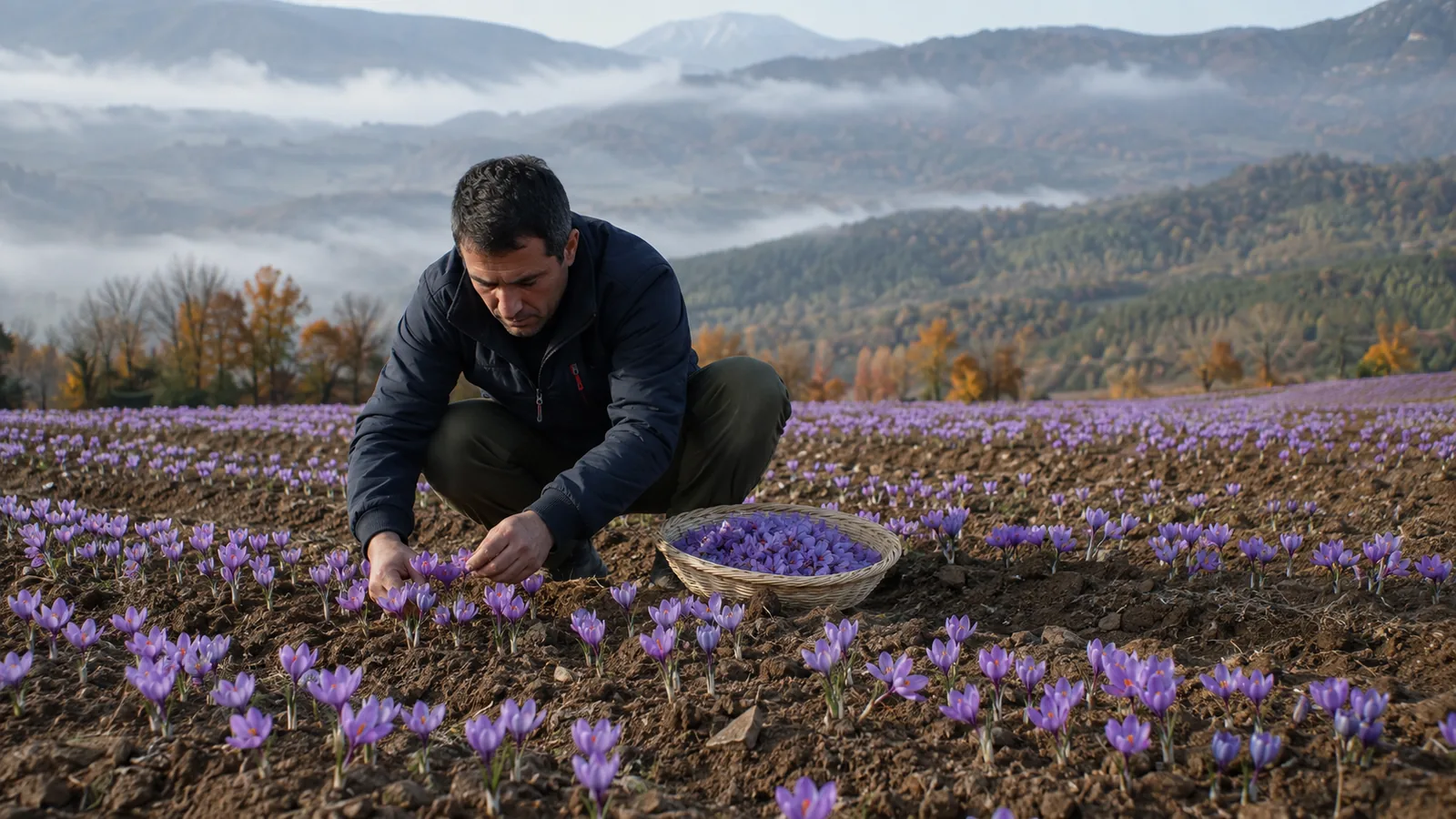
The phrase “simultaneous planting and harvesting of saffron in Mazandaran” describes two parts of a growing provincial sector: new fields being established while mature fields elsewhere produced flowers. It should not be read as planting corms and harvesting a normal crop from the same plot at the same time.
What simultaneous planting and harvesting means
Saffron is a perennial crop grown from corms. A new field is normally planted while the corms are dormant, then managed through its first growing cycle. Established fields flower in autumn and can be harvested in successive years without being replanted annually.
Across a province, those stages can overlap in the same agricultural year. One grower may establish a field while another prepares an older plot for autumn flowering. The title captures that wider activity, not a single-day operation in one field.
Mazandaran saffron cultivation moved beyond Khorasan
The original report said saffron cultivation had always been limited to Khorasan before Mazandaran began developing the crop. Khorasan is Iran’s dominant saffron region, but “limited” is too absolute: saffron has also been cultivated in other provinces. The useful point is that Mazandaran’s organised production was comparatively new and concentrated away from the humid coastal plain.
Growers and advisers focused on upland areas where cooler conditions and better-drained soils could suit the crop. Mazandaran contains sharp changes in elevation, rainfall and soil over short distances, so provincial averages are less useful than field-level assessment.
Mohammad Sadeghi’s case for the uplands
Agricultural expert Mohammad Sadeghi identified higher-altitude land as the better option. The translated text describes that land as having “low soil texture and poor soil,” wording that is not agronomically clear. It may refer to lighter, less productive land, but the original soil measurements are not provided.
Poor land is not automatically good saffron land. Drainage, soil structure, organic matter, salinity, disease pressure and winter conditions still matter. A field trial and soil analysis provide a safer basis than treating altitude alone as proof of suitability.
What the quality claim actually establishes
The report said laboratory analysis placed upland Mazandaran saffron among the best for colour and taste and classified it as good-quality saffron. Without the laboratory name, sample count, harvest year, test method and results, that claim cannot establish a comparative national ranking.
It does show that local growers were seeking evidence rather than relying only on appearance. A robust quality assessment would identify the lot, drying method and storage conditions, then report defined chemical and physical measurements. Origin by itself does not guarantee colour strength, aroma or flavour.
Low water demand is useful, but not the whole decision
Sadeghi presented saffron as a crop that does not require much water and said several parts of Mazandaran had cultivation potential. Saffron’s summer dormancy can reduce irrigation demand during the hottest months, which is one reason it interests farmers seeking a higher-value use for limited water.
The crop still needs moisture at the correct points in its cycle and performs poorly in waterlogged ground. This is especially important in a province known for humid and rainy districts. Upland microclimate, slope and drainage help explain why cultivation cannot simply be extended across all of Mazandaran.
A small area can produce value, but returns are not automatic
The original account said even a small saffron area could be economically justified and that the crop did not demand high technical knowledge. It also noted that after planting, a grower could harvest each year. These ideas need qualification.
A perennial field can produce over several seasons, but yield changes with field age, corm size, planting density, disease, irrigation and weather. Harvest is highly time-sensitive, and separating and drying the stigmas requires careful handling. Profit depends on dry yield, labour, quality, price and the buyer—not acreage alone.
More than 12 years of organised cultivation
Sadeghi said larger-scale saffron cultivation had been under way in Mazandaran for more than 12 years. That historical statement helps place the crop beyond a one-season experiment, although it does not specify a starting area or a continuous provincial time series.
An official November 2021 report from Behshahr offers a dated local snapshot: 31 hectares in mountain areas, three kilograms of dry saffron per hectare and 104 growers. It names Shohada and Ashrestaq rural districts as cultivation areas.
Planting and harvest happen on different calendars
The Behshahr report placed planting from early August through September depending on location, with planting in the mountainous Yaneh Sar area during September. It said the local harvest began at the start of the Iranian month of Aban, around late October.
Those dates explain the title’s apparent overlap. Late planting in one upland location can be close on the calendar to the start of harvest from older fields elsewhere. It still does not mean a newly planted field immediately delivers the established-field yield.
Snow, hail and drought can all damage saffron
The original article claimed saffron had zero vulnerability to snow, hail and drought. That is not credible and should not guide a farmer. Saffron can tolerate cold, but severe weather, water stress and physical damage can reduce flowers, leaves or corm performance.
Risk depends on timing. Hail can damage emerging foliage and flowers; snow or hard frost can interrupt access during harvest; drought can limit corm growth and future flowering. “Lower water requirement” is not the same as immunity to water shortage.
What a current Mazandaran field assessment should cover
A grower considering saffron should verify elevation, summer moisture, drainage, soil-borne disease risk, corm source, planting date and autumn labour. A small trial can show whether the field’s flowering and dry yield justify expansion before substantial capital is committed.
Mazandaran’s uplands have a documented saffron sector, and established and newly planted fields can exist side by side. The practical lesson is to keep their stages separate: record new planted area, bearing area, flower harvest and dry saffron yield independently.

![Exporting Saffron to Turkey + Price Guide [Complete 0 to 100]](https://img.rowhanisaffron.com/20260827003933/saffron-export-turkey-quality-inspection.webp)



