


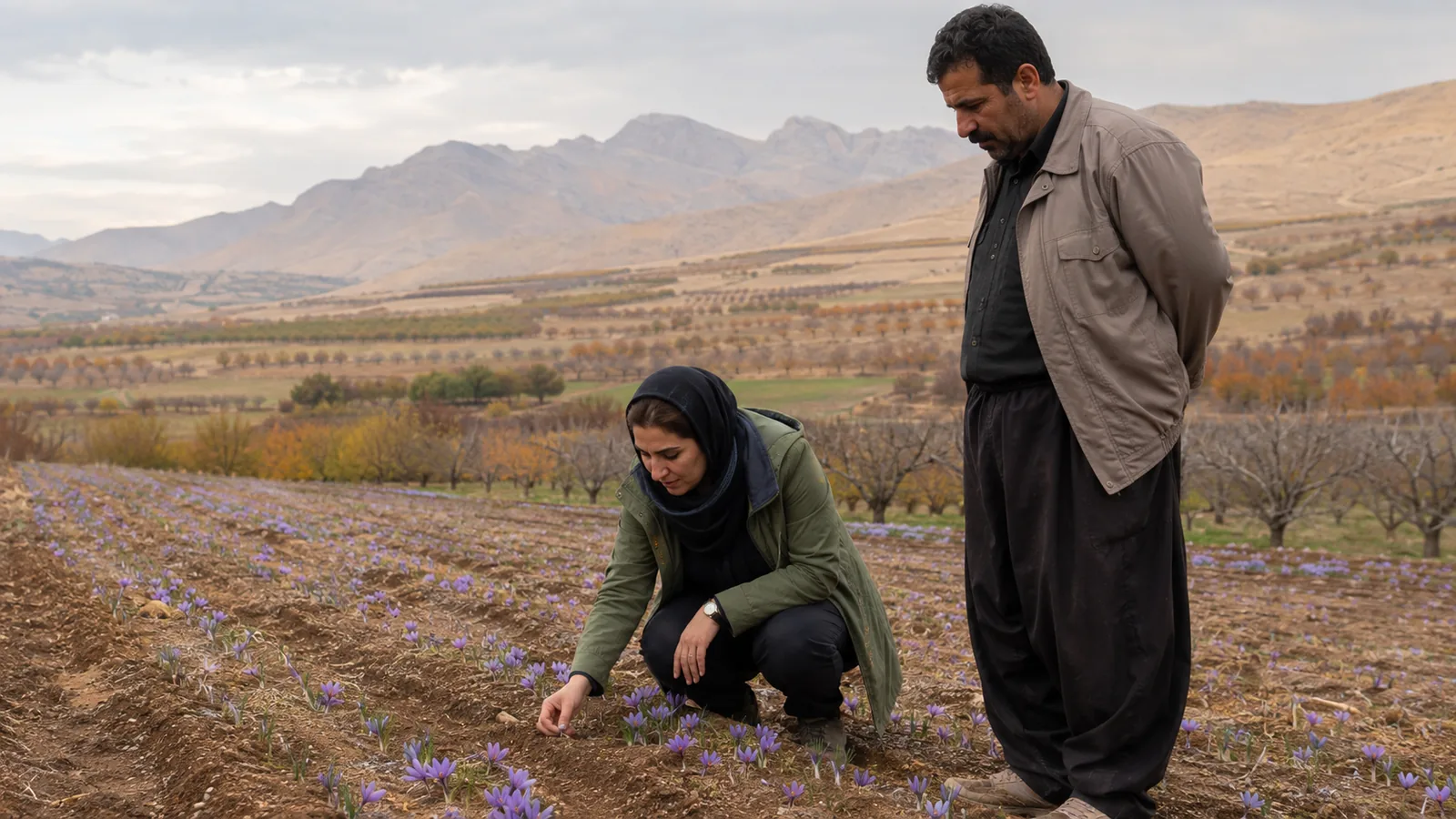
West Azerbaijan saffron cultivation moved from an earlier restriction to controlled development in locations assessed by provincial researchers. The change belongs to a wider agricultural story shaped by major crop and livestock production, processing capacity, drought and the pressure to earn more from limited water.
How saffron cultivation developed in West Azerbaijan
The head of the West Azerbaijan Agricultural Jihad Organization said saffron cultivation had been prohibited in the province until a few years earlier. By the time of the report, cultivation was being developed and an agreement had been signed with a research centre.
This does not mean every part of the province became suitable. The important change was from a broad restriction to research-led selection. Saffron needs free-draining soil, healthy corms, an appropriate temperature cycle and correctly timed irrigation. Those conditions vary between counties and even neighbouring fields.
Why the research-centre role matters
Introducing a crop into a new area is more than distributing planting material. Trial plots can show whether corms emerge evenly, flower reliably and remain healthy under local soil, winter and rainfall conditions. Researchers can also compare dry yield using a defined method rather than relying on the appearance of the flowers.
A later official November 2024 provincial report confirms that saffron was being planted in areas approved by researchers at the provincial Agricultural and Natural Resources Research Center. It also says specialist advice remained part of farmer support.
Main crops and livestock in West Azerbaijan Province
The historical account described total crop production of about 4.5 million tons and identified sugar beet as a crop for which the province ranked first nationally. It separately gave horticultural production as 1.5 million tons from 120,000 hectares.
Another translated passage refers to 1.1 million tons of agricultural and horticultural products, a first-place ranking, and 150,000 tons of stone fruit. The categories and punctuation are unclear, so these figures should not be added to the 1.5-million-ton total. They are preserved as parts of the original agricultural profile, not harmonised into a new statistic.
On the livestock side, the report highlighted beekeeping and said West Azerbaijan produced 22,000 tons of honey, ranking first in Iran at that time. Honey output is relevant to the province’s agricultural scale, but it is not a measure of saffron performance.
Honey figures also change from year to year
A separate official January 2024 report put annual honey production nearer 27,000 tons and said the province had more than 1.5 million colonies. It attributed 22% of national honey output to West Azerbaijan.
The later number should not silently replace the historical 22,000-ton figure. Different years, estimates and census bases can produce different totals. Dating both is more useful than presenting either as a permanent characteristic.
Processing and cold storage were major assets
The original report said West Azerbaijan ranked second after Razavi Khorasan in conversion industries. It attributed the capacity to process 4.1 million tons of agricultural products to the province, together with cold-storage capacity of 940,000 tons.
Those facilities matter because agricultural value is not created in the field alone. Sorting, drying, packing, refrigerated storage and transport can reduce losses and help products reach market in better condition. Saffron needs a more specialised chain than fruit: rapid separation of stigmas, controlled drying, protection from moisture and light, and traceable packing.
Drought changed the development priorities
The provincial account said drought had affected West Azerbaijan and neighbouring provinces since the Iranian year 1397, which began in 2018. Its translated wording says average rainfall “rose” from 385 millimetres to 340 millimetres, but the numbers describe a fall of 45 millimetres. It also reported a two-degree rise in temperature.
These figures are an attributed historical comparison, not a current climate normal. Still, they explain why water productivity became central to agricultural planning. A drier, warmer period can affect water supply, flowering, pest pressure and the suitability of crops across the province.
Lake Urmia, pistachios and farmer income
The report’s second stated goal was to increase farmers’ incomes while reducing water consumption. It identified areas around Lake Urmia as suitable for developing pistachio cultivation and presented saffron as another comparatively low-water, high-value option.
Neither crop is automatically appropriate merely because it may use less water than an alternative. Soil salinity, drainage, winter temperature, access to suitable planting material, labour and market conditions all matter. Near Lake Urmia, water and soil constraints make local assessment especially important.
Low-water saffron still needs careful irrigation
Saffron is dormant through summer, which can reduce irrigation demand during the hottest period. It still needs moisture at the right points in its annual cycle. Poorly timed irrigation can delay emergence, while waterlogging can damage corms.
The crop is also labour-intensive at harvest. Flowers open over a short season and need prompt picking, separation and drying. A credible development plan therefore considers labour, processing and market access alongside water use.
What the 2024 saffron figures show
The 2024 official report recorded 74 planted hectares across West Azerbaijan, of which about 43 hectares were bearing that year. It forecast roughly 160 kilograms of saffron, identified 90 primary growers and estimated 10,000 person-days of indirect work across the province.
Those figures imply about 3.7 kilograms per bearing hectare if the forecast and bearing-area definitions align. That is a calculation from the reported numbers, not a separately measured provincial average. The report also named fragmented, small holdings as a major challenge.
Export potential is not the same as unrestricted trade
The historical statement said saffron’s market had no export restrictions. That wording should not be read as a standing legal or commercial guarantee. Export rules, sanctions, banking access, food-safety requirements, packaging, certification and buyer demand can all change.
What remains valid is the economic logic: a small amount of carefully processed dry saffron can carry substantial value. Capturing that value depends on verifiable quality and a functioning route to market, not simply on calling the crop exportable.
How to read the province’s saffron development today
West Azerbaijan’s experience is best understood as cautious crop development inside a large, diverse agricultural economy. The province did not move from “banned” to unlimited planting; it moved toward cultivation in research-approved areas and later recorded a modest but established sector.
Current decisions should use current field tests and official records. The historical crop, livestock, drought, processing and storage figures explain why saffron attracted attention, while the later saffron data show the need to separate planted area, bearing area, forecast output and actual dry yield.

![Exporting Saffron to Turkey + Price Guide [Complete 0 to 100]](https://img.rowhanisaffron.com/20260827003933/saffron-export-turkey-quality-inspection.webp)



