


Rafsanjan saffron production has grown in selected mountain districts alongside the city’s much larger pistachio economy. The “more than 35 hectares” figure records one stage of that expansion, while later official reports show why every area and yield number needs its date and basis attached.
What the 35-hectare figure records
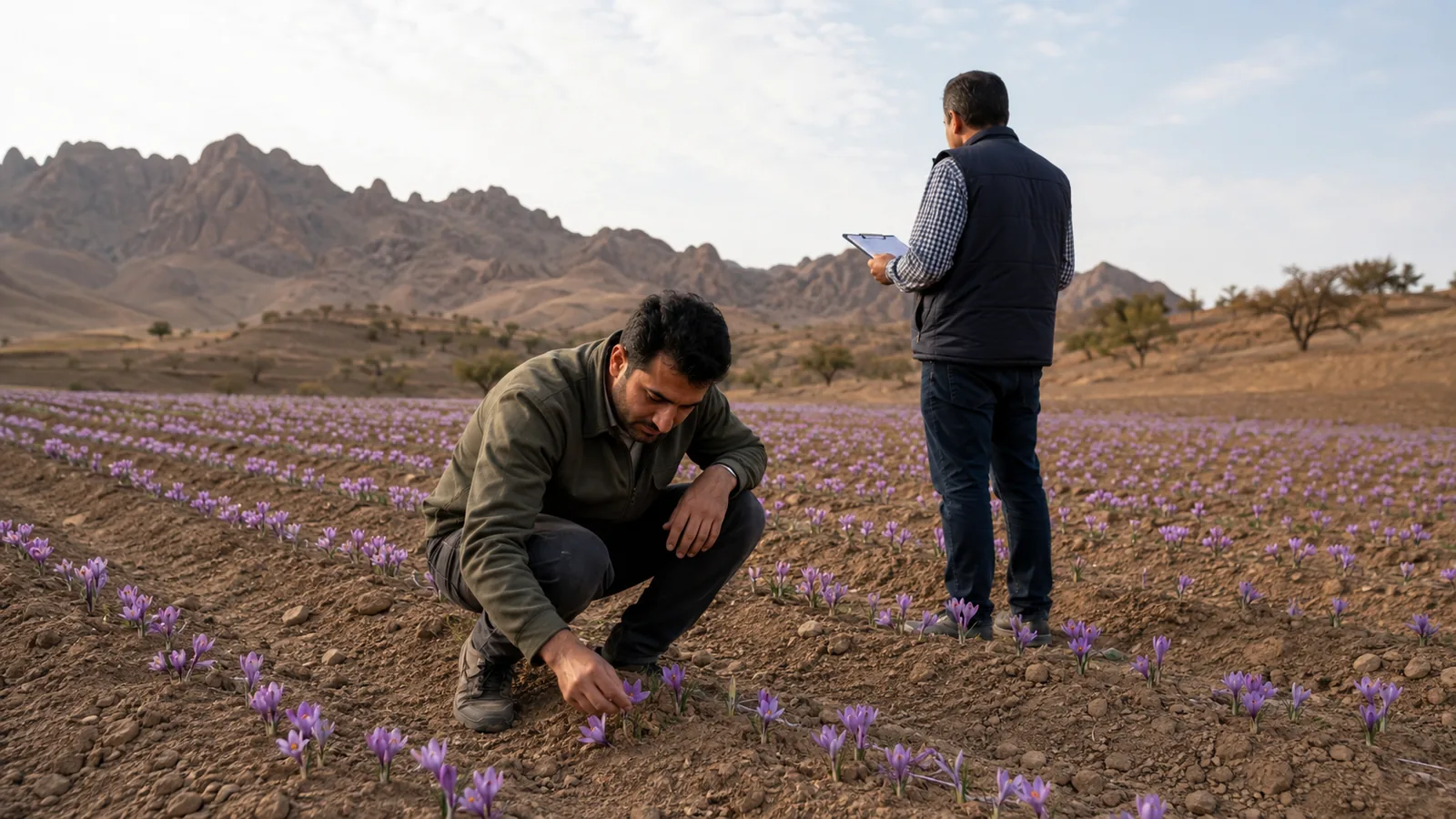
Hossein Rezaei, then director of Rafsanjan’s Agricultural Jihad office, said the area under saffron cultivation had reached 35 hectares by the end of the preceding year. He also reported the purchase of 40 tons of saffron corms for new planting. In some translations these corms are called “saffron onions,” but corm is the more accurate term.
The title says “more than 35 hectares,” while the body gives 35 hectares. The safest reading is that the reported base had reached 35 hectares and was expected to increase through the newly purchased planting material. It does not establish the final area planted after distribution.
Rafsanjan saffron cultivation is concentrated in cooler districts
Rezaei identified Raviz, Khonaman and Sarcheshmeh among the suitable cultivation areas. These higher, cooler parts of the county differ from the Rafsanjan plain, and that local variation is central to the story. Saffron’s suitability cannot be inferred from a county name alone.
Soil drainage, winter cold, summer dormancy, corm health and access to correctly timed irrigation all need to be assessed at field level. A crop that performs in Raviz may not produce the same result on saline land or under a different water regime elsewhere in the county.
Why Rafsanjan was looking beyond pistachios
The original statement was made against a background of water pressure and damaging climatic conditions affecting pistachios, the region’s strategic crop. Rezaei described alternative crops and greenhouses as ways to support employment and the local economy alongside industry.
He did not argue that saffron should replace pistachios everywhere. In fact, he said there was no better crop than pistachios on the Rafsanjan plain. His argument was about diversification in suitable places: reducing dependence on a single crop without ignoring the land, knowledge and infrastructure already built around pistachios.
What official sources say about Rafsanjan saffron production
An official May 2017 report on Rafsanjan saffron cultivation put the county’s area at 40 hectares. It said 60% was in Raviz, also named Khonaman and Sarcheshmeh, and described Davaran and nearby villages as suitable for planting.
That report attributed an average yield of 12 kilograms per hectare to Raviz and compared it with a six-kilogram national average. Those are official statements, not a guarantee for a new field. The unusually high local figure needs the harvest year, bearing-area definition, drying method and measured sample before it can be compared confidently with another source.
A second official snapshot reported a smaller area
An official October 2020 production report gave a different snapshot: 25 hectares, an average of three kilograms per hectare and a forecast harvest of about 75 kilograms. It located production in mountain areas with fresh water and suitable land, as well as around some wells where water and soil conditions remained appropriate.
The 25-, 35- and 40-hectare figures should not be blended into a single trend without their underlying surveys. They may refer to different years, planted versus bearing land, or revised records. Together they establish that saffron was a real Rafsanjan crop; they do not support a precise current acreage.
The 40 tons of corms were an input, not an output figure
The original 40-ton number refers to planting corms purchased for expansion, not dried saffron production. Confusing the two would exaggerate output enormously. Dry saffron yield is measured in kilograms after flowers are picked, stigmas separated and the material dried.
Corm quality also affects establishment. The 2020 official report warned growers to obtain large, healthy, pest-free corms after poor material from some saffron regions caused planting problems. Weight alone does not prove quality; source, disease status and appropriate storage matter.
Greenhouses were part of a broader diversification plan
Rezaei said greenhouse cultivation was developing across the county and referred to 82,000 square metres licensed for the Kashkuyeh area. The translated source then describes a countywide greenhouse figure as “33,000 hectares,” a scale that is incompatible with the surrounding statement and may be a unit or transcription error. It should not be repeated as a verified area without the original licence records.
He also said some greenhouse operations could earn seven or eight times as much as pistachios and mentioned a planned one-hectare hydroponic greenhouse at Islamic Azad University of Rafsanjan. These were development claims, not universal return forecasts. Crop choice, capital cost, energy, water quality, expertise and market access determine whether a greenhouse is profitable.
Barberry, Damask rose and medicinal plants were also considered
The same account mentioned barberry, Mohammadi flower—better known in English as Damask rose—and medicinal plants as economically promising options. It also referred to heavy and light livestock breeding. These activities have different soils, water needs, labour patterns and markets, so they should be evaluated separately rather than treated as interchangeable alternatives.
Rezaei additionally cited trout production in Lotfabad as a profitable local activity, with fish ready to enter the market. That detail shows how wide the diversification discussion was; it is not evidence about saffron yield or a reason to combine the two production systems.
What a current Rafsanjan assessment should verify
Anyone using this history as an official source for Rafsanjan saffron should verify today’s planted and bearing hectares, output, dry-weight method and district distribution with current local records. Field suitability, water and soil tests, clean corm supply, labour availability and a route to processing and sale matter more than a headline acreage.
The durable conclusion is measured rather than promotional: Rafsanjan has documented saffron cultivation, especially in its mountain districts, and officials saw it as one part of a broader response to agricultural risk. Its future depends on matching the crop to the right fields and reporting production figures on a consistent basis.

![Exporting Saffron to Turkey + Price Guide [Complete 0 to 100]](https://img.rowhanisaffron.com/20260827003933/saffron-export-turkey-quality-inspection.webp)



