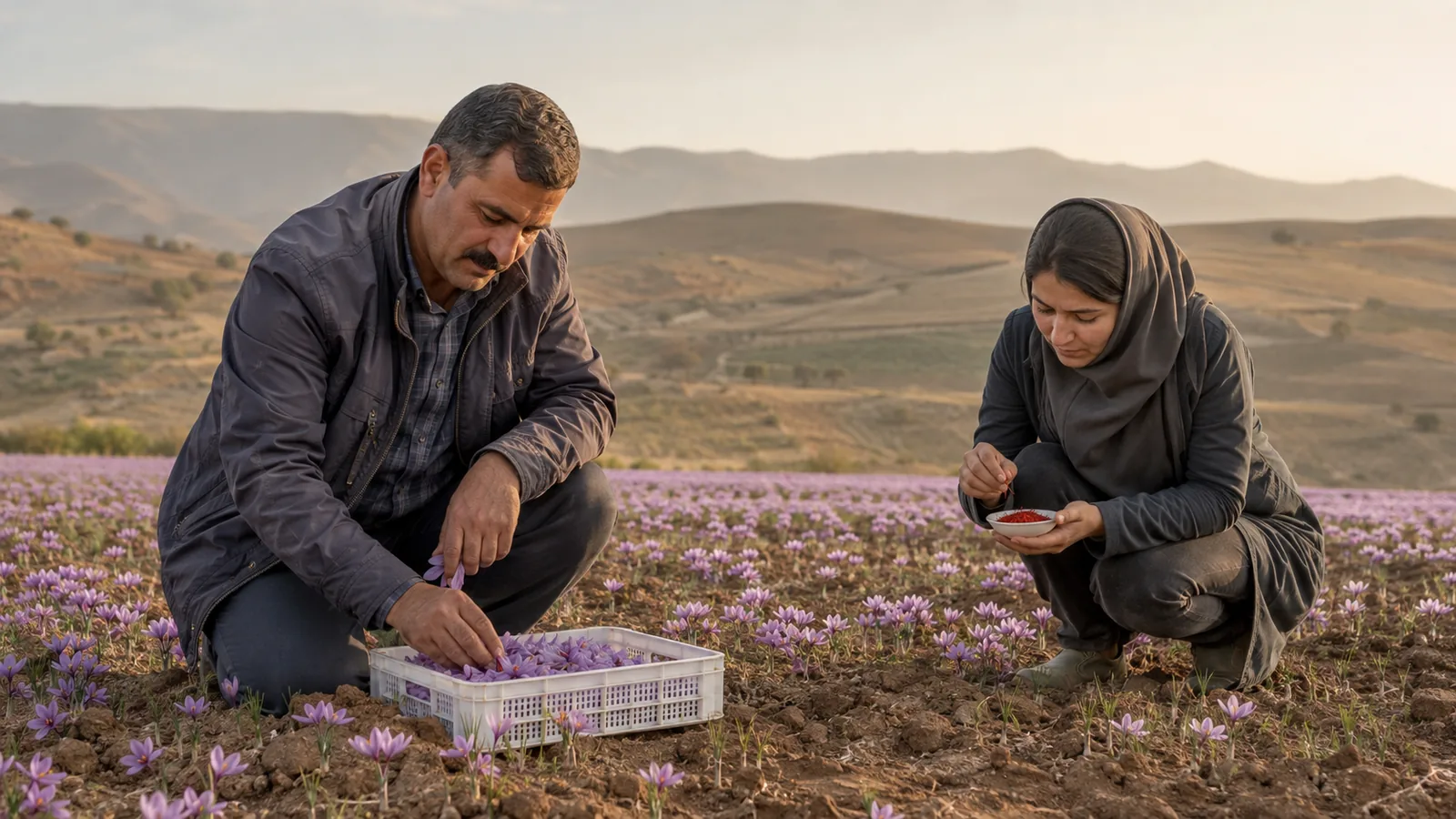
A historical Kermanshah agriculture statement called the province “the best source of saffron in the world.” That was an official expression of local confidence, not an independently verified global ranking. The stronger story is measurable: saffron had become a promising crop in Kermanshah, with recognised quality, comparatively modest water needs and room for better processing and marketing.
What “the best source of saffron” meant in the original report
Nourbakhsh Hatami, then head of the Kermanshah Agricultural Jihad Organization, described the province as both a birthplace of saffron cultivation and an especially suitable place to grow the crop. His wording should be read as an attributed assessment. There is no single international table that names one province the world’s best saffron source.
Quality also cannot be established by origin alone. Stigma maturity, harvesting time, separation from the flower, drying, storage and laboratory measurements all affect the finished spice. Kermanshah’s climate may support good production, but a buyer still needs evidence from the particular lot.
Kermanshah’s wider agricultural base
Hatami put the province’s area at 2.5 million hectares. In the translated account, more than 1.5 million hectares were described as forests and pastures, with about 950,000 hectares of orchard and rain-fed land. He used those figures to argue that local agriculture was not reaching its potential and that the province’s employment and economic conditions could be stronger.
These broad land categories do not mean all of that land is available or suitable for saffron. Forest, rangeland and rain-fed farmland have different ecological and legal constraints. A sound cultivation decision begins at field level, with soil drainage, corm health, temperature, access to timely irrigation and the labour available for the short flowering season.
Why Hatami linked saffron with chickpeas
The original statement paired saffron with chickpeas, one of Kermanshah’s established crops. Hatami argued that reviving both sectors and developing their added value could improve the provincial economy. The point was larger than increasing planted area: farmers need cleaning, grading, packaging, traceability and a route to market if more of a crop’s value is to stay locally.
That distinction matters for saffron. More hectares can raise raw output, but they do not automatically create a resilient business. Product consistency, hygienic handling and credible labelling determine whether growers and processors can reach buyers who pay for verified quality.
The historical price claim needs a date
Hatami said Kermanshah saffron had sold for 14 to 15 million tomans per kilogram in the preceding year, around 50% above what he described as the national price. Those are historical, attributed figures. They are not a current quotation and should not be used to value today’s crop.
Nor does a higher reported price prove that every local lot was superior. Grade, moisture, colour strength, aroma, cleanliness, packaging, transaction size and the stage of the supply chain can all change a kilogram price. A fair comparison needs the same date, grade and trading basis.
Employment was part of the development case
The account also associated the sector with work for 250 to 300 people a year. It did not define whether that figure referred to growers, seasonal flower pickers, processors or a combination, so it should not be converted into a claim about permanent full-time jobs.
Saffron does create concentrated labour demand. Flowers must be picked promptly and the red stigmas separated and dried carefully. Local packing and quality-control work can extend activity beyond harvest, although the number and duration of jobs depend on planted area, yield and the amount processed within the province.
Low water use does not mean no water planning
Hatami presented relatively low water consumption as an advantage. Saffron’s growing cycle can suit places where summer irrigation is constrained because the corm is dormant through the hottest months. That does not make it a water-free crop.
Planting conditions and the timing of the first irrigation influence emergence and flowering. Excess water and poorly drained soil can harm corms, while badly timed or insufficient irrigation can reduce performance. Local agronomic advice is more useful than applying a generic calendar across every district.
A later official snapshot adds scale and context
An official December 2020 provincial report attributed 422 hectares of saffron to Kermanshah, including 120 newly added hectares. It reported production from 302 hectares, stated 1,700 kilograms for the season and gave an average yield of four kilograms per hectare.
Those figures require careful reading: 302 hectares multiplied by four kilograms gives 1,208 kilograms, not 1,700. The report may have mixed planted area, bearing area, rounded average yield or different reporting bases. Preserving the figures alongside their inconsistency is more responsible than forcing them into a false calculation.
Where cultivation was concentrated
The same official report said saffron was cultivated in every county except Qasr-e Shirin and Sarpol-e Zahab. It identified Kermanshah County, Dalahu and Harsin as the largest cultivation areas and noted five active saffron-packing units in the province.
That processing capacity supports Hatami’s added-value argument, but the number of units alone says nothing about their throughput or standards. Buyers and growers benefit when each batch can be traced from field and harvest date through drying, storage and packing.
How to judge Kermanshah saffron in practice
Province of origin can provide useful context, but it is only the beginning of a purchasing decision. Look for dry, clean red stigmas, an identifiable producer or packer, a harvest or packing date, sensible storage and, for commercial purchases, test results tied to the lot being offered.
Kermanshah has a documented saffron sector and officials have made a credible case for its development. The phrase “best source of saffron” is best understood as that case in headline form. The quality of any individual purchase still rests on how the crop was grown, handled, tested and represented.