The price of 1kg of gold is not a fixed dollar amount. One kilogram contains about 32.1507 troy ounces, so its raw metal value is 32.1507 multiplied by the current gold price per troy ounce, adjusted for purity. At a spot price of US$4,100 per ounce, for example, 1kg of fine gold would have a metal value of about US$131,800 before any dealer premium, tax, shipping or storage cost.
How much is 1kg of gold?
For a quick estimate, find a current US-dollar gold quote and use this calculation:
1kg gold value = gold price per troy ounce × 32.1507466 × fineness
The last number matters. A bar described as 999.9 fine is 99.99% gold, so the purity multiplier is 0.9999. Jewellery is usually much less pure and should not be valued as though every gram were fine gold.
Here are three simple examples for one kilogram of fine gold. These are calculation examples, not live quotes:
- At US$3,500 per troy ounce: approximately US$112,528.
- At US$4,100 per troy ounce: approximately US$131,818.
- At US$4,500 per troy ounce: approximately US$144,678.
The LBMA precious-metal price page explains that its gold benchmark is set twice each London business day in US dollars per troy ounce. Because the market moves, the most useful answer is always a dated quote plus the calculation—not an undated number that looks permanent.
Why the quoted price and the purchase price differ
Multiplying the spot price by the fine-gold weight gives the metal value, sometimes called melt value. It does not necessarily tell you what a one-kilogram bar will cost at a dealer or what a buyer will pay when you sell it.
A retail purchase price may include:
- the dealer’s premium or markup;
- fabrication and assay costs;
- shipping, insurance and secure storage;
- taxes or duties that apply in the buyer’s country;
- a currency-conversion spread when the local purchase is not in US dollars.
A resale offer may instead sit below the displayed retail price. The joint CFTC and FINRA guidance on buying physical precious metals recommends comparing the metal’s spot value with the dealer’s premium and asking about all fees. That distinction is important when a headline price is used to value a physical bar.
Gold uses troy ounces, not ordinary ounces
Gold markets measure weight in troy ounces. One troy ounce is 31.1034768 grams, while the ordinary avoirdupois ounce used for many household goods is lighter. Dividing 1,000 grams by the troy-ounce conversion gives approximately 32.1507466 troy ounces.
Mixing the two ounce systems produces a substantial error. A kilogram is about 35.274 ordinary ounces, but that number should not be multiplied by a gold quote stated per troy ounce.
Purity changes the value of a kilogram
A kilogram on the scale is gross weight. Its fine-gold content depends on fineness:
- 999.9 fine: about 999.9 grams of pure gold.
- 995 fine: about 995 grams of pure gold.
- 18-karat gold: nominally 75% gold, so one kilogram contains about 750 grams of gold before any assay variation.
For a reliable valuation, use the actual stamped fineness and, for a significant transaction, appropriate documentation or an independent assay. Appearance alone does not establish purity.
Is a one-kilogram bar the standard London gold bar?
No. One-kilogram bars are real, widely traded products, but they are not the large bar normally meant by a London Good Delivery bar. The LBMA’s wholesale market definitions put a Good Delivery gold bar between 350 and 430 fine troy ounces, generally close to 400 ounces or 12.5 kilograms, with minimum fineness of 995 parts per thousand.
That difference explains why a wholesale benchmark and the price of a particular one-kilogram retail bar are related but not identical. Product size, brand, condition, certification and local availability can affect the premium without changing the underlying amount of gold.
Factors affecting gold prices
The gold supply and mining picture matters, but it is only one part of the market. Gold is also held as jewellery, an industrial material, a central-bank reserve and an investment asset. Global demand from those uses can change at different times.
Currency and interest rates
International gold prices are commonly discussed in US dollars. Exchange-rate movements therefore affect what buyers pay in euros, pounds and other currencies, even when the dollar gold price is unchanged. Interest rates also change the opportunity cost of holding an asset that pays no income.
Economic and political factors
Economic and geopolitical uncertainty, including periods of high inflation, can increase investment demand for gold, but “safe haven” does not mean its price is stable every day or guaranteed to rise. The World Gold Council’s 2026 mid-year outlook described a wide first-half trading range and linked the outlook to geopolitics, rate expectations, investor positioning and the US dollar. That volatility is why an old price range should not be used as a current valuation.
Supply, recycling and buying demand
New mine production responds slowly because exploration and development take time. Recycled gold can respond more quickly when prices or economic conditions change. Jewellery, bars and coins, exchange-traded products, technology use and central-bank purchases all contribute to demand, so no single factor explains every move.
How to check the price of 1kg of gold accurately
- Note the time and currency. A price without a timestamp can already be stale.
- Confirm the unit. Use a quote per fine troy ounce, not an ordinary ounce.
- Multiply by 32.1507466. This gives the indicative value of one kilogram of fine gold.
- Adjust for fineness. Multiply by 0.9999 for a 999.9-fine bar, for example.
- Add the real transaction costs. Ask for the premium, tax, delivery, insurance, storage and currency-conversion charges separately.
- Compare the buy-back terms. A dealer’s resale offer may not match its selling price.
Gold value versus saffron value
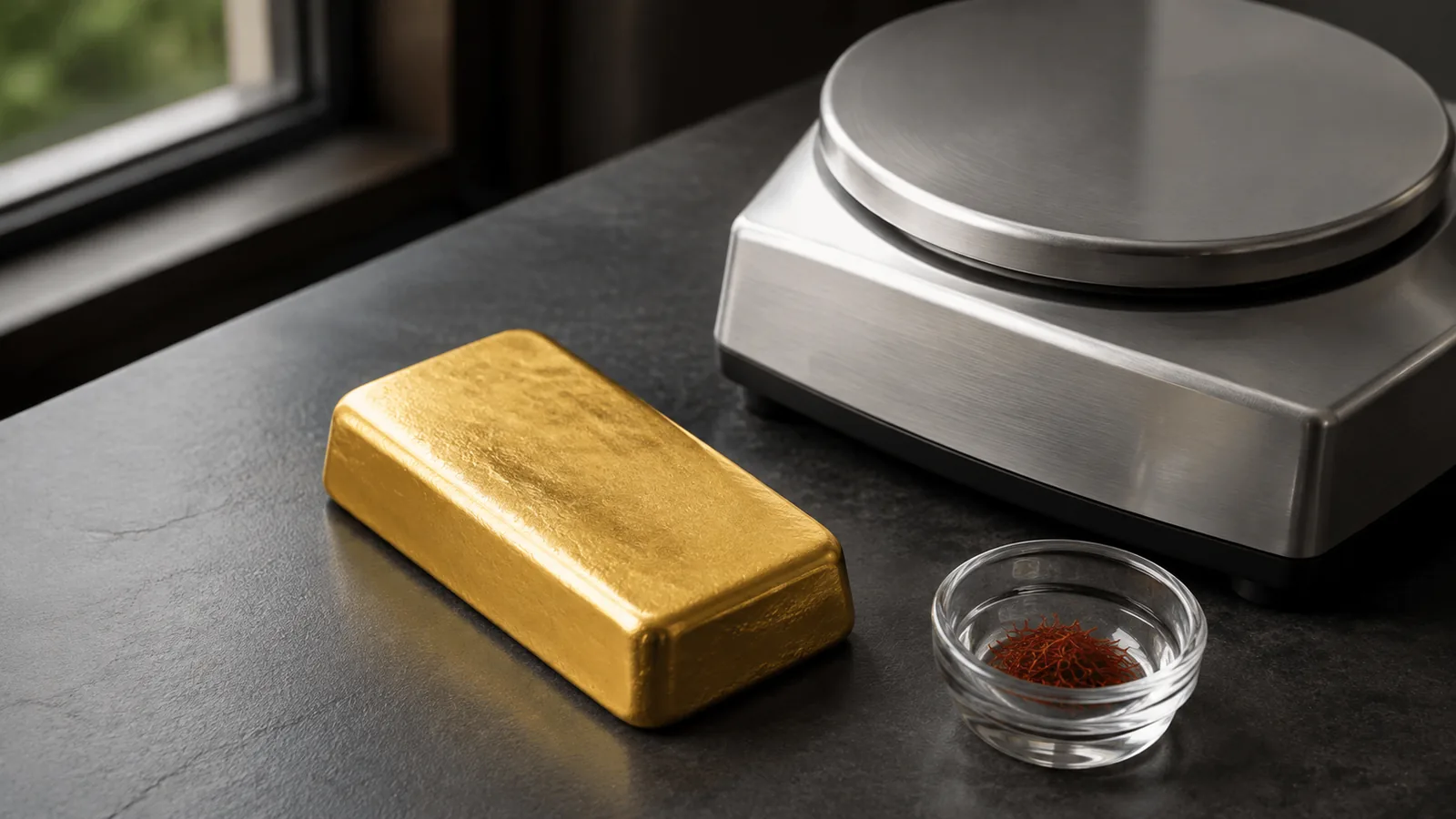
Gold and saffron are sometimes compared because both can command a high price for a small weight. The comparison needs care: gold has a continuously quoted international metal market, while saffron prices vary by grade, origin, harvest, testing, package size and seller. Our article on whether saffron is worth more than gold explains why a dramatic price-per-kilogram claim can be misleading. For the spice itself, use the current saffron price page or compare the listed saffron products.
The practical answer
To find the price of 1kg of gold, multiply the live per-troy-ounce quote by 32.1507466, adjust for purity, then add the costs of buying the physical product. Keep the quote’s date, time and currency beside the result. That gives a transparent estimate that can be checked again when the market changes.