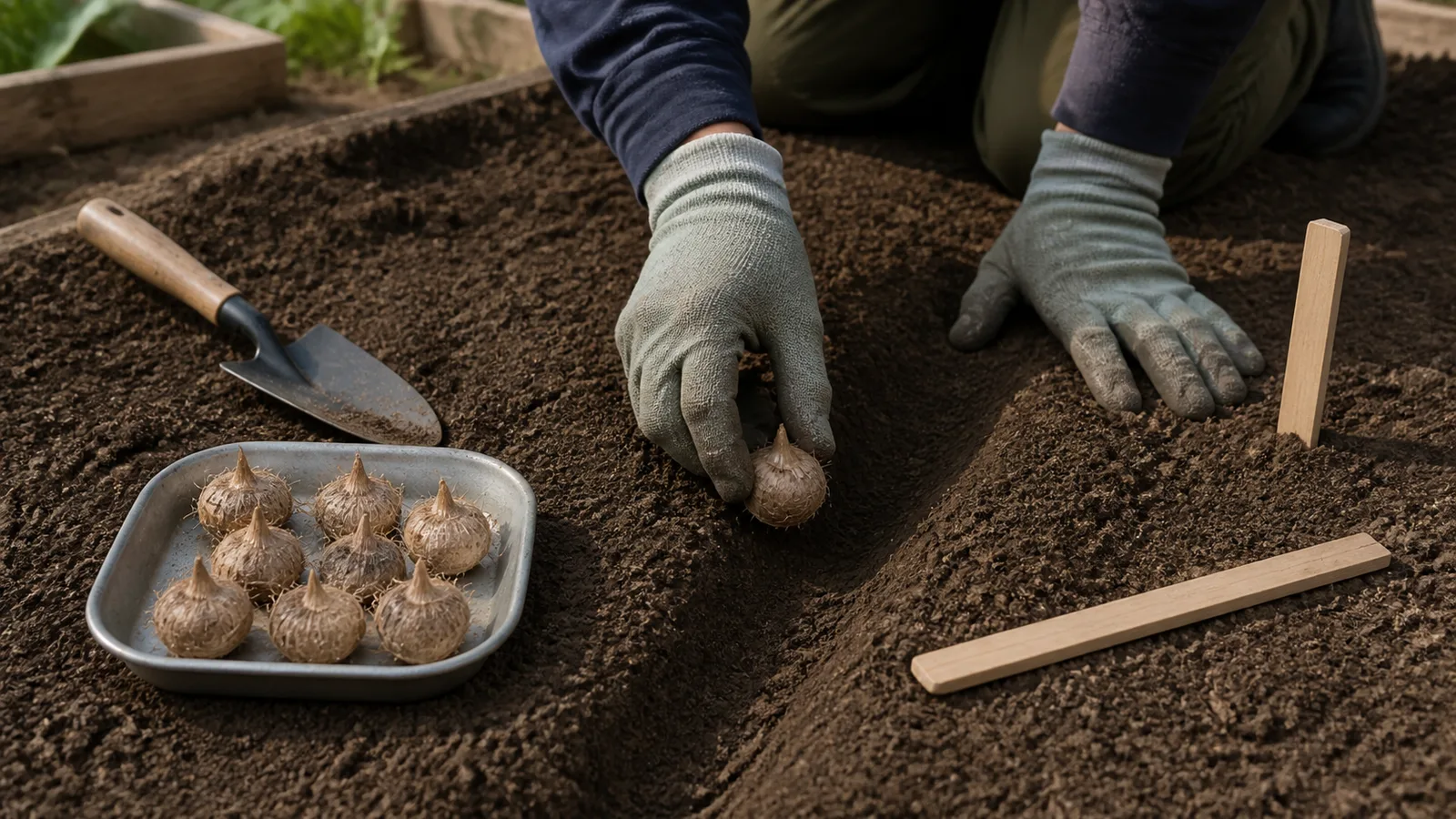
Learn how to plant saffron by starting with the corm, the site and the season—not with a universal calendar. Saffron (Crocus sativus) grows from corms rather than seed. It flowers in autumn, produces leaves through the cool season and becomes dormant in summer. The exact planting date, depth, spacing and irrigation plan should match your climate, soil and production system.
For a first planting, choose a small, sunny, well-drained bed; obtain firm, healthy corms from a traceable source; plant them pointed side up; and keep the soil moist enough for establishment without leaving it waterlogged. The detailed steps below explain how to adapt that plan.
1. Check whether your site suits saffron
Saffron is not a tropical plant, despite the wording of the old article. It is a geophyte with a summer-dormant corm and active growth during the cooler part of the year. Successful regions commonly have dry summers and cool autumn-to-spring conditions, but local soil and water can be as important as temperature.
Choose a position that receives direct sun and is not shaded by dense trees. Some traditional fields grow near barberry or almond plants, as the original Khorasan account noted, but shade and root competition change moisture and yield. A sheltered site can reduce physical damage from severe wind without trapping humid air.
The old guide said cultivation was uncommon in Gilan, Mazandaran and Iran’s warm southern regions because their moisture or heat did not match its preferred cycle. That is a dated regional generalisation, not proof that every site in those provinces is unsuitable. Drainage, local seasonal temperatures, rainfall and production records should decide whether a specific plot is viable.
The old guide quoted 35–40°C summers and elevations of 1,300–2,300 metres as though they were requirements. They describe conditions found in some producing areas, not universal limits. Saffron is cultivated successfully outside that elevation band. Use local frost, heat, rainfall and soil records instead of selecting land by altitude alone.
2. Test drainage and soil before planting
Saffron corms remain in the soil for several years, so drainage is essential. Avoid a low point where irrigation or rain stands around the corms. A loose loam or sandy loam can work well, but soil texture alone does not decide suitability. A 2020 study found that soil physical and chemical properties influence saffron growth, yield and quality.
The earlier article listed loam, lime, clay and sand together, gave an unusable “pH 7–7” range and then appeared to prefer saline, poor, wet or acidic soil because of a translation error. Do not follow that sentence. Test pH, salinity, organic matter and nutrient status. Correct drainage or choose another bed if the soil remains saturated.
Remove perennial weeds before planting. If compaction prevents drainage or root growth, loosen the soil to the depth needed by the bed. Excessive tillage can destroy structure, so the goal is a friable planting zone rather than repeatedly pulverised soil.
3. Prepare the bed and fertilise from evidence
The historical Khorasan method called for deep ploughing in autumn or winter, secondary cultivation after spring rains, then manure and ammonium phosphate before an August or September planting. That sequence may fit a particular field; it is not a recipe for every garden or farm.
The quoted rates—40–80 tonnes of manure plus 200 kilograms of ammonium phosphate, and later another 10–20 tonnes of manure—did not state area, soil test, nutrient analysis or whether the quantities were per hectare. Applying them blindly could waste nutrients, contaminate water or damage the crop.
Use mature, well-composted organic matter if a soil assessment shows it will improve structure or nutrient supply. Base phosphorus, nitrogen and other fertiliser on a soil test and a local agronomist’s recommendation. Fresh manure should not touch corms.
4. Select healthy saffron corms
New saffron fields are established vegetatively with corms. Select firm corms with intact tunics and no soft, dark, mouldy or wounded areas. Keep lots from different suppliers separate until their health and performance are known.
Corm size influences flowering potential, but the largest corm is not a substitute for health. A 2024 field study found that corm size and planting depth interact with saffron performance. Record the size class you plant so first-year results can be interpreted honestly.
Corm rot can spread through infected planting material and favourable soil conditions. A review of saffron corm-rot epidemiology and management supports an integrated approach: clean material, drainage, sanitation and removal of diseased plants rather than one promised treatment.
5. Choose the planting time for your climate
The old Iranian guide described lifting corms from late May to late August and recommended replanting soon after lifting. It also warned against delaying until roots and shoots begin. That reflects a summer-dormant production cycle in Khorasan.
In other regions, plant during dormancy early enough for the corms to settle before autumn growth, but avoid working saturated soil or leaving lifted corms in hot sun. Ask a local extension service or experienced grower for a regional window. If you must store corms briefly, keep them dry, ventilated and protected from heat, rodents and crushing; do not pile them 20–30 centimetres deep without monitoring temperature and decay.
6. Set depth and spacing
Place each corm with the growing point upwards. The previous article recommended 15–20 centimetres deep and described groups of 3–5, sometimes 15, corms in a hole. Those are traditional configurations, not universal rules.
Depth affects temperature buffering, daughter-corm formation and the distance a shoot must travel. Spacing controls competition, disease airflow and how quickly the bed becomes crowded. Climate, corm size, soil and how many years the planting will remain in place all influence the choice.
For a home bed, use one corm per position in labelled rows so plants can be observed and lifted easily. For commercial planting, calculate corms per square metre and row width from equipment, labour and the planned field life. Do not hide an unknown planting density inside “three to fifteen per hole.”
7. Cover, mark and water the bed
Backfill with friable soil, firm it lightly enough to remove large air pockets, and mark the rows. Heavy compaction can reduce infiltration and make emergence harder. A thin surface mulch may help some soils, but do not create a wet mat over poorly drained corms.
The Khorasan account delayed first irrigation until autumn and used staggered watering blocks to spread flowering and labour. It said flowers might appear 15–20 days after initial irrigation. That timing varies with soil temperature, corm condition and weather and should not be treated as a guarantee.
Water evenly through the root zone, then let excess water drain. An experiment on water supply and corm planting density demonstrates that irrigation and density can affect saffron quality, nutrient uptake and water-use efficiency. A fixed “every 6–12 days” schedule from April is not safe across different climates and soils. Check moisture at corm depth and adjust to rainfall and plant stage.
8. Loosen surface crust carefully
The translated guide called this step “breakdown.” It meant breaking a surface crust after irrigation so shoots could emerge more easily and surface-applied organic matter could mix with the upper soil.
If crusting occurs, loosen only the shallow surface and keep tools above the corms and emerging shoots. Deep cultivation after planting can cut roots, corms and buds. Preventing compaction and using irrigation that does not seal the soil are better than repeatedly breaking a hard crust.
9. Control weeds without guessing at herbicides
Weeds compete for light, water and nutrients and can obstruct flower picking. The old article also described weeds as possible hosts around pests and diseases, particularly nematodes; that risk depends on the weed and nematode species and should be diagnosed rather than assumed. Remove weeds while small, before they set seed, and avoid disturbing saffron roots. The original schedule weeded after flowering and again before a later irrigation; actual timing should follow weed growth.
Do not apply an herbicide merely because a field guide names a general “chemical struggle.” Product registration, crop tolerance, timing and residue rules vary by country. Use only a product specifically authorised for saffron in your jurisdiction and follow its label; when that evidence is absent, use mechanical or hand control that protects the crop.
10. Expect a multi-year planting, not instant yield
A new bed may flower in its first autumn, but its yield depends strongly on corm size, planting date and establishment. Daughter corms develop over time, and crowding eventually changes performance. Keep yearly records of flowers, dried stigma weight, disease and bed area.
The old guide suggested leaving corms in place for five to seven years. That may suit some farms, while other systems lift and divide sooner. Decide from crowding, health and measured yield rather than the calendar alone.
A concise planting checklist
- Choose a sunny site with dependable drainage.
- Test soil pH, salinity, nutrients and organic matter.
- Correct weeds and compaction before the corms arrive.
- Buy firm, healthy, traceable corms and sort by size.
- Plant during local dormancy, pointed side up.
- Select depth and spacing for climate, soil and field life.
- Water evenly without saturating the bed.
- Control crusting, weeds and disease with shallow, evidence-based methods.
- Record emergence, flowering, yield and losses each season.
Learning how to plant saffron is ultimately learning how the corm responds to one site. Start with a manageable area, measure what happens, and refine depth, density, water and nutrition from your own records instead of copying a translated rate or calendar without its units.