


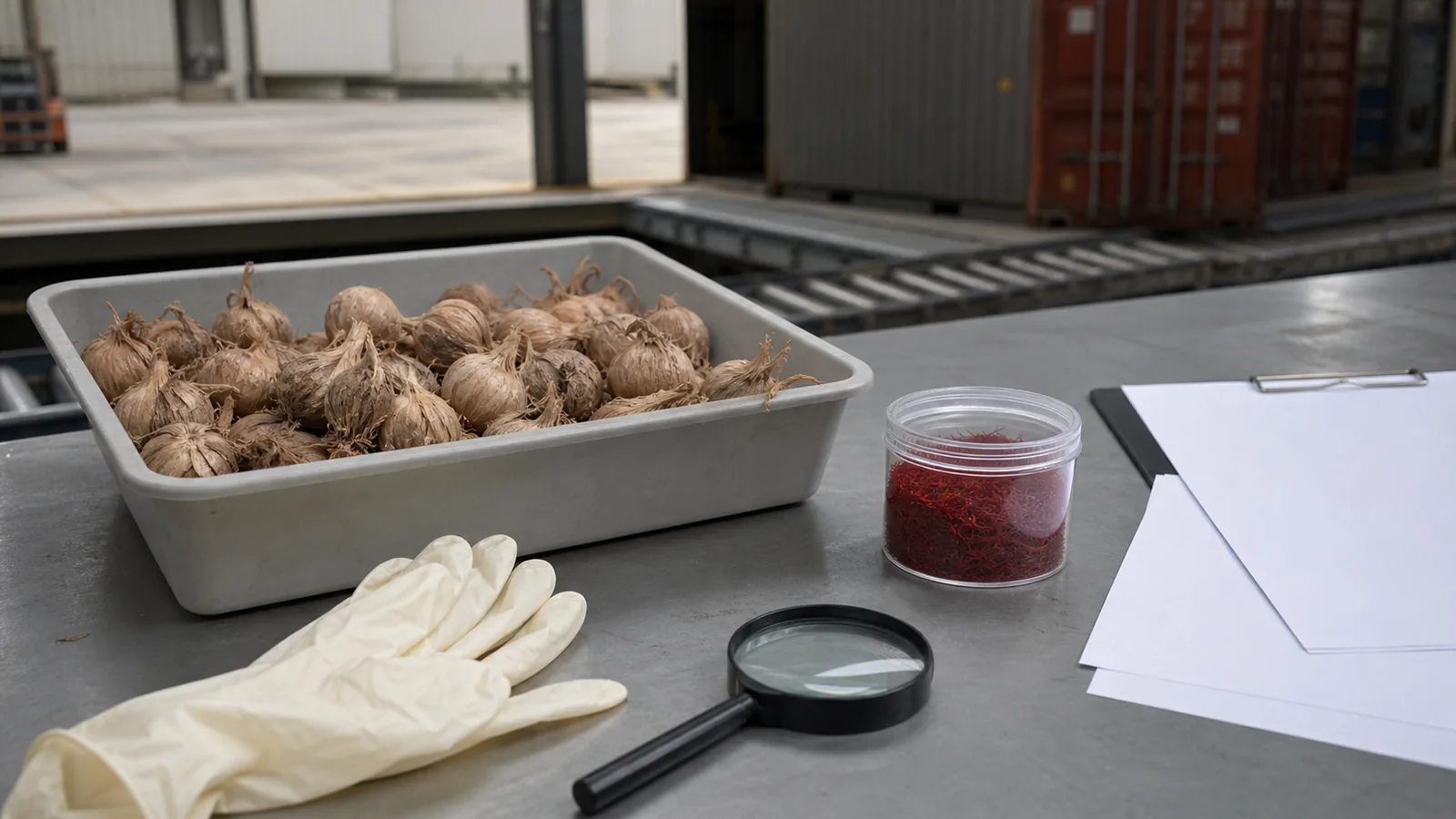
The Iranian saffron onion discussed in this 2017 report is the crop’s planting corm, not the dried spice sold for cooking. Officials said the unauthorised movement of saffron corms across Iran’s eastern border was being treated as smuggling and asked border and agricultural organisations to stop it.
That does not mean saffron itself is generally illegal. The legal issue in the article was the export of planting material under the rules in force in Iran at the time. Rules for carrying plants, corms or food across a border depend on the origin, destination, plant-health requirements and current law.
What officials reported in 2017
Seyyed Mohammad Kiyaei, identified as a director responsible for greenhouses, medicinal plants and mushrooms in Iran’s Ministry of Agricultural Jihad, described saffron corms as protected Iranian germplasm. His name appears with several spellings in the old English translation.
Kiyaei said the ministry was working with the Headquarters for Combating the Smuggling of Goods and Currency and with police. Because corms could leave through different routes—especially toward Afghanistan—agricultural organisations in South Khorasan and Razavi Khorasan were expected to help train eastern border guards to recognise them.
The inherited text rendered “germplasm” as zhorm plasm. Germplasm means living genetic resources used to reproduce a crop; it does not mean that saffron threads are a prohibited drug or hazardous substance.
Why corm movement raised concern
Cultivated saffron, Crocus sativus, is propagated through corms. Moving productive planting stock can help establish fields elsewhere. It can also move soil, pests or plant disease unless the material is inspected and accompanied by the documents required by the countries involved.
Kiyaei acknowledged that European countries, including the Netherlands, produced and exported saffron corms. His concern was specifically that corms used in Afghanistan might have originated in Iran and left without authorisation. The page does not provide shipment records or a measured share, so that remains a 2017 official allegation rather than proof about every Afghan planting.
Is saffron illegal?
Saffron spice is a lawful food ingredient in many countries. A border can nevertheless regulate the movement of live corms, agricultural soil, commercial food consignments or undeclared goods. A traveller may therefore be permitted to buy packaged saffron threads while being prohibited from carrying planting corms without a permit or phytosanitary certificate.
Do not use this historical article as customs advice. Before taking saffron corms across a border, check the current plant-import and export rules of both countries and obtain written guidance where necessary.
The tariff argument in the report
Kiyaei referred to import tariffs of 35–38% on Iranian saffron in China and India, compared with a zero rate for Afghan saffron. He alleged that this difference encouraged some people to move Iranian saffron unofficially into Afghanistan and then export it under an Afghan identity.
Those percentages are preserved because they shaped the argument in the 2017 article. They are not current tariff guidance, and the page does not include customs schedules or evidence tracing a particular consignment. Kiyaei said the ministry would discuss lower tariffs with relevant organisations because China and India were target markets.
Iran and Afghanistan production figures
The report also presented a less alarmed government view. Mohammad Ali Tahmasebi was quoted as saying Iran had about 95,000 hectares under saffron and expected 360 tonnes of production that year. He placed Afghanistan’s output at 3.5 tonnes and concluded that it was not then a comparable production rival.
These figures describe a forecast and comparison published in 2017. They should not be carried forward as today’s cultivated area or output without checking recent official statistics.
How legitimate corm trade should differ
- The botanical identity and source of the corms should be documented.
- The shipment should meet current export, import and phytosanitary requirements.
- Corms should be traceable to a grower or supplier and inspected for visible damage or disease.
- Weights, lot numbers, treatment and storage conditions should be recorded.
- The declared destination and use should match the permit and commercial documents.
Legal, inspected trade and covert movement are not the same activity. The fact that saffron corms are commercially produced in several countries does not settle whether a particular shipment was permitted.
The lasting lesson
The 2017 dispute combined crop genetics, plant health, export competition and tariff policy. Its strongest practical lesson is traceability: planting material should have a known source and cross borders through the proper agricultural controls.
For customers buying saffron to cook with, a sealed, labelled thread product is a different category from live corms. For growers, current permits and plant-health advice should be checked before any international order is paid for or shipped.

![Exporting Saffron to Turkey + Price Guide [Complete 0 to 100]](https://img.rowhanisaffron.com/20260827003933/saffron-export-turkey-quality-inspection.webp)



