


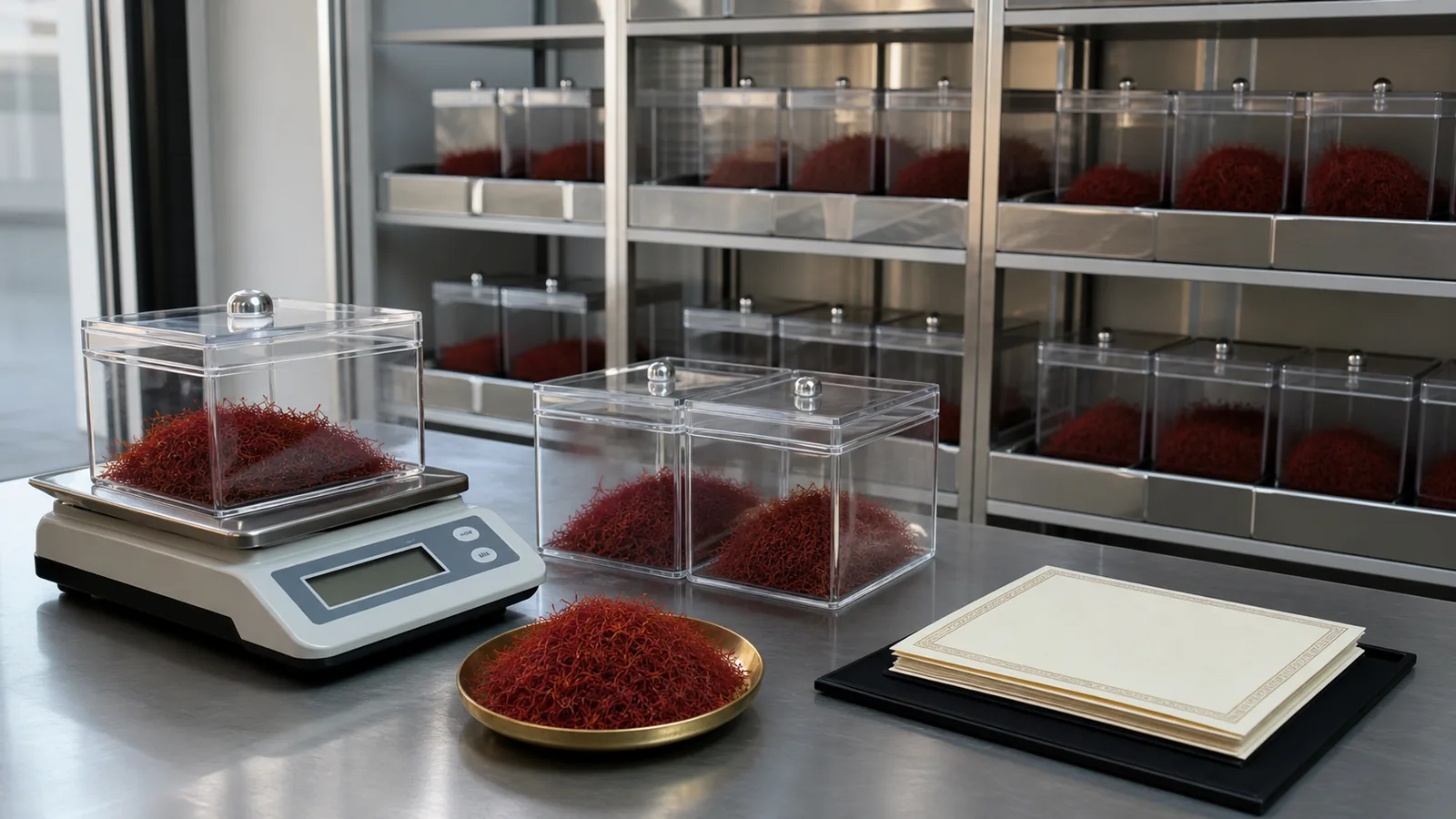
The Iranian Saffron Bank described in this historical report was a physical saffron depository in Torbat Heydarieh, not a retail bank for cash accounts. Growers or owners could deposit graded saffron, receive a certificate recording the stored quantity, transfer that certificate, and later request the corresponding product.
This explains the core search question: a saffron bank stores and documents spice inventory. The report used banking language because saffron was deposited and withdrawn, but the asset in the account was saffron rather than ordinary money.
What the original announcement said
The page, published in 2017, cited a China Radio International report about a launch announced on Sunday, 22 January. The stored English text does not attach a year to that January date, so this page does not infer one.
Gholamreza Karimi, identified as director of the Saffron Bank, said reserves were expected to reach 10 tonnes and could later grow to 20 tonnes. Depositors would present saffron for grading and receive a “certificate of deposit” recognised by the bank. The spice would be held at low temperature.
The source also said a certificate could be sold to another person. A holder with the required certificate could ask for saffron in the amount represented by the deposit. It did not publish the bank’s complete rules, fees, insurance terms or quality specifications.
How a saffron deposit could work
- Delivery: a grower, merchant or other owner brings a documented lot to the facility.
- Inspection: the warehouse identifies the grade, checks the weight and decides whether the lot meets its acceptance rules.
- Storage: accepted saffron is sealed, recorded and kept under controlled conditions.
- Certificate: the depositor receives a document linked to a stated quantity and grade.
- Transfer or withdrawal: subject to the applicable rules, the certificate may change hands or be presented to collect the represented saffron.
The 2017 article outlines those functions but does not establish that every certificate was freely tradable on an exchange. A warehouse receipt, an exchange-traded instrument and a private storage receipt may have different legal effects.
Why grade recognition matters
A useful certificate must describe more than weight. Saffron lots differ in thread composition, moisture, cleanliness, aroma, colour strength and physical condition. If two deposits are to support comparable documents, the grading method and sampling procedure need to be consistent.
Traceability also matters. Records should connect the certificate to a physical lot, owner, intake date, storage location and any test result. Without that chain, a buyer cannot know what the document actually represents.
Why saffron needs careful storage
Dried saffron should be protected from moisture, heat, light, strong odours and contamination. A low-temperature room may help control deterioration, but temperature alone is not enough. Packaging integrity, humidity, hygiene, pest control and stock rotation all influence quality.
The report did not state the storage temperature or humidity, so those details cannot be reconstructed from the announcement. “Low temperature” should be read as a description, not a complete preservation protocol.
Was the bank intended to influence the market?
Centralised storage can reduce repeated handling and give owners a documented inventory position. In principle, it may also help buyers compare graded lots and let producers choose when to sell rather than moving every batch immediately after harvest.
It cannot by itself guarantee a price, buyer or profit. Storage costs, quality changes, contract enforceability, market demand and the institution’s governance still affect the value of a certificate.
The production claim in context
The old report said Iran produced more than 90% of the world’s saffron and exported to over 50 countries. Those figures are part of its explanation for locating a specialised depository in a major production centre. They are historical claims, not current statistics, and should be checked against recent official data before reuse.
Torbat Heydarieh was described as a saffron centre in the country’s northeast. The machine translation called it “in the north,” but the city is in Razavi Khorasan in northeastern Iran.
What this page is not about
This Iranian Saffron Bank is not the same as a conventional financial bank, and it is unrelated to businesses or photographs sought under phrases such as “Saffron Red Bank.” It also does not answer the broader question “what is saffron” in full: saffron is the dried red stigma of Crocus sativus, and the bank’s role was to store that spice as a documented commodity.
Anyone evaluating a saffron depository today should obtain its current licence, operating rules, approved grades, custody safeguards, insurance, charges and redemption procedure. The 2017 announcement explains the concept, not the present status of a facility.

![Exporting Saffron to Turkey + Price Guide [Complete 0 to 100]](https://img.rowhanisaffron.com/20260827003933/saffron-export-turkey-quality-inspection.webp)



