


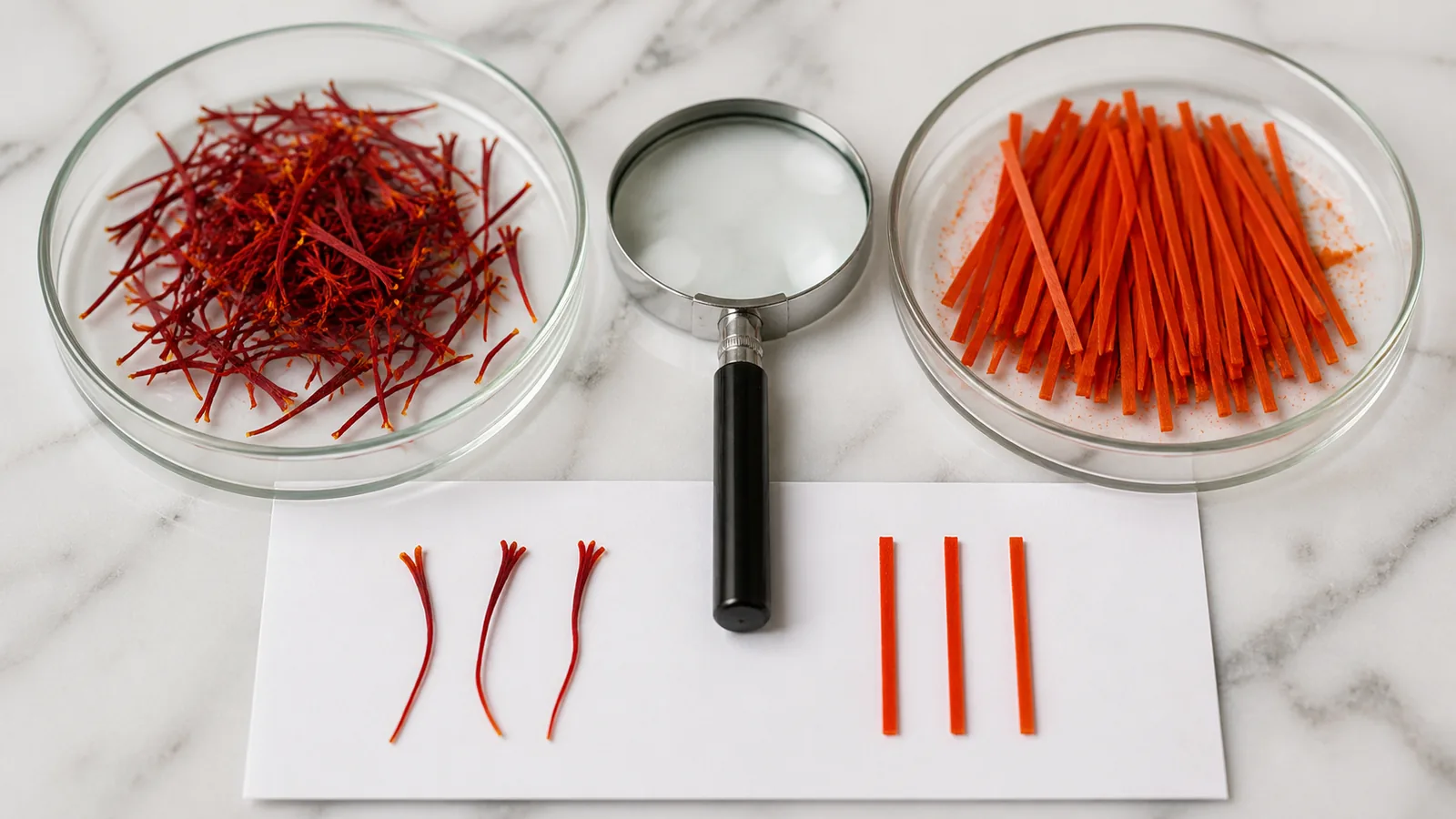
You can sometimes spot fake saffron with your eyes, but appearance alone cannot prove authenticity. Whole threads reveal clues that powder hides: genuine saffron has a recognisable stigma shape, natural variation and no uniform coating. A careful visual check can reject an obvious imitation; a sophisticated adulterant may still require laboratory analysis.
That was also the central point of a 2017 interview with Gholamreza Miri of Iran’s National Saffron Council. He warned that some substituted plant material could resemble saffron closely enough to mislead even experienced observers.
What the 2017 report alleged
The article said dishonest sellers sometimes coloured pale saffron style or other plant material with chemicals, then mixed or sold it as higher-value red saffron. Miri also referred to saffron-like material imported from India and Pakistan whose botanical identity was unclear in the translated report.
The page’s old subheading claimed that half the saffron on the market was counterfeit. The body of the interview, however, said only “a few percent” was non-standard or unhygienic. Those statements conflict, and the article provides no survey or sampling method to verify either figure. Neither percentage should be treated as a current prevalence estimate.
Visual features of genuine saffron threads
A saffron thread is the dried stigma of Crocus sativus. The red portion commonly widens toward one end, rather than looking like a perfectly cylindrical fibre cut from the same material throughout. In a real batch, thread length and curvature vary naturally.
Colour should be deep red to red-orange, with differences caused by grade and the amount of pale style retained. A pile in which every strand has exactly the same width, length and surface colour deserves closer attention. So do flat petals, wood-like splinters, plastic-looking fibres or obvious coloured dust collecting at the bottom.
These are warning signs, not a certification method. Genuine threads can break during handling, and a skilled imitator can cut or dye another material to mimic familiar shapes.
Why the water test is limited
When saffron is placed in warm water, colour and aroma move into the liquid over time. A dye that makes the water change immediately and leaves a pale strand can be suspicious. Yet speed varies with water temperature, thread size, grinding and the quantity used.
Some adulterants are designed to release colour gradually, while genuine powdered saffron colours water more quickly than intact threads. A home test can raise a question; it cannot identify a chemical or calculate purity.
Smell and taste are supporting clues
Genuine saffron has a complex dry aroma that people variously describe as hay-like, honeyed, earthy or slightly metallic. It should not smell like perfume, sweet flavouring or one sharp synthetic fragrance. Added essence can imitate part of the aroma, especially for someone who has not handled a known sample.
Do not taste an unknown loose powder merely to test it. If a product may contain an unapproved colour or unidentified plant material, swallowing it is not a sensible authentication method.
Packaging and traceability matter
Miri contrasted licensed facilities, where product could be sampled and violations traced, with informal sellers that had no identifiable address or permit. He said Iran had about 53 saffron standard marks at the time, many in Mashhad, and argued that a recognised standard mark could matter even when the producer was not a famous brand.
For a modern purchase, look for a sealed pack with the producer, net weight, batch or lot, origin and the applicable local food-business details. Keep the receipt. A logo by itself can be copied, so confirm unfamiliar licences through the authority that issued them where a public register exists.
What a laboratory can establish
Laboratory methods can examine whether a sample contains saffron’s characteristic compounds and whether undeclared dyes or other plant material are present. The appropriate method depends on the suspected adulteration and the regulatory question.
The US Food and Drug Administration describes adding cheaper plant material to saffron as a form of economically motivated adulteration. That guidance also shows why substitution is more than a cosmetic quality problem: the buyer receives something different from the food named on the label.
A practical buying check
- Prefer whole threads when visual inspection matters.
- Compare them with a known authentic sample under good neutral light.
- Check traceable packaging, lot information and the seller’s address.
- Treat an implausibly low price as a reason to investigate, not proof of fraud.
- Do not rely on one home test or a photograph from the internet.
- For a valuable or commercial lot, request appropriate independent testing.
So, can you spot fake saffron by eye? Sometimes. The safest conclusion is narrower: your eyes can identify reasons not to buy, but they cannot certify a convincing sample as genuine.

![Exporting Saffron to Turkey + Price Guide [Complete 0 to 100]](https://img.rowhanisaffron.com/20260827003933/saffron-export-turkey-quality-inspection.webp)



