


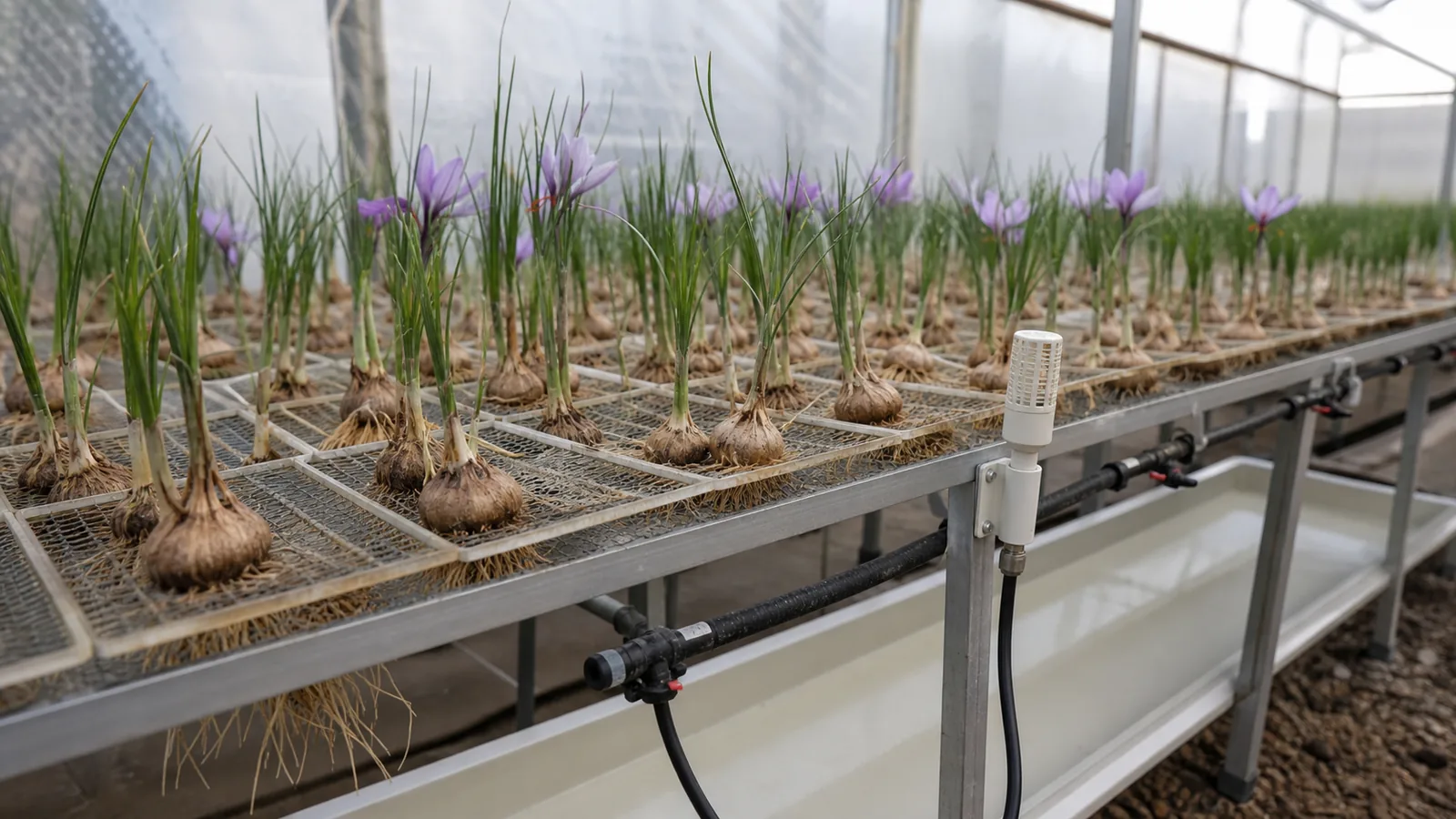
Planting saffron without soil in Iran was presented in this 2017 report as an experimental greenhouse project in Bardaskan, Khorasan Razavi. Two young growers placed saffron corms in a controlled 10-square-metre space rather than a conventional field. The project used 70kg of planting corms and was intended to test whether protected, soilless production could reduce pressure on limited water resources.
“Without soil” does not mean without water, roots or crop management. It can describe several systems, from dry indoor flower forcing to aeroponic or hydroponic root support. The original report did not provide enough technical detail to identify the exact system or reproduce it safely at commercial scale.
The Bardaskan greenhouse trial
The report named Ali Abbas Nia and Mohsen Khorshahi as the growers. It said they developed the trial after gathering information and consulting an engineer named Sadeghi, described in the translated text as “the father of saffron of Iran.”
Hossein Mohammadi, identified as a local agricultural authority, described the work as a first experimental project in the country. The initial area was 10 square metres, stocked with 70kg of saffron corms. Abbas Nia said the crop had progressed after two months, although the inherited report ends that sentence before giving a measured result.
These names and figures belong to the 2017 account. The article did not include a research protocol, harvest weight, control plot or laboratory report.
How saffron can flower without field soil
A saffron corm stores energy accumulated during its previous growth cycle. Under suitable temperature and humidity, a mature corm can produce a flower before a new season of leaf and root growth is complete. Indoor systems use that biology to manage flowering in trays, racks or other supports.
The flowers still need to be harvested quickly and their stigmas separated and dried correctly. If the system is intended to keep corms for another cycle, the plant also needs an appropriate root environment, moisture, nutrition, light and disease control so it can rebuild reserves. Simply placing corms on a shelf is not a complete multi-year cultivation method.
What the project claimed
The translated report attributed three strong claims to Mohammadi: reduced water demand, output equivalent to five times ordinary field yield per hectare, and a product price three times higher than ordinary saffron.
Those claims are preserved as statements from the report, not presented as proven performance. A 10-square-metre trial cannot establish per-hectare economics without comparable planting density, corm size, flower count, dry-saffron yield, energy use, labour, equipment depreciation and the fate of the corms after forcing.
A higher sale price would also require a buyer to recognise a meaningful difference in quality or timing. Growing without soil does not automatically make the dried spice three times more valuable.
Water savings need a complete calculation
A controlled system may deliver water more precisely than open-field irrigation, but the useful comparison is total resource use per gram of marketable saffron. It should include cleaning, humidification, nutrient solution where used, cooling or heating, and any water needed when corms return to a growing medium.
Energy matters too. Fans, pumps, lighting and climate control can shift part of the environmental cost from water to electricity. A strong trial records both rather than reporting only the absence of field irrigation.
Questions to answer before expanding
- Which corm sizes and health standards were used?
- Was the system dry forcing, aeroponic, hydroponic or a combination?
- What temperature, humidity, airflow and light schedule controlled flowering?
- How many flowers and grams of dry saffron came from the 70kg of corms?
- How did quality compare with a field-grown control?
- What happened to the corms after harvest, and could they flower again?
- What were the labour, equipment, energy and disease-loss costs?
The proposed expansion
Abbas Nia asked agricultural experts for technical support and said he wanted to expand the project the following year. The machine-translated area appears as “two octopus,” which is not a valid land unit. It may have meant two hectares, but the source available on this page cannot confirm that reading.
The historical experiment is still useful as a starting idea: controlled saffron flowering may help growers test timing, labour organisation and resource use. It is not, by itself, a finished business case. Anyone planning a modern system should begin with a small measured trial, local horticultural advice and a clear comparison against field production.

![Exporting Saffron to Turkey + Price Guide [Complete 0 to 100]](https://img.rowhanisaffron.com/20260827003933/saffron-export-turkey-quality-inspection.webp)



