


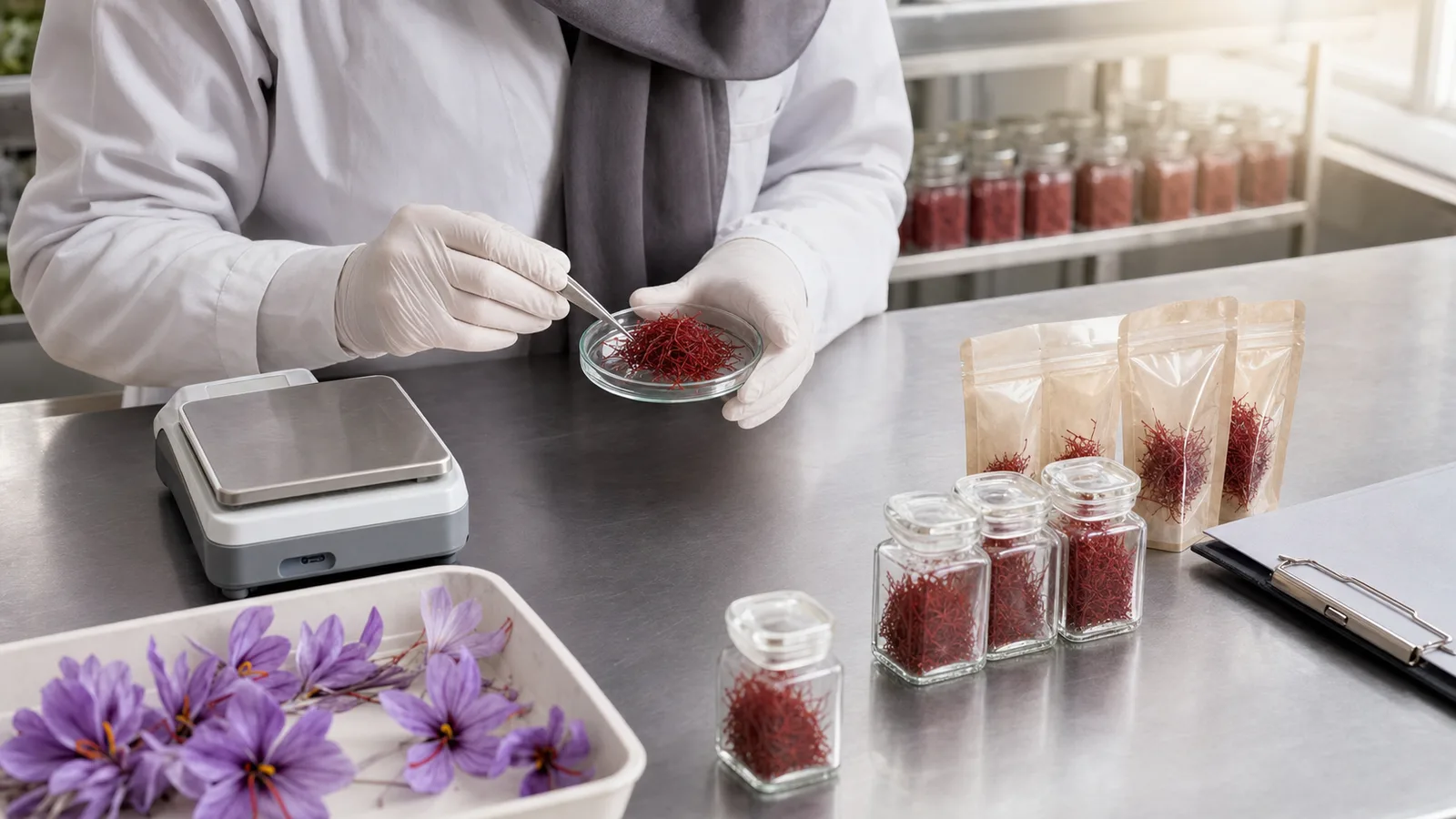
Requirements for improving saffron status in Iran extend well beyond producing more spice. A stronger position depends on protecting quality after harvest, documenting each lot, packaging for the buyer, financing the gap between purchasing and export, and developing products that have a real market and a defensible evidence base.
Those themes came from a 2017 interview with Hamid Reza Mahalati, identified in the original report as managing director of Saffron Hamid 110. His comments described the obstacles seen by one business at that time. They remain useful as a value-chain checklist, but the quantities and market shares he quoted should not be mistaken for current national statistics.
The first requirement: move beyond anonymous bulk sales
Bulk saffron is not inherently poor saffron. The problem is that an unbranded shipment gives the producer less control over the identity, presentation and final retail value of the product. Once another business grades, packs and sells it under a different name, origin becomes harder for the customer to see.
Mahalati argued that Iranian exporters needed packaging adapted to buyers in Europe and Arab markets. His company had introduced two designs during the preceding year and planned another five or six before year-end. That was a company plan from 2017, not a description of the current range.
Good packaging now has to do more than look attractive. It should protect saffron from moisture, light, crushing and foreign odours; carry an accurate net weight and lot identity; provide storage and origin information; and meet the legal labelling requirements of the destination market. Design begins after those functions are settled, not before.
Quality must survive picking, separation and drying
The interview attributed a very large gap between flowers produced and dried saffron reaching the market to inadequate handling and storage. It quoted roughly 500 tonnes produced, about 360 tonnes harvested and 120–140 tonnes lost. No methodology or official dataset accompanied those figures, so they cannot establish the actual national loss for that year.
The underlying problem is real: quality can be lost at several points. Flowers left too long before stigma separation may deteriorate. Drying that is too slow, too hot or inconsistent can change aroma and colour. Damp storage encourages degradation, while rough handling creates fragments that may be graded differently.
Research on drying conditions and saffron volatile compounds shows why post-harvest control matters. A reliable operation records harvest time, separation time, drying method, final moisture, lot weight and storage conditions. That evidence is more useful than estimating one unexplained national loss percentage.
Standards and traceability turn origin into evidence
An Iranian name on a box does not prove the origin or quality of its contents. Exporters need a chain of records connecting corm-growing area, harvest lot, processing location, laboratory result, pack and shipment. Buyers should be able to trace a complaint or test result back to a defined lot.
The current ISO 3632-1:2025 specification for dried saffron sets product requirements, while analytical testing can assess characteristics such as colouring strength and detect some forms of adulteration. Certification and test reports need a verifiable scope, date, sample and laboratory; a standard number used as marketing decoration is not traceability.
A 2012 study of barriers to Iran’s saffron export also identified that competitiveness is a system problem rather than a single packaging problem. Consistent quality, market intelligence, coordination and distribution matter together.
Export finance connects farmers to reliable buyers
Mahalati described a cash-flow gap: an exporter may have to pay growers before the foreign buyer pays for the shipment. He used a Spanish requirement of about 200 kilograms per month as an example. Because the interview did not publish the customer, period or contract, that number should be treated as one 2017 commercial statement rather than Spain’s current monthly demand.
The finance problem is broader. A credible exporter needs working capital for purchasing, testing, packaging, insurance, documentation and transport. Financing should reward traceable procurement and confirmed orders, not simply encourage stockpiling.
The interview also proposed closer cooperation between experienced trading companies and farmers, plus access to unused government land through leases or partnerships. Land support only works if soil, water, corm health, labour and route-to-market are assessed first. Expanding hectares without a buyer or quality plan can increase risk rather than improve Iran’s saffron status.
Saffron uses less water than some crops—but not no water
The old article described saffron as one of Iran’s least water-intensive crops and said it needed irrigation only two or three times a year. The number of irrigations varies with rainfall, soil, climate, planting system and crop stage. It should not be copied as a universal schedule.
Saffron can be attractive in water-constrained areas, but the comparison must be local. Growers still need water of acceptable quality at the correct times, and they need drainage that protects the corms. A low annual water requirement cannot compensate for saline water, waterlogging or a missed establishment irrigation.
Historic production-share claims need dates
Mahalati placed Iran’s share of world saffron production near 97%, with the remainder spread among Spain, Mexico, the Netherlands and the Kashmir region of India and Pakistan. Iran has long been the dominant producer, but the precise share changes with crop year, source and whether a dataset measures production, exports or re-exports.
Those categories should not be mixed. A country can be a significant packer or exporter without growing the same volume domestically. Current market claims should therefore name the data source, commodity code, period and measure instead of repeating the 97% figure indefinitely.
The same caution applies to the interview’s observation that some saffron left Iran in passenger luggage and did not appear in formal customs figures. Informal movement may make official export totals incomplete, but no amount was documented in the article.
Value-added products need a product case, not a trend claim
Saffron Hamid 110 reported work on nano-sized saffron powder, a saffron-infused distillate and multivitamin supplements. The interview linked this programme to consumer interest in herbal products and noted that saffron tablets were already sold.
Each proposal raises different questions. A finer powder needs controls for particle size, oxidation, contamination and dose uniformity. A water-based drink needs food-safety, shelf-life and sensory testing. A supplement needs lawful claims, defined ingredients, dose evidence and interaction warnings. “Nano” or “herbal” does not make a product more effective or safer.
Some small human trials and reviews have reported effects of standardised saffron preparations on depressive symptoms. A systematic map of saffron clinical evidence also shows how varied the products, populations and study quality are. This does not prove that ordinary saffron consumption prevents severe depression, and no food or supplement should be marketed as a replacement for mental-health care.
Government support should solve measurable bottlenecks
The interview called for material and policy support. Effective support would be tied to outcomes that strengthen the whole chain:
- clean planting material and field-level extension;
- fast, hygienic flower handling and controlled drying;
- accredited lot testing and interoperable traceability records;
- working capital linked to documented purchases and orders;
- destination-specific labelling and regulatory advice;
- market research before product development;
- enforcement against adulteration and false origin claims.
Subsidising a package design while leaving drying inconsistent will not build trust. Financing extra production without confirmed demand may depress farm prices. Policy works best when it removes a verified bottleneck and measures the result.
A global Iranian saffron brand is built lot by lot
Mahalati believed specialised processing, international relationships and lower production and export costs could strengthen Iran’s global brand. He also cited lower Chinese production costs as competitive pressure. That comparison was not supported by a cost study in the source and should not be repeated as a current fact.
Cost matters, but the durable advantage is confidence. A buyer who receives the specified grade, from the stated origin, with consistent documents and delivery is more likely to return. Packaging makes that promise visible; post-harvest control and traceability make it true.
Improving Iran’s saffron status therefore means treating production, quality, finance, product design and export service as one chain. More cultivation can help only when the spice survives that chain with its value—and its Iranian origin—intact.
Historical interview source: Donya-e-Eqtesad, as cited in the original 2017 post.

![Exporting Saffron to Turkey + Price Guide [Complete 0 to 100]](https://img.rowhanisaffron.com/20260827003933/saffron-export-turkey-quality-inspection.webp)



