Activating saffron means infusing lightly crushed threads in a small amount of liquid before they enter a recipe. The best liquid is usually the one the dish already contains: water for flexibility, milk for creamy foods, and stock for savoury cooking.
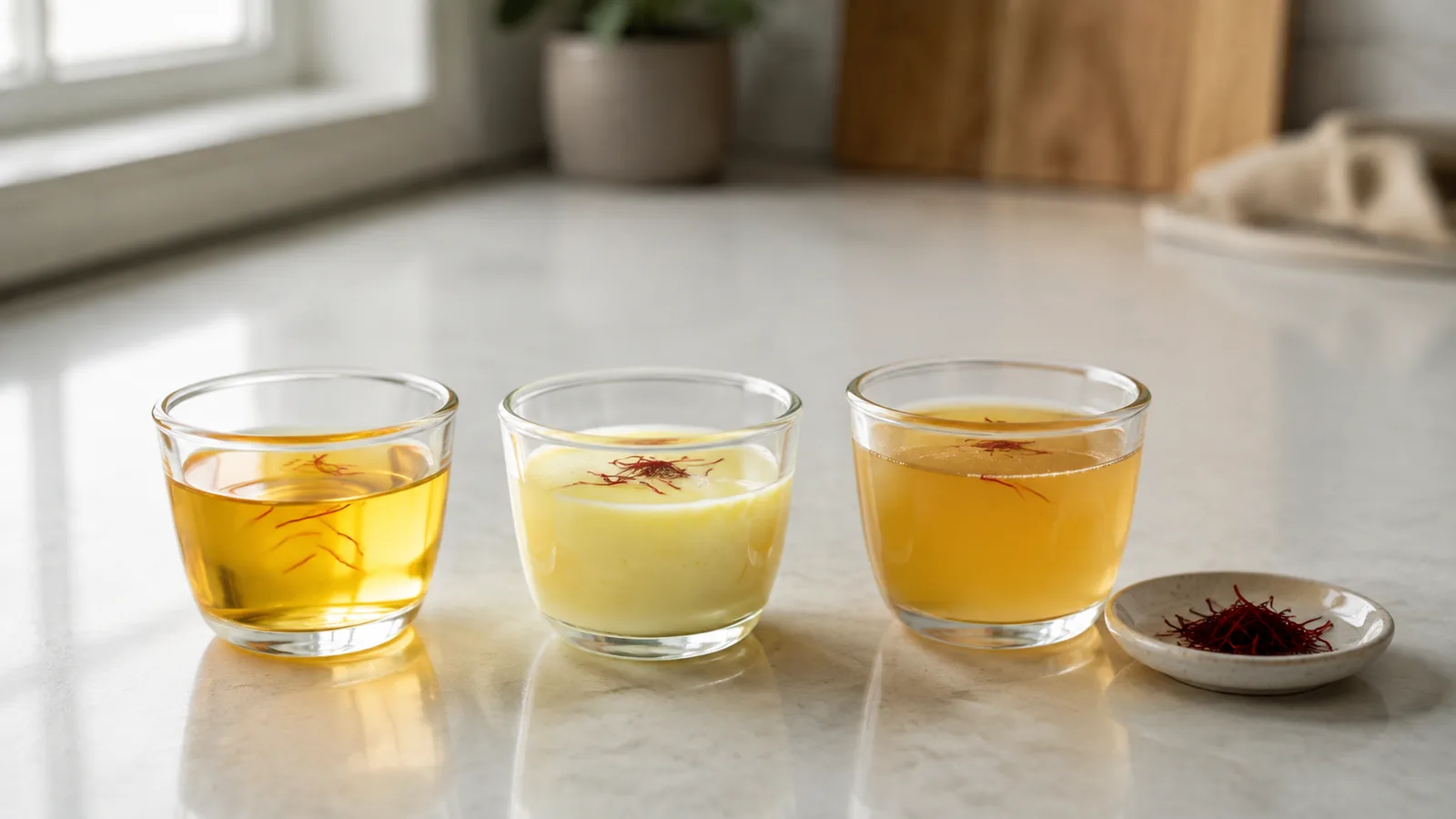
Choose the activation method from the finished dish
There is no need to bloom saffron the same way for every recipe. The purpose is to spread its colour, bitterness and aroma without adding a liquid or flavour that works against the food. Begin with the final texture and choose backwards.
If you need the basic crushing, steeping and timing sequence, follow the step-by-step guide to activating saffron for cooking. This page focuses on choosing and controlling the infusion.
Use water when you want a neutral carrier
Warm water is the safest default because it brings no salt, fat, dairy or sweetness. It suits rice, bread dough, tea, clear soup and any dish where the other ingredients are still being decided. Use only enough to cover the crushed threads—often two or three tablespoons for a home recipe.
A water infusion is also easy to split. You can add most of it to the cooking liquid and reserve a teaspoon for a coloured garnish or a separate portion of rice.
Use milk for a creamy recipe
Warm milk belongs naturally in custard, kheer, rice pudding, ice cream base, saffron milk and some mild sauces. Infusing directly in a small portion prevents you from warming the whole recipe just to bloom the spice.
Milk can soften the impression of bitterness, but it also changes the dish. Do not choose it simply because it looks rich. Water may be better in a dairy-free dessert or when the final recipe already has a carefully balanced liquid ratio. The fuller comparison of saffron in milk or water covers that choice.
Use stock when dilution matters
For risotto, paella, soup, stew or sauce, take a few tablespoons of the recipe’s own warm stock. This keeps the liquid balance intact and gives the infusion a direct route into the food.
Choose a stock that leaves room for saffron. Heavy smoke, concentrated roasting flavours and too much salt can make the aroma difficult to notice. If the main sauce is very strong, flavour the accompanying rice or a lighter broth instead.
What about a cold or ice infusion?
Saffron also releases colour in cool liquid, but the process is slower. An ice method can be convenient when you are preparing ahead, yet it is not automatically stronger or more authentic than a warm infusion. Keep the container covered and do not leave milk or stock at room temperature while waiting.
For most everyday cooking, 15 minutes in warm liquid is simpler. If you compare warm and cold methods, keep the saffron amount, liquid volume and steeping vessel the same so the test tells you something useful.
Control concentration before adding volume
An activation liquid should be concentrated enough to smell and taste, but not so concentrated that one sip or spoonful becomes harsh. Too much water can disappear into a large recipe before you judge the infusion; too little may leave some crushed threads dry.
Use a small clear cup so you can see whether all the saffron is wet. Cover it to limit aroma loss, wait at least 15 minutes, then stir and smell before adding it. If the recipe can accept more liquid later, it is easier to dilute a concentrated infusion than to retrieve an overly watery one.
Match the infusion timing to the cooking method
For steamed rice, the infusion may enter with the cooking water or colour a reserved portion near the end. In a soup or stew, add it with enough time to distribute but avoid hours of hard boiling. In custard or ice cream, mix it into the liquid base before thickening or freezing.
The guide on hot water and saffron explains why brief heat and prolonged boiling are different questions.
Judge more than colour
A useful infusion develops a yellow-to-golden hue and a recognizable aroma. Colour can appear before the flavour feels balanced, so a brilliantly yellow liquid is not proof that you used the right amount.
Scientific sensory work separates saffron’s aroma, flavour, bitterness, astringency and pungency rather than treating them as one quality. A trained-panel study of saffron samples also found meaningful variation between samples. Adjust a new batch by tasting the dish, not by copying the shade from a photograph.
Activation does not prove authenticity
Watching threads colour water can reveal an obvious dye problem, but it cannot certify a sample. Other plant material can be coloured, and a genuine but old sample may produce a weak result. Keep inspection and recipe preparation as separate decisions.
If the sample itself is uncertain, use the evidence-based guide to real versus fake saffron before cooking. Laboratory methods and traceability carry more weight than a dramatic water-test video.
Keep a repeatable kitchen note
When consistency matters, record the saffron weight or approximate thread count, liquid type, liquid volume, steep time and recipe yield. Those details make the next batch easier to adjust. “One pinch” is difficult to reproduce between cooks.
Change one variable at a time. If the flavour was faint, do not simultaneously double the saffron, reduce the liquid and extend the steep. A simple note helps you learn whether the difference came from the batch or the method.
A quick decision guide
- Choose warm water for a neutral, flexible infusion.
- Choose warm milk for a dish that is already creamy.
- Choose warm stock for savoury food where extra water would dilute flavour.
- Use a cool infusion only when you can give it more time and handle perishable liquids safely.
- Keep the volume small, cover it, and add both liquid and softened threads.
Activating saffron should make the recipe easier to control, not more complicated. Choose the liquid from the dish, measure it, and compare the result with your own previous batch. If you need intact threads, review the current Sargol saffron pack details.