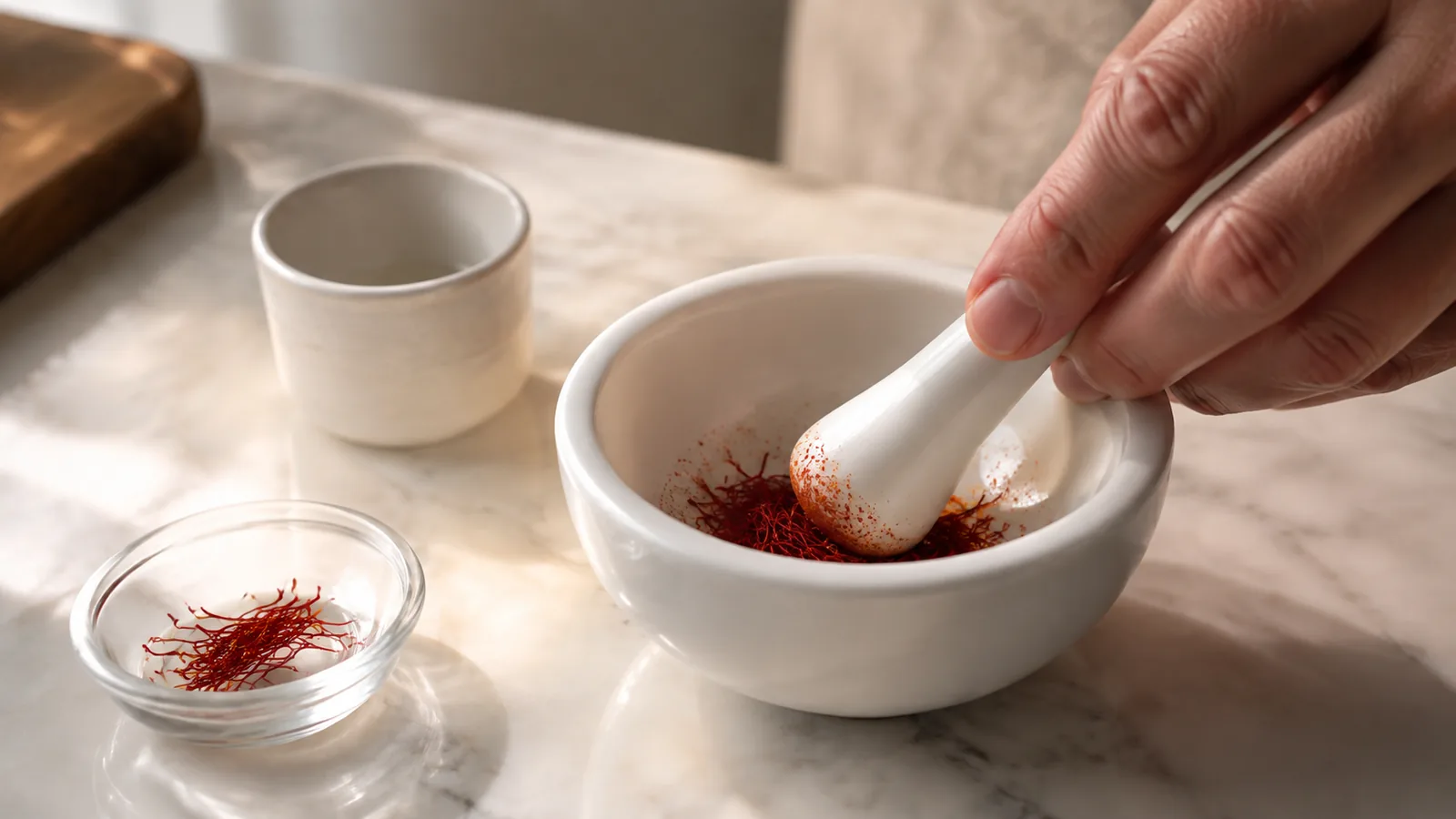
The best fertilizers for saffron are the ones that correct a measured need without creating a new problem. There is no single bag, NPK ratio or organic product that suits every field. Start with soil condition, nutrient history, irrigation water and crop stage; then choose the smallest programme that supplies what is missing.
Saffron is a perennial corm crop. The fertilizer applied this season can affect leaf growth, daughter-corm development, next year’s flowering and the salt balance around the corms. That makes careful testing more valuable than a long shopping list.
Start with a soil test, not a product name
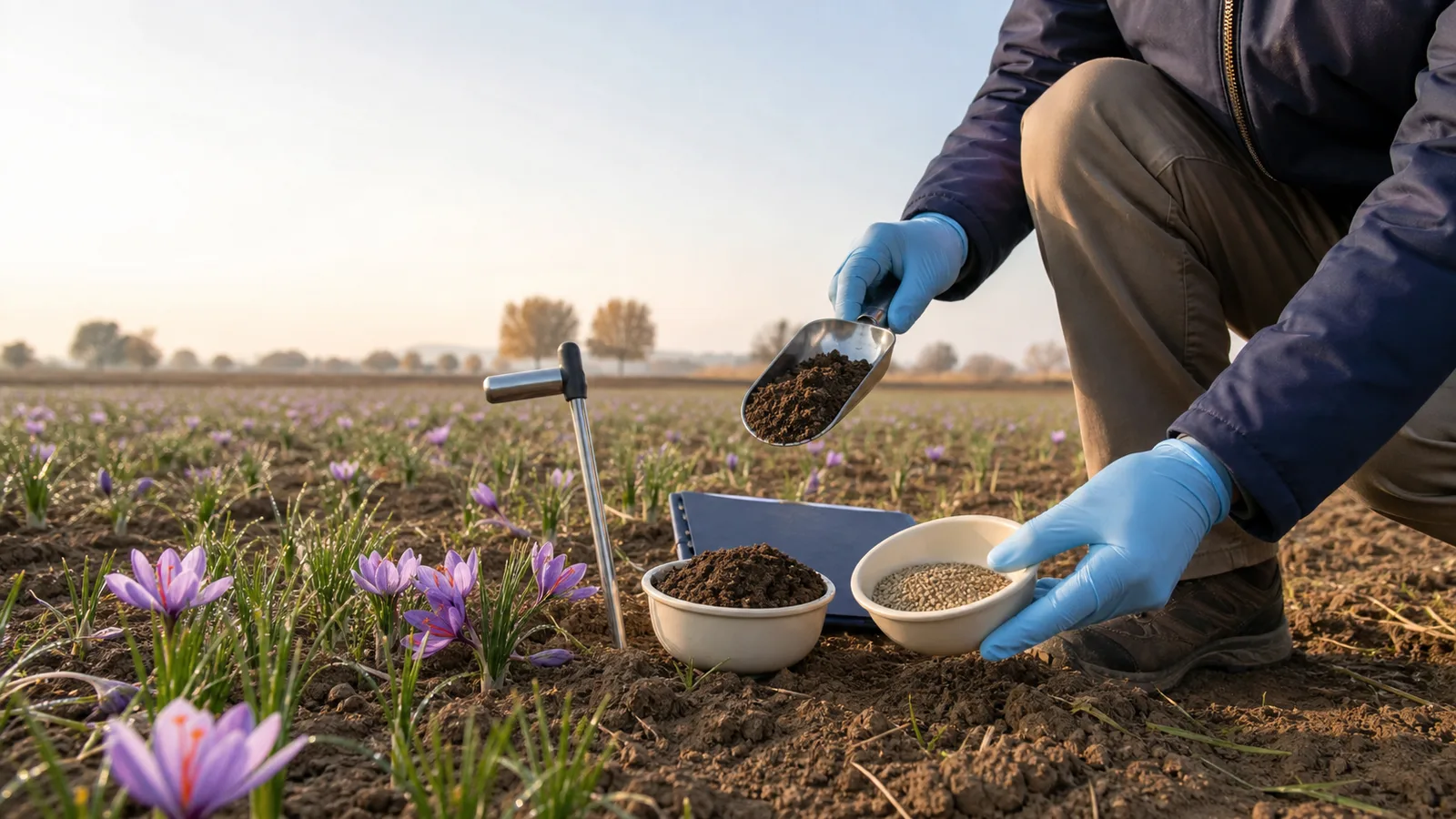
A useful soil analysis should cover pH, electrical conductivity or soluble salts, organic matter, phosphorus and potassium, with nitrogen and micronutrient advice interpreted for local conditions. Test the irrigation water too if it is saline or alkaline. Saffron is often grown in dry regions where salts accumulate, and both manure and mineral fertilizers add ions to the root zone.
Take samples from the depth where the corms and active roots sit. Keep visibly weak patches separate from healthy parts of the field so the result does not average away the problem. If leaves show unusual colour or growth, tissue testing can help distinguish a shortage from disease, wet soil, salinity or natural senescence.
A result showing adequate phosphorus is a reason not to add triple superphosphate. High potassium is a reason not to apply sulfate of potash simply because it appears in a saffron schedule. The best saffron fertilizer plan is specific enough to leave unnecessary nutrients out.
What the main nutrients do
Nitrogen
Nitrogen supports green leaf growth and the photosynthesis that helps build daughter corms. Too little can limit the crop, but more is not automatically better. A saffron field study comparing animal manure and mineral fertilizer found that nitrogen alone increased leaf area without producing the highest spice yield. Excess or poorly timed nitrogen can favour foliage, raise salt load and increase loss to water or the environment.
Set nitrogen from the soil’s supply, organic-matter mineralisation, previous manure and local field evidence. Split applications may be easier to manage than a large dose, but the right timing and rate depend on climate and irrigation.
Phosphorus
Phosphorus is involved in energy transfer, root activity and plant development. It is relatively immobile in soil, so a confirmed deficiency is usually easier to correct during bed preparation than after a perennial stand is established. Existing soil phosphorus, pH and placement all change how much the crop can use.
Do not treat phosphorus as a guaranteed source of cold resistance. A plant with adequate nutrition is better placed to grow normally, but fertilizer cannot insulate corms from unsuitable depth, standing water or extreme weather.
Potassium
Potassium contributes to water regulation, enzyme activity and plant tissue function. Sulfate of potash is a common potassium source where chloride is undesirable, but it is still a salt-containing fertilizer. Apply it because the test and recommendation call for potassium, not because every saffron crop is assumed to need it.
Sulfur
Sulfur is an essential nutrient, and elemental sulfur can lower pH in some non-calcareous soils as soil organisms oxidise it. It does not simply “remove salinity.” Utah State University’s salinity guidance explains that salts have to be moved out of the root zone by suitable water and drainage; chemical salt-neutralising products are not a substitute. In lime-rich soils, large sulfur additions may be ineffective or create other salt problems.
Organic fertilizers for saffron
Composted manure
Well-processed manure can add organic matter and nutrients and improve the physical condition of some soils. Saffron trials have reported benefits from manure alone or integrated with mineral and biological inputs. A three-season arid-climate experiment found positive responses, but the tested rate and combinations belonged to that soil and production system, not to every farm. The study also found that some integrated treatments increased weed biomass, a reminder that every input has trade-offs.
“Aged for 18–36 months” is not a reliable quality specification by itself. Ask how the material was composted and obtain its nutrient, moisture, salt and maturity analysis. It should be stable, free of obvious contaminants and handled under local food-safety rules. The University of Minnesota warns that repeated or excessive manure compost can build phosphorus, potassium, sodium and soluble salts; its first recommendation is to test the soil.
Compost and other organic amendments
Plant-based compost may improve structure with less salt than some manure composts, but the analysis still matters. Organic does not mean nutrient-free, weed-free or suitable at any rate. Incorporate amendments before planting where possible, instead of burying fresh material against established corms.
Mineral and granular fertilizers
Granular products deliver a known analysis and can correct a defined shortage. Common names in saffron programmes include sulfate of potash, triple superphosphate and bentonite-based elemental sulfur. None is a complete plan:
- Sulfate of potash supplies potassium and sulfur; skip or reduce it when soil potassium is already adequate.
- Triple superphosphate is a concentrated phosphate source; use placement and rate guidance from a soil test.
- Bentonite sulfur contains elemental sulfur that must oxidise over time. A “75% or higher” analysis tells you concentration, not whether the soil needs acidification or sulfur.
Keep concentrated fertilizer away from direct contact with corms. Moisture moving through a band of salts can injure roots, especially in dry soil. Calibrate spreaders and record the actual nutrient rate, not only the product weight.
Balanced NPK fertilizers: 20-20-20 and 5-10-10
A 20-20-20 fertilizer contains equal labelled proportions of nitrogen, phosphate and potash. It is convenient, but “balanced” describes the bag, not the soil. A field that needs nitrogen but already contains abundant phosphorus does not become balanced by receiving all three equally.
The same applies to a low-nitrogen 5-10-10 source. A search for a saffron hydroponic low nitrogen 5-10-10 source may lead to general garden fertilizers, but a hydroponic nutrient solution must also account for water chemistry, calcium, magnesium, micronutrients, pH and electrical conductivity. Do not copy an NPK number from soil culture into a soilless system.
Some surveyed Iranian fields have used NPK 20-20-20 as a foliar application during active leaf growth. That is regional evidence, not proof that 20-20-20 is highly effective everywhere or that it automatically improves photosynthesis and bulb production. Follow a crop-specific label and measured need.
Foliar fertilizer after flower harvest
Healthy saffron leaves can absorb limited amounts of some nutrients, making foliar treatment useful for a confirmed deficiency after the spice has been harvested. It cannot safely carry the whole macronutrient programme. Weather, concentration, leaf condition and product formulation determine whether a spray is absorbed or burns the crop.
Do not rely on “sunny and above 15°C” as a universal trigger. A hot bright leaf can dry too quickly, while wind causes drift. Work from active green foliage, a mild calm window and the product’s label. Our detailed guide to saffron foliar fertilization covers testing, timing, calibration and rainfast periods.
Humic acid, seaweed extract and biological products
Humic acid products may influence nutrient availability or soil properties under particular conditions, but the source, concentration and application method vary. They do not replace organic matter, drainage or a missing nutrient. Use the guaranteed analysis and evidence for the formulation being considered.
Seaweed extracts are biostimulants rather than complete fertilizers. Some saffron experiments have reported effects on growth and daughter-corm production from a particular extract and programme. It is too broad to claim that all seaweed sprays provide disease protection, frost resistance or higher yield.
Microbial inoculants such as phosphate-solubilising organisms, nitrogen-associated products or sulfur-oxidising bacteria must remain viable and meet the soil conditions in which they work. A name such as “Zaj Fertilizer” or a local biological product is not enough information. Identify the organisms or nutrient analysis, evidence, storage requirements, expiry date, permitted crop use and application method before including it.
Phosphite is not ordinary phosphate fertilizer
Phosphite compounds are often marketed alongside fertilizers and plant-health products. They are chemically different from the phosphate that plants use as their main phosphorus source. Penn State Extension explains that some phosphite formulations are registered as fungicides and others are sold as fertilizers; conversion in soil is too inefficient to make phosphite a direct substitute for phosphate fertilizer.
Do not add a phosphite product merely to “combat fungal infections.” Disease-control claims require the right diagnosis and a product legally labelled for that crop, pathogen and use in the grower’s location. A nutrient label must not be treated as a pesticide label.
When to fertilize saffron
Before planting
Correct major soil limitations and incorporate tested compost, manure or required phosphorus and potassium while the bed can still be worked evenly. Plan drainage at the same time; fertilizer cannot rescue corms sitting in water.
At establishment and the first irrigation
Some regional programmes apply part of their nutrient plan with the first irrigation. That can be appropriate for soluble, labelled products at a calculated rate. It does not make every “early irrigation fertilizer” or Zaj product necessary. Water distribution must be even, and the solution must not concentrate around corms.
After flower harvest and during leaf growth
The crop remains active after the flowers are picked. Where the plan calls for nitrogen, potassium or a confirmed foliar correction, this period may support daughter-corm growth. Coordinate fertilizer with watering saffron plants so dry roots are not exposed to a strong salt solution and nutrients are not washed below the root zone.
As leaves yellow and dormancy approaches
Stop routine feeding. Natural senescence is not a shortage to correct. Record the treatment, weather, leaf response, flowering and corm size so the following year’s plan is based on the field rather than memory.
Common fertilizer mistakes
- Applying manure, 20-20-20 and granular NPK together without calculating their combined nutrient load.
- Using sulfur for salinity without testing whether the problem is salinity, sodicity or high pH.
- Treating phosphite as both a phosphorus fertilizer and an unlabelled fungicide.
- Copying a field rate into a pot, greenhouse or hydroponic system.
- Fertilizing yellow leaves caused by rot, waterlogging or natural dormancy.
- Judging success only by more foliage instead of flowers, daughter corms, soil condition and input cost.
The best fertilizer for growing saffron is a plan, not a brand: test, identify the limiting factor, apply an appropriate source at a defensible rate, and measure the result. That approach protects the corms, the soil and the harvest while avoiding the expensive habit of feeding what is already sufficient.