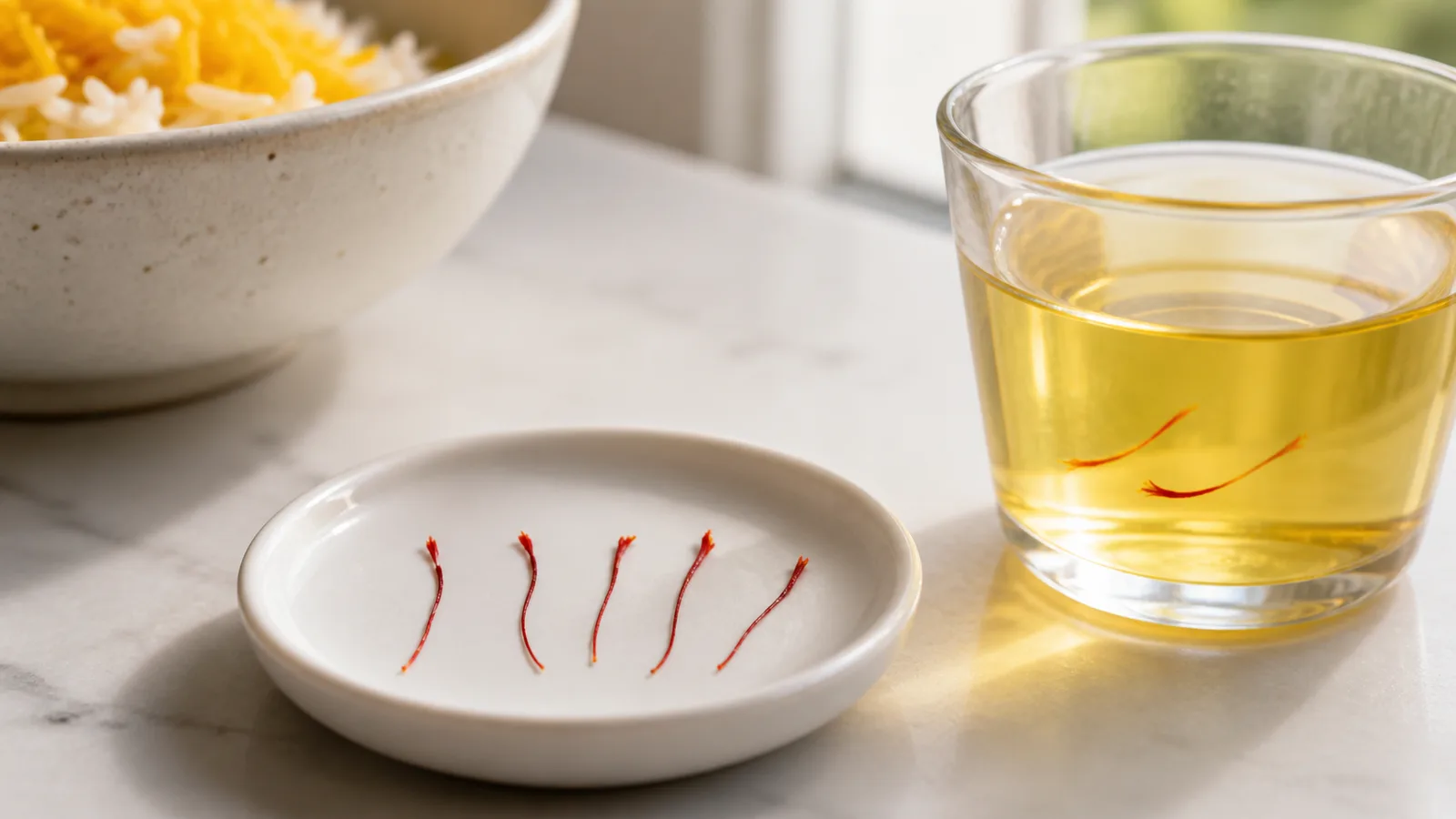
No country has saffron that is always the most expensive. Kashmir saffron from India often carries a high retail premium because supply is limited and the name has protected geographical status, while small lots from Spain, Greece or Italy can also cost more in a particular market. Iran is the largest producer and sells both premium and value grades. The answer changes with grade, pack size, seller, currency, tax and date.
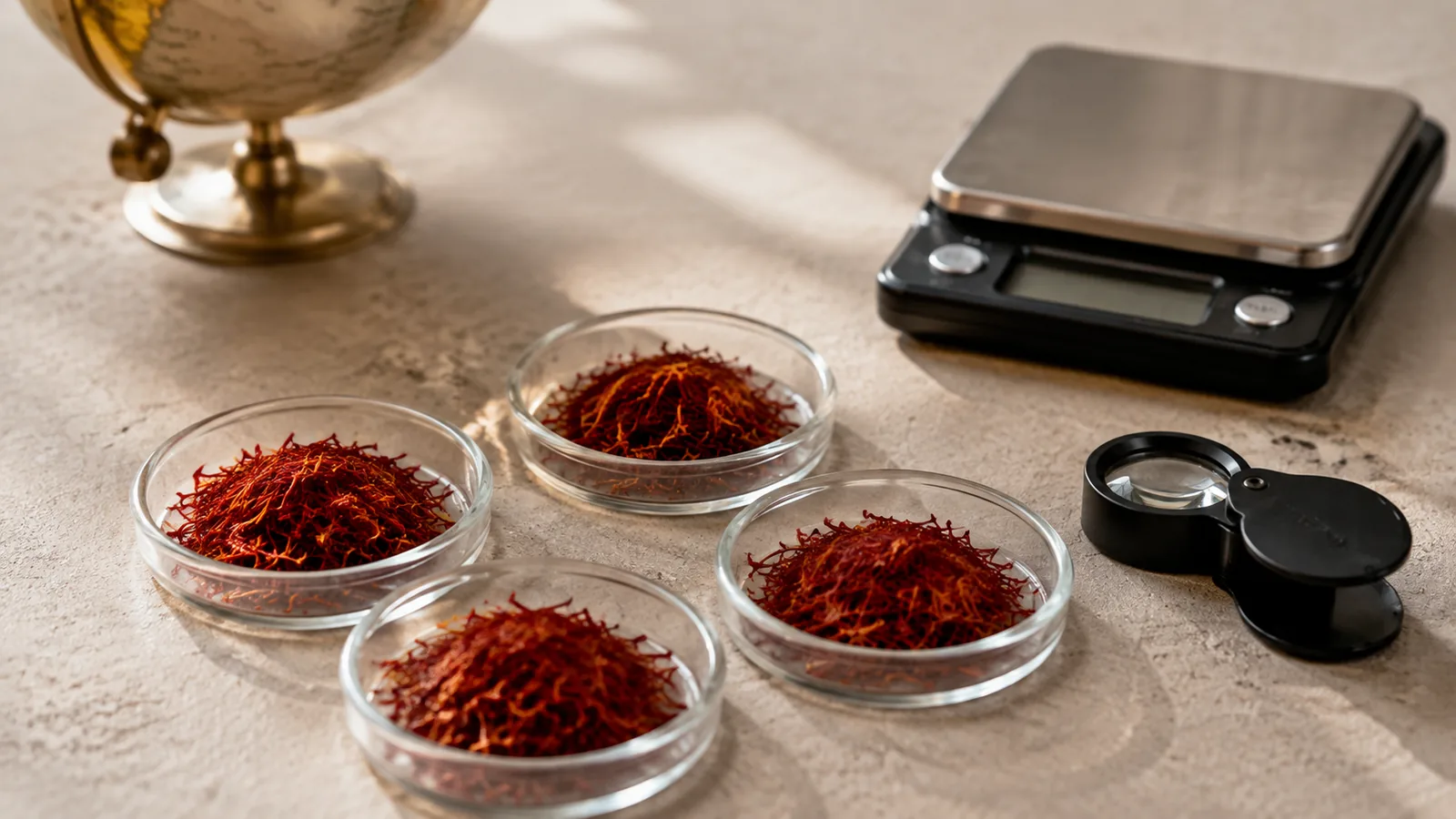
Why there is no single most expensive saffron country
Lists of the most expensive saffron countries often compare unlike products. A one-gram retail jar in London cannot be compared fairly with a kilogram wholesale quote in Iran. Powder should not be compared with whole threads, and a protected-origin product is not the same as an unverified marketplace listing.
Even within one country, saffron is sold in different cuts and grades. A clean all-red lot with strong laboratory results can command more than a mixed thread grade from the same harvest. Packaging, certification, freight and the retailer’s margin may then move the shelf price again.
That means “In which country is saffron the most expensive?” needs a narrower comparison: the same date, currency, unit, thread form, grade, test standard and sales level. Without those controls, a country ranking sounds precise but is not.
Iran: the largest producer, with more than one price tier
Iran is the centre of world saffron production. The UN Food and Agriculture Organization’s account of the Qanat-based saffron farming system in Gonabad identifies Iran as the world’s largest producer and says it accounts for more than 90% of production.
Large output does not mean all Iranian saffron is cheap, nor does it mean every Iranian lot is identical. Iranian categories may differ in how much yellow style remains, thread thickness, physical condition and laboratory quality. Premium all-red grades can be expensive, particularly after testing, careful packing and export costs.
Iran may nevertheless look less expensive at origin because buyers are closer to a large supply base. A local or wholesale price is not the same as the final retail cost abroad. Exchange rates, customs, reseller margins and pack size can reverse an apparent country comparison.
India: why Kashmir saffron often commands a premium
India’s best-known saffron comes from Kashmir, particularly the Pampore area. Kashmir saffron is scarce relative to Iran’s production and has a strong regional identity. India’s official Geographical Indications Registry lists Kashmir Saffron as registered GI 635, covering Jammu and Kashmir.
That protected name, limited production, local demand and the cost of verified supply can place genuine Kashmiri saffron among the priciest retail offerings. This does not prove that every product labelled “Kashmir” is authentic or that it will always cost more than every Iranian, Spanish or Greek lot. A premium name still needs traceability and a credible seller.
The old version of this article attributed the price to “high-altitude” growing in general. Altitude may be part of a region’s growing conditions, but it is not a price certificate. Origin protection, supply, grading, testing and the route to market are more useful buying evidence.
Spain: La Mancha origin and careful presentation
Spanish saffron has a long culinary reputation, and Azafrán de La Mancha is a protected designation of origin. The EU specification for Azafrán de la Mancha defines the named product and its production area rather than declaring it the world’s most expensive saffron.
Protected origin and small retail packaging can add value because the buyer is paying for a documented regional product. Some Spanish jars may cost more per gram than a larger Iranian pack. Others may not. The label has meaning, but the unit price and actual specification still matter.
Greece: Krokos Kozanis PDO
Greek saffron is closely associated with Kozani. The European Commission describes Krokos Kozanis PDO as a protected product whose cultivation, harvesting, drying and packing depend on regional know-how. Its small packs and controlled origin can produce a high per-gram shelf price.
Greece therefore belongs in a serious comparison of premium saffron countries. It still cannot be assigned a permanent place above or below Kashmir, Iran or La Mancha without contemporaneous like-for-like prices.
What about Italy, Afghanistan and Azerbaijan?
Smaller producers can appear expensive because output is limited and labour costs are spread over fewer packages. Italy has specialist cultivation in several regions, including Sicily; searches for Caltanissetta or Agrigento saffron usually point to local production rather than a national benchmark. Afghanistan and Azerbaijan also have saffron production and export activity.
A small country’s saffron can be excellent, but rarity alone does not establish quality. Nor does a low-cost offer automatically mean poor material. Country tells you where to begin asking questions; it does not replace inspection, testing or traceability.
Saffron production by country: who produces the most?
Iran produces the most saffron by a wide margin. That production question should not be confused with “Which country has the best saffron?” or “Where is saffron most expensive?” Volume, quality and retail price measure different things.
Kashmir can command a scarcity premium while Iran remains the largest producer. Spain and Greece can add value through protected regional systems. A buyer may reasonably prefer one origin for its aroma or culinary tradition without turning that preference into a universal quality ranking.
What actually makes one saffron more expensive?
- Thread grade and cut: a higher proportion of clean red stigma usually costs more than a grade with substantial yellow style.
- Analytical quality: colouring strength, aroma-related measures, flavour-related measures, moisture and foreign matter help describe a batch.
- Whole threads or powder: intact threads are easier for a buyer to inspect; powder can be genuine, but it hides visual evidence.
- Origin assurance: a PDO or GI, batch record and supply-chain documentation can add cost and reduce uncertainty.
- Harvest and storage: careful drying, protection from moisture, light and heat, and sensible stock rotation affect saleable quality.
- Pack size: a decorative half-gram jar almost always costs more per gram than a plain larger pack.
- Market costs: freight, import duties, currency movements, certification and retail overhead differ by country.
The current ISO 3632-1:2025 saffron specification provides a common technical vocabulary for saffron rather than a “best country” award. A test report applies to the sampled lot. It does not prove that every product from the same origin will perform identically.
How to compare prices without being misled
Start by converting every offer to the same currency and price per gram. Check whether tax and shipping are included. Then compare whole threads with whole threads, the same grade where possible, and recent listings from credible sellers. A kilogram trade quote and a gift jar belong in separate comparisons.
Next, look beyond price. The seller should identify the origin and form, show the actual product clearly, provide a usable lot or date reference and explain any grade claim. Deep red colour alone is not proof, and a famous country name is not a substitute for traceability.
Our saffron price page is the better place to check the current price of saffron; evergreen country articles should not freeze a temporary figure into the text. Buyers who want to compare available pack sizes can also view the current saffron products.
So where is saffron most expensive?
Genuine Kashmir saffron is often among the most expensive saffron sold at retail, especially in small verified packs. Premium PDO saffron from Spain or Greece and small-batch Italian products can also reach high per-gram prices. Top Iranian grades may be equally premium, while Iran’s scale can make other lots comparatively good value.
The sound answer is therefore a method, not a flag: compare the same grade, form, unit, date and market. Choose the batch that offers documented origin and quality for the intended use. The country matters, but it never tells the whole price story.