


Watering saffron plants is less about following a fixed calendar than matching water to the crop’s life cycle. In most climates, the important periods are establishment and pre-flowering in autumn, active leaf growth through winter, and daughter-corm development in late winter and spring. The soil should be moist enough for growth but never remain waterlogged.
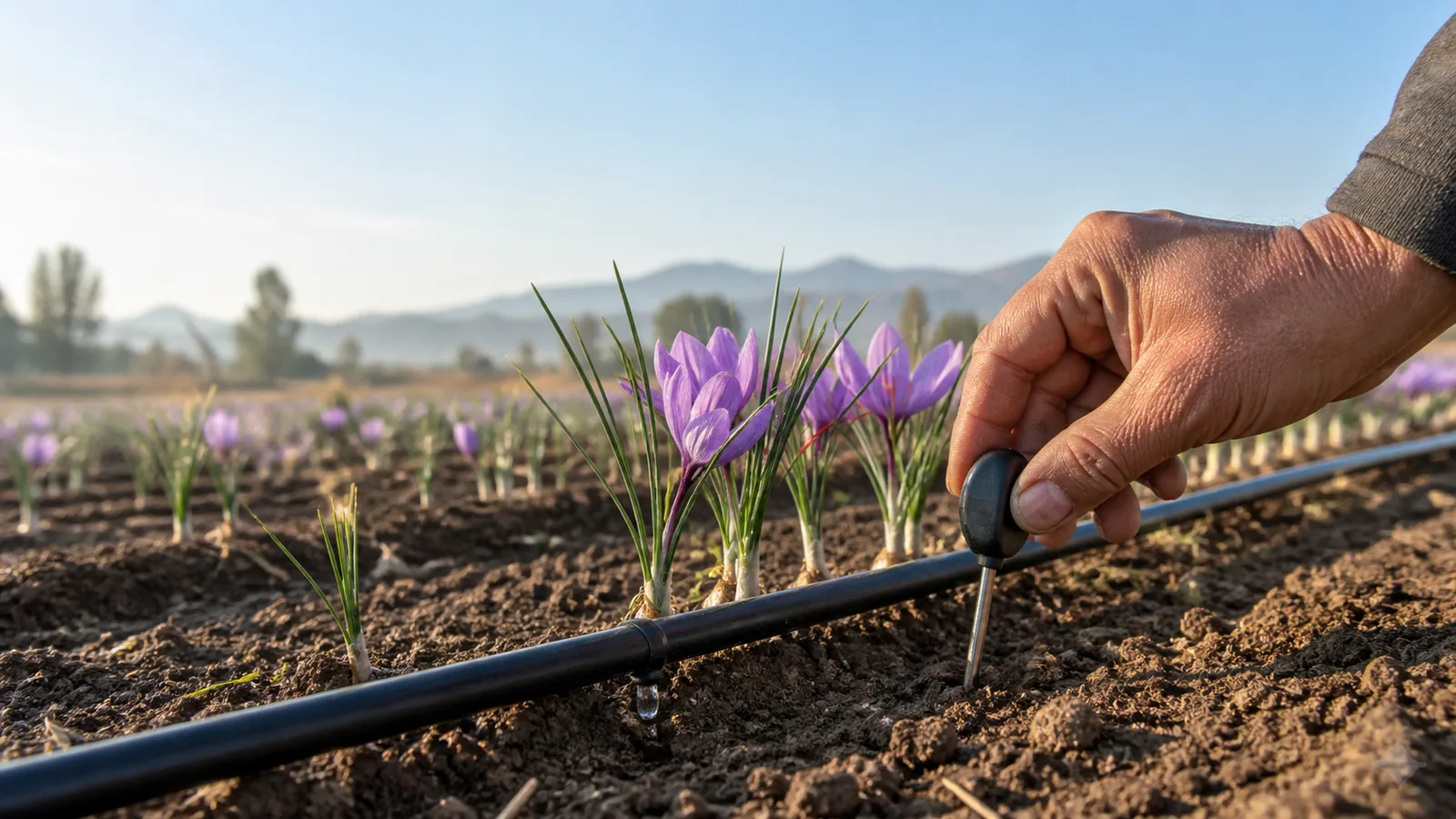
The best time to water saffron therefore changes with rainfall, soil texture, temperature and whether the corms are in a field, a raised bed or a covered structure. Saffron uses less water than many conventional crops, but “drought tolerant” does not mean that water never affects yield. It means irrigation should be deliberate.
When should you water saffron?
Start with the plant, not the month printed on a general schedule. Saffron normally flowers in autumn, carries green leaves through the cooler part of the year and builds daughter corms before the foliage yellows in spring. It then enters a warm-season dormancy. Because those stages shift by region, an October date in Iran cannot simply be copied into a garden in Vermont or a field in southern Europe.
1. After planting and before flowering
Newly planted corms need good contact with the soil. If the bed is dry and autumn rain is not expected, water deeply enough to moisten the root zone, then allow excess water to drain. In arid saffron regions, a carefully timed pre-flowering irrigation is often used to support emergence. The timing matters: a multi-region study of Iranian saffron fields found that the first irrigation interacts with temperature and that watering too early under unsuitable temperatures can favour leaves over flowers.
That is why “water in early October” is only a regional starting point, not a worldwide rule. Watch local temperatures, expected rainfall and the crop’s usual flowering window. A grower who has access to extension advice or field records should use those alongside soil-moisture readings.
2. During flowering and immediately afterwards
Do not keep the ground saturated while flowers are being picked. If rainfall has already moistened the root zone, another irrigation may add risk without helping the crop. Where autumn remains dry, water the soil rather than the flowers and avoid leaving wet, compacted patches.
After harvest, the leaves continue working. They are feeding the daughter corms that influence the following season, so this is not the end of the watering year. Supplemental irrigation can be useful if the root zone is becoming dry, but the amount should reflect rain and soil rather than a rule such as “always water 14 days after harvest.”
3. Through winter and spring leaf growth
Green saffron leaves need access to moisture, especially as temperatures rise and daughter corms develop. Check beneath the surface instead of judging by a dry crust. Sandy soil may need smaller, more frequent applications; a heavier soil holds water longer and demands more caution.
Research does not support one interval for every field. A two-year Iranian experiment compared 12-, 24- and 36-day intervals under specific basin and furrow systems, while newer work schedules irrigation from measured soil-moisture deficit or evapotranspiration. Those are useful findings for system design, not proof that every saffron bed should be watered every 12 or 24 days.
4. As leaves yellow and dormancy begins
Reduce irrigation as the leaves naturally turn yellow. Once the foliage has died back, the corm is dormant and its demand is low. Warm, persistently wet soil during dormancy raises the risk of rot, so regular summer watering is usually a poor default. The same field study found that high-yield locations generally had little or no rain from July through September and emphasised the value of a dry warm-season environment.
Some arid production systems use a measured late-summer or pre-flowering irrigation, and field trials have reported yield benefits in their particular conditions. That does not conflict with keeping dormant corms out of waterlogged soil. It means a controlled irrigation intended to start the next cycle is different from watering wet ground all summer. Use local evidence before adding that step.
Saffron rainfall requirements
Figures such as 400–600 mm appear often in saffron guidance, but they need context. Total annual rainfall does not reveal when the rain fell, how much ran off, or how long the root zone stayed wet. Distribution during the active season matters as much as the headline total.
Research in semi-arid Iran has found that fields around 200 mm of seasonal rain may need much more supplemental irrigation than fields receiving roughly 400 mm. Around 600 mm, rainfed production may be possible in a suitable soil and climate, sometimes with only a strategic irrigation. A peer-reviewed agro-climatic assessment likewise notes that about 600 mm of seasonal rainfall can be nearly sufficient, while stressing the roles of soil and management.
This is why saffron’s low water requirement compared with other crops should be described carefully. Its drought tolerance and summer dormancy can make it a good fit for water-limited regions, but insufficient moisture during flowering or daughter-corm growth can still reduce performance.
How often to water saffron
There is no safe universal answer such as weekly, every two weeks or once a month. Use these checks before each irrigation:
- Feel or measure moisture at corm/root depth, not only at the surface.
- Account for rain since the previous check and rain forecast for the next few days.
- Notice whether water drains promptly or remains in low patches.
- Identify the crop stage: emerging, flowering, actively leafing, senescing or dormant.
- Adjust for soil texture, bed depth, wind, temperature and plant density.
A soil-moisture probe gives a more consistent reading than a calendar. For a small bed, a narrow trowel can show whether the soil below the surface is still moist. For a commercial field, sensors, rainfall records and evapotranspiration estimates can support a proper irrigation schedule.
Which irrigation practice is preferred in saffron cultivation?
Drip irrigation is often preferred where water is limited because a well-designed system can deliver measured amounts close to the crop with less surface wetting. In a three-year arid-climate comparison of sprinkler, drip, furrow and basin systems, drip generally produced the highest water-use efficiency. That result is useful, but it does not make drip the winner in every soil, field layout or budget.
Sprinklers can serve an evenly planted bed, although wind and evaporation affect distribution and wet foliage may be undesirable. Furrow and basin irrigation remain common in production regions, but they require careful levelling and control to prevent long periods of saturation. “Pressure irrigation” describes how water is delivered to a system; it is not a separate crop requirement.
Whichever method is used, check that the far and near ends of the bed receive comparable amounts. Fix clogged emitters, runoff channels and ponding before increasing the total volume. Good drainage is part of irrigation design, not a separate problem; the University of Vermont’s saffron cultivation guidance warns that standing water can rot corms.
Watering saffron in pots and raised beds
A container can dry faster than a field, but “once a month” is still too rigid. Use a pot with open drainage holes and a free-draining mix. Water until the mix is evenly moistened and excess water leaves the container, then check it again before watering. Never let the pot sit in a saucer of water.
Outdoor pots may receive all they need from rain during the active season. Pots under a roof, in a high tunnel or indoors need manual checks because they miss natural rainfall. The University of Vermont advises keeping protected saffron moist but not oversaturated, while its outdoor trial beds generally rely on rain after planting. A pot warms and cools faster than field soil, so it deserves closer observation during sudden weather changes.
Does water temperature matter?
Extremely hot or icy water can shock roots and should be avoided. In practice, drainage, timing and total volume matter far more than matching water to an exact soil temperature. If water has been standing in a hose under strong sun, let the hot water clear before irrigating. Stored water that is near the surrounding air temperature is usually suitable.
Signs the schedule needs changing
Persistent wetness, a sour smell, soft corm tissue, patchy emergence or spreading yellowing can point to poor drainage or disease. Stop adding water until the cause is understood. Our guide to saffron pest control and corm rot explains the diagnosis-first steps.
Dry soil at root depth, loss of leaf firmness during active growth and a bed that sheds water instead of absorbing it indicate a different problem. Apply water slowly enough to enter the soil, then recheck rather than immediately repeating the full irrigation. Natural leaf yellowing at the end of spring is not, by itself, a reason to keep watering.
The best saffron irrigation plan is one that changes with the field. Record rainfall, irrigation dates, crop stage and any wet or dry patches. Those notes make next season’s decisions more reliable than any universal calendar—and help deliver enough water without turning a low-water crop into a waterlogged one.

![Exporting Saffron to Turkey + Price Guide [Complete 0 to 100]](https://img.rowhanisaffron.com/20260827003933/saffron-export-turkey-quality-inspection.webp)



