


Saffron pest control methods work best when they begin with a diagnosis, not a spray bottle. A soft or discoloured corm, a grooved leaf and a freshly dug planting hole are three different problems. Treating them as if they had one cause wastes time and can make the field harder to manage.
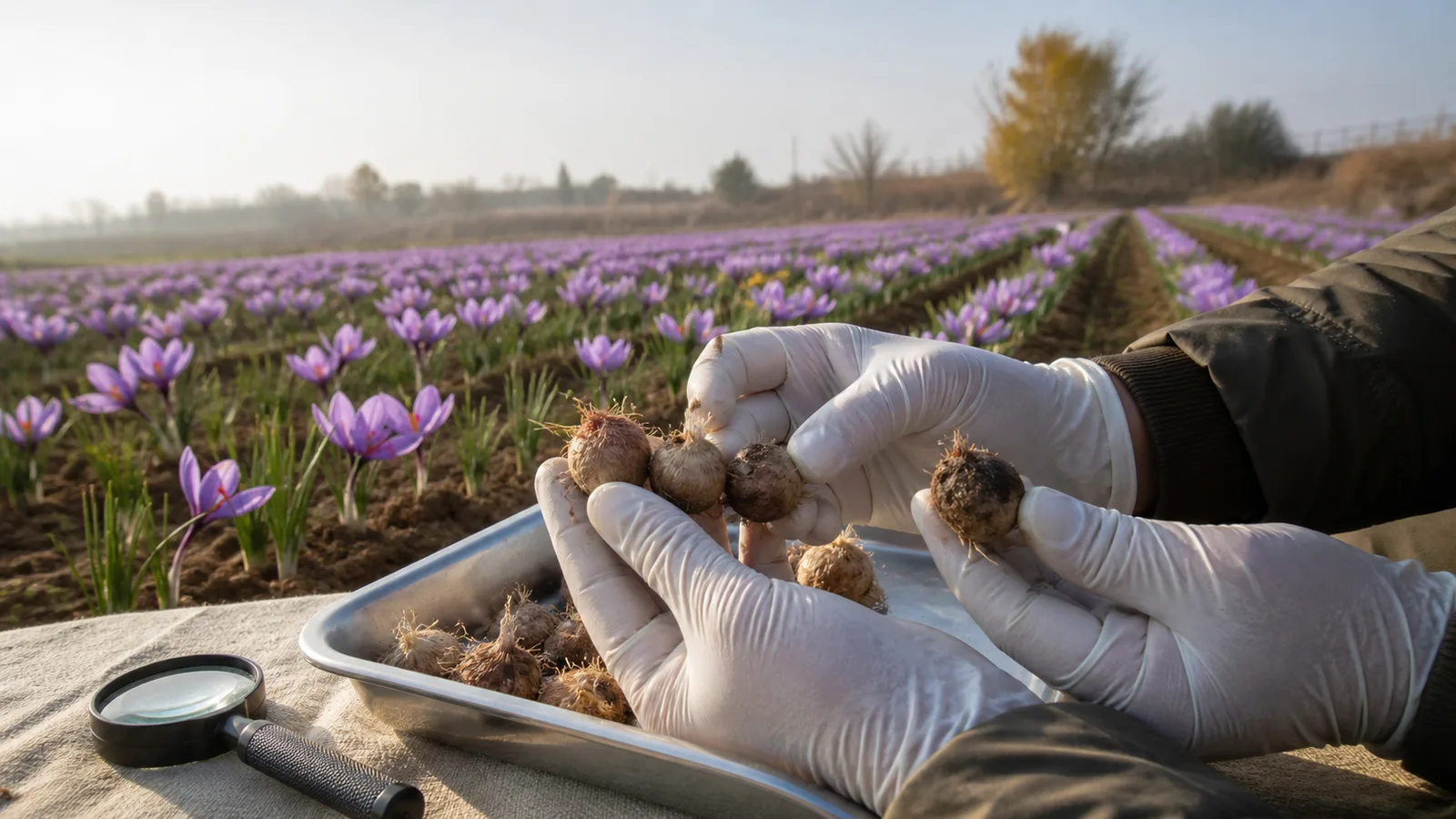
The safest approach is integrated pest management: inspect the crop often, identify the likely pest or disease, correct the growing conditions that favour it, and use a locally authorised pesticide only when the diagnosis and product label support that choice. That matters especially with saffron, because the harvested spice is a food crop and the corm remains in the soil for several seasons.
Start with diagnosis, not a pesticide
Several saffron problems look alike at first. Poor emergence may come from damaged planting stock, waterlogged soil, corm rot, mites or simply a corm that was planted at the wrong depth. Yellowing leaves can reflect disease, feeding damage or a problem with water and nutrition. Before choosing a saffron pesticide, dig up a small number of affected plants and compare them with healthy plants from the same field.
Look at the roots, the base of the leaves and every side of the corm. Record where the symptoms occur. A disease concentrated in a wet corner points to a different cause than damage scattered along a field boundary. If the loss is spreading or the cause is uncertain, send samples to a plant-disease laboratory or local agricultural extension service. A photograph alone is rarely enough to distinguish every corm-rot organism.
Managing corm rot of saffron
Corm rot is not one single disease. Researchers have associated saffron rot with several fungi, including Fusarium and Rhizoctonia, as well as other organisms that can enter already weakened tissue. A peer-reviewed review of saffron corm rot describes it as a disease complex and recommends an integrated programme rather than relying on one treatment.
Common warning signs include patches of plants that fail to emerge, weak shoots, roots that darken or decay, soft areas on the corm, reddish-brown tissue, and white or purple fungal growth. Those signs overlap, so they indicate a need for closer inspection rather than proving which pathogen is present.
Reduce infection pressure before planting
- Buy firm, healthy corms from a source that can explain how its planting stock was produced and stored.
- Keep new corms separate until they have been inspected. Do not plant material that is soft, cut, mouldy or unusually discoloured.
- Move rejected corms and infected debris away from the growing area. Clean soil from tools and equipment before carrying them to another plot.
- Use a well-drained bed. Heavy soil, standing water and frequent irrigation keep corms wet for too long.
- Rotate out of saffron where disease has built up, and control volunteer host plants during the break.
A loose, well-drained loam is usually easier to manage than compacted ground. Organic matter should be fully decomposed and used to improve soil structure, not piled directly around the corm. The right watering interval depends on rainfall, soil and growth stage; our guide to watering saffron plants explains those decisions in more detail.
How to choose the best saffron fungicide
There is no universal “best saffron fungicide.” A fungicide must match the diagnosed organism, be registered for the crop and use in the country where the saffron is grown, and be applied exactly as its current label directs. In the United States, the EPA explains that pesticide labels are legally enforceable; elsewhere, growers should check the equivalent national or regional register. The EU Pesticides Database, for example, records whether active substances are approved or non-approved and provides residue information.
Older saffron articles and product searches often mention carbendazim, iprodione-carbendazim mixtures and metalaxyl. Those names are included here so a grower can recognise them, not as a buying or application recommendation. Registration changes over time and differs by country. They are not interchangeable: a product aimed at an oomycete is not automatically the right treatment for Fusarium, Rhizoctonia or a bacterial problem.
Repeated use of the same mode of action can also select for resistant pathogen populations. The Fungicide Resistance Action Committee explains why mode of action, pathogen biology and cropping practice all matter. If a treatment is justified, follow the current label and local professional advice on timing, permitted use, protective equipment, harvest intervals and resistance management. Never improvise a corm dip or soil fumigation from an old recipe.
Saffron insects and mites
Thrips
Thrips can leave pale or silvery marks, streaks and distorted tissue on saffron leaves and flowers. Their presence does not automatically mean an insecticide is needed. Shake affected leaves or flowers over white paper and inspect the dislodged insects; sticky cards can help show whether the population is rising, although they do not measure crop damage by themselves.
Keep weeds and heavily damaged plant material under control without stripping the field of every beneficial insect. If monitoring shows that treatment is necessary, choose a saffron insecticide that is authorised for the crop and target pest, then avoid repeated applications from the same mode-of-action group. UC Integrated Pest Management guidance recommends combining cultural practices, natural enemies and selective controls, and notes that finding thrips does not by itself prove damaging levels.
Corm and bulb mites
Mites can travel with infested planting material and feed in already damaged or decaying tissue. They may contribute to weak growth and early decline, but livestock near a field is not a diagnosis. Inspect corms with a hand lens, reject damaged stock, keep storage areas clean and dry, and avoid moving soil, corm waste or dirty tools from an affected plot. Where symptoms persist, a laboratory can determine whether mites, a pathogen or both are involved.
Bacterial symptoms need a different response
Burkholderia species have been reported in association with saffron disease, but a reddish-brown corm does not identify a bacterium on sight. Fungicides do not treat bacterial disease. Isolate suspect planting stock, remove badly affected corms, sanitise tools and packaging, and avoid warm, damp storage. Confirmation is worth the effort before making a field-wide decision.
Hedgehogs, rabbits and rodents
Wildlife damage tends to appear as disturbed soil, clipped leaves, tooth marks or missing corms. Check tracks, droppings and the pattern of damage before blaming a particular animal. Rabbits and some rodents can be reduced with sound fencing, protected storage, cleared spillages and physical barriers around vulnerable beds. Repair gaps promptly and keep corm waste out of reach.
Hedgehogs should not be poisoned, trapped indiscriminately or driven from dens with gas. They may be protected by local wildlife law, and poison intended for another species can harm them. The UK government’s official pest-control guidance advises using only permitted methods for the identified animal and protecting non-target wildlife. Where burrows or repeated damage make exclusion difficult, ask a licensed wildlife or pest professional for a lawful, species-specific plan.
Can I grow saffron at home without these problems?
Yes, but a pot or raised bed is not automatically disease-free. Begin with healthy corms and a container that drains freely. Water thoroughly when the crop needs it, then let excess water escape; do not leave the pot standing in water. Keep new corms apart from an established collection until you have checked them, and clean reused pots and tools before planting.
Home growers have one useful advantage: a small planting can be inspected corm by corm. Remove a suspicious plant early rather than waiting for neighbouring shoots to decline. For the wider planting cycle, see our guide to saffron cultivation and care.
A practical inspection routine
- Before planting: inspect new corms, prepare drainage and clean tools and storage containers.
- After emergence: mark weak or missing patches instead of treating the whole field immediately.
- During growth: check leaves and flowers for feeding marks, and compare affected plants with healthy ones.
- When symptoms spread: isolate suspect material and obtain a reliable diagnosis.
- Before any chemical control: confirm that the current label permits the crop, pest, location and method of application.
- After harvest: remove infected waste, clean equipment and review where drainage or pest entry needs to be corrected.
The dangers facing saffron cultivation are manageable when each one is identified correctly. Healthy planting stock, drainage, sanitation, monitoring and humane exclusion do most of the preventative work. A pesticide, fungicide or insecticide is a targeted last step—not a substitute for knowing what is damaging the crop.

![Exporting Saffron to Turkey + Price Guide [Complete 0 to 100]](https://img.rowhanisaffron.com/20260827003933/saffron-export-turkey-quality-inspection.webp)



