Saffron foliar fertilization can supply a small, targeted amount of nutrient through active green leaves. It is most useful when a soil or tissue test, visible symptoms and field history point to a specific shortage. It should not be treated as a compulsory spray programme or a replacement for healthy soil, suitable irrigation and root nutrition.
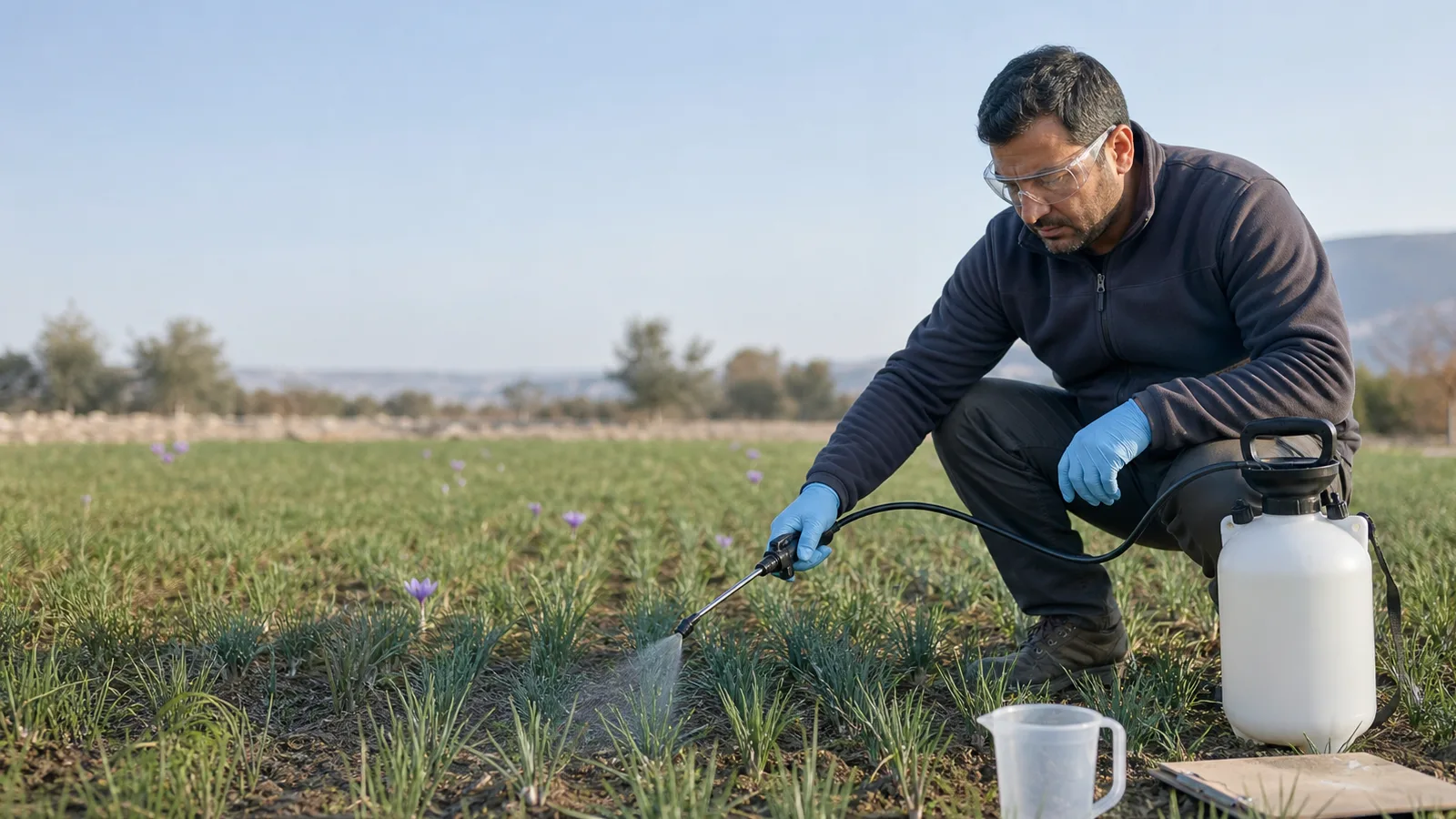
The practical rule is simple: identify what the crop needs, choose a product whose analysis and label match that need, and spray while the saffron still has healthy leaf area. A generic January-to-April calendar is too broad for a crop grown in very different climates.
What foliar feeding can and cannot do
Plants take most of their nutrients through their roots. Leaves can absorb limited amounts of certain nutrients, which makes foliar feeding useful for a confirmed shortfall or when soil conditions temporarily restrict uptake. Penn State Extension’s foliar-fertilization guidance warns that routine spraying without a documented need is not recommended and that concentrated solutions can burn foliage.
Saffron does have a reason for special attention after flowering. Its leaves continue photosynthesising while daughter corms develop below ground, helping to determine the following season’s potential. Root activity and nutrient movement change as the crop approaches senescence, but the roots do not simply disappear at the beginning of winter. Foliar nutrition is a supplement during the active-leaf period, not compensation for a root system that has stopped functioning all season.
Several saffron trials have reported responses to particular foliar products and micronutrients. One greenhouse experiment found differences in flower and corm traits among concentrations of a specific NPK-plus-micronutrient formulation. Another field study found that nutrient foliar application did not significantly change some yield traits. Those results are not contradictory: response depends on the starting nutrient status, corm size, environment, formulation and rate. A successful treatment in one trial is not a universal recipe.
Begin with evidence from the field
Before deciding how to fertilize saffron, compare healthy and weak parts of the planting. Record leaf colour, growth, soil type, drainage, irrigation, recent amendments and the position of affected plants. Yellowing can come from nutrient shortage, waterlogging, disease, salinity or natural end-of-season senescence. Spraying all five problems with a micronutrient mix will not solve four of them.
- Test the soil for pH, salinity, organic matter and available nutrients using a laboratory familiar with local soils.
- Use tissue analysis where an appropriate saffron sampling method and interpretation are available. Keep symptomatic and healthy samples separate.
- Review prior inputs so a hidden excess is not mistaken for a deficiency.
- Check roots and corms if poor growth occurs in wet or spreading patches.
- Ask for a local recommendation when the test result does not translate clearly into a crop rate.
Utah State University Extension notes that plant type, nutrient concentration and application method all affect foliar uptake, and recommends testing suspected deficiencies. Although its examples cover vegetable crops rather than saffron, the diagnostic principle applies: do not guess which element is missing from leaf colour alone.
When to apply foliar fertilizer to saffron
After flowering, once there is enough green leaf area
Avoid contaminating flowers or the stigmas being harvested. After flowering, inspect the actively growing leaves and use test results to decide whether a foliar treatment is justified. In many Northern Hemisphere production systems, that window falls in winter, but growth stage is more reliable than the month.
During active winter and early-spring growth
Healthy green foliage offers the practical application window. Some regional saffron programmes place foliar nutrition from late January to early March, while the original version of this article referred to January through April. Both ranges need a climate label: the right date moves with flowering, temperature and leaf senescence.
Do not wait until most leaves are yellow. Senescing foliage has less useful surface and the crop is already moving into dormancy. Stop the programme when the label, tissue result or crop stage no longer supports another application.
Do not spray by interval alone
A 14–20 day interval may appear in local schedules, but it is not a general saffron rule. Reapplication depends on the diagnosed nutrient, formulation, concentration, label, weather and crop response. If the product label allows only one application, a calendar cannot override it. If a deficiency has been corrected, another spray may add cost and leaf-burn risk rather than benefit.
How to spray without damaging the crop
- Read the whole label. Confirm the product is intended for foliar use on the crop or under the applicable local rules. Follow its dilution, water volume, protective-equipment, compatibility and re-entry instructions.
- Measure; do not estimate. Calibrate the sprayer and mix only the required volume. More concentrated is not more effective.
- Test a small area first. Observe it for the period recommended by the supplier or adviser before treating the entire field.
- Choose calm, mild weather. Strong wind causes uneven coverage and off-target drift. Hot sun speeds drying and can increase scorch risk; frost can injure already-wet leaves.
- Respect the rainfast period. Do not rely on a blanket “24 hours after rain” rule. Start with suitable leaf conditions and allow the exact drying time stated on the current label before rain or irrigation.
- Cover leaves evenly without runoff. Large droplets rolling into the soil do not provide better foliar nutrition.
The old recommendation to spray between 11 a.m. and 1 p.m. at exactly 12°C is too precise for worldwide use. Leaf temperature, humidity, wind and the formulation all change through the day. A cool, calm morning or later part of the day is often practical, provided leaves can dry and the label permits it. If the crop is drought-stressed, correct its root-zone moisture carefully before spraying; our guide to watering saffron plants explains how to make that decision.
Choosing nutrients and biostimulants
Nitrogen, phosphorus and potassium
These macronutrients are needed in larger amounts than leaves can normally receive safely in a corrective spray. A foliar NPK product may supplement a programme, but it should not replace a soil-based nutrient plan. Excess nitrogen can also push vegetative growth without guaranteeing more flowers. Use local soil and crop recommendations to set the main programme.
Iron, zinc, manganese and copper
Foliar treatment can be useful when a confirmed micronutrient deficiency is difficult to correct quickly through the soil. The margin between enough and too much can be narrow, particularly for elements such as copper and boron. Do not combine micronutrients simply because they are sold together. Match the element and rate to the evidence.
Seaweed extract and amino-acid products
These are usually described as biostimulants rather than complete fertilizers. A two-year saffron study of a particular seaweed-extract treatment reported changes in daughter-corm production under its experimental conditions. That does not show that every seaweed product prevents frost, drought or disease. Composition varies, so use the product’s guaranteed analysis and trial evidence rather than a category-wide promise.
Amino-acid formulations also differ. Claims that they automatically increase protein production, photosynthesis and drought tolerance are too broad without product- and crop-specific evidence. Treat them as optional inputs whose value must be demonstrated in the field.
Humic acid, Thiobacillus and potassium silicate
Humic substances and microbial products may be used in soil or irrigation programmes, depending on their formulation; they should not be moved into a foliar tank unless their label specifically allows it. Thiobacillus products are microbial soil amendments, not a universal leaf nutrient. Potassium silicate also requires careful label-based mixing because high-pH or incompatible solutions can damage plants or react in the tank.
Names such as “Keyplex potassium” or “white fertilizer” sometimes appear in older schedules. The first is a trade-name family and the second is not a standard nutrient description. Translate either term into its guaranteed nutrient analysis, concentration, registration and instructions before deciding whether it belongs in a saffron plan. A colour or brand name is not a fertilizer recommendation.
A safer seasonal saffron fertilization plan
Before planting or before the active season
Test the soil, correct major physical or pH problems where practical, and plan the main root-zone nutrition. Apply compost, phosphorus, potassium, sulfur, humic products or microbial amendments only when the analysis and local recommendation support them. They are not all required in every field.
After flower harvest
Keep the leaves healthy, review irrigation and inspect for disease. If evidence shows a nutrient shortage that can be corrected through foliage, select one suitable treatment and make a small test application.
During active leaf growth
Evaluate the response before repeating. Use tissue testing where available and keep product, rate, weather and treated-area records. Change one part of the programme at a time if you want the result to teach you anything.
As leaves yellow
Stop routine foliar feeding. Natural senescence is not a deficiency to reverse. Review the season’s records and use corm size, plant health and next year’s flowering to judge whether the programme was worth continuing.
Effective saffron foliar fertilization is precise because it is selective. It supplies a demonstrated need during the useful leaf window, under weather that allows safe coverage. A shorter evidence-led programme will usually be more defensible than a long list of products applied because a calendar says they belong together.