Where is 90% of the World’s Saffron Grown?
Iran is the country usually meant when people ask, “Where is 90% of the world’s saffron grown?” The exact share changes with the harvest year and the dataset. In 2025, the UN Food and Agriculture Organization described Iran as producing more than 90% of the world’s saffron in one report and 85–90% in another. The sound conclusion is the same: Iran is by far the leading saffron-producing country, while “90%” is a useful rounded estimate rather than a permanent annual statistic.
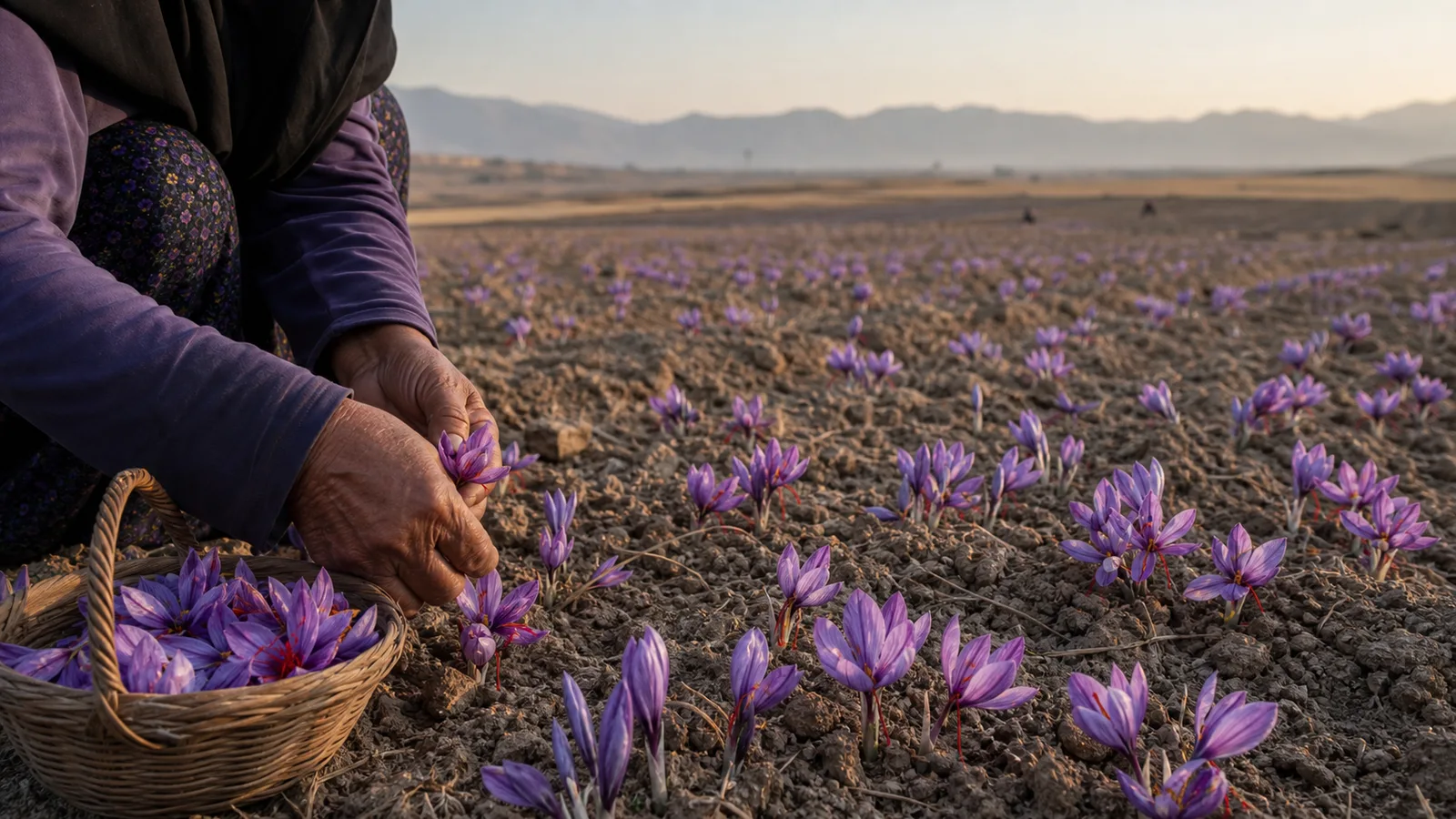
Most Iranian saffron farming is associated with the country’s eastern Khorasan region, especially Razavi Khorasan, South Khorasan and North Khorasan. Here, generations of growers have adapted the crop to a dry landscape and developed the knowledge, labour network and post-harvest skills needed to handle a flower that offers only a tiny amount of spice.
Why does Iran produce so much saffron?
Climate matters, but it is not the whole explanation. Crocus sativus needs a growing cycle that suits its summer dormancy and autumn flowering. Many parts of Khorasan combine dry summers, cool seasonal conditions and well-drained ground. Saffron also needs careful timing: flowers must be collected and their red stigmas separated and dried without losing the colour, aroma and flavour buyers expect.
Iran has all of that at scale. Farmers have long experience with the crop, seasonal workers know how to pick and separate the flowers, and established markets connect farms to processors and exporters. The FAO-recognised qanat-based saffron system in Gonabad shows how cultivation has been fitted to an arid environment where water is scarce. Saffron needs irrigation, but it can be grown with much less water than many alternative crops.
This combination explains Iran’s dominant output more convincingly than the idea that one patch of soil is magically superior. Suitable land exists elsewhere. What is difficult to reproduce quickly is the entire farming culture and supply chain around it.
What plant does saffron come from?
Saffron is made from the dried red stigmas of the saffron crocus, Crocus sativus. This is the saffron plant; its purple bloom is the saffron flower. Each flower carries only three red stigmas. Those fragile strands are the spice sold as saffron, kesar or azafrán; the petals and the yellow stamens are not equivalent substitutes.
The plant grows from a corm, not from ordinary seed. A corm looks rather like a small bulb and produces new corms underground. In the flowering season, growers pick the blooms and separate the stigmas before drying them. This is why photographs of a vast saffron field can be misleading about yield: almost the whole visible flower is left behind, while only three slender strands become saleable spice.
International standards treat saffron as a defined product, not simply any colourful part of a crocus. The current ISO 3632-1:2025 specification covers dried saffron obtained from the pistils of Crocus sativus in filament, cut-filament and powder forms. That distinction matters when comparing whole threads with cheap powders or products padded with unrelated plant material.
Why is saffron so expensive?
The price begins with the mismatch between effort and yield. Every flower provides only three stigmas, and the crop blooms over a short period. Picking flowers, separating the useful part and drying it correctly still require a great deal of skilled manual work. The result is very little finished spice from a large volume of fresh flowers.
That does not mean every expensive pack is excellent, or that saffron should cost the same in every country. Grade, harvest, moisture, packaging, testing, origin, trade costs and retail margin all affect the final price. Our fuller guide explains why saffron is expensive without treating price alone as proof of quality.
Which other countries grow saffron?
Iran is not the only saffron production country. Saffron is also grown in India, particularly Kashmir; Afghanistan; Spain; Greece; Morocco; Italy and smaller growing areas elsewhere. Some have strong regional traditions and protected names, even though their output is much smaller than Iran’s.
Production origin and selling origin are not always the same. Threads grown in one country may be processed, packed or re-exported from another. A Spanish brand name, for example, does not by itself prove that the crop was grown in Spain. Buyers who care about provenance should look for a clearly stated country of harvest, traceable lot information and meaningful quality testing.
Does Iranian origin automatically mean the best saffron?
Iran can produce outstanding saffron, but nationality is not a quality grade. A well-handled harvest from Iran can be excellent; an old, damp or adulterated batch from the same country can be poor. The same principle applies to saffron from Kashmir, Afghanistan, Spain or anywhere else.
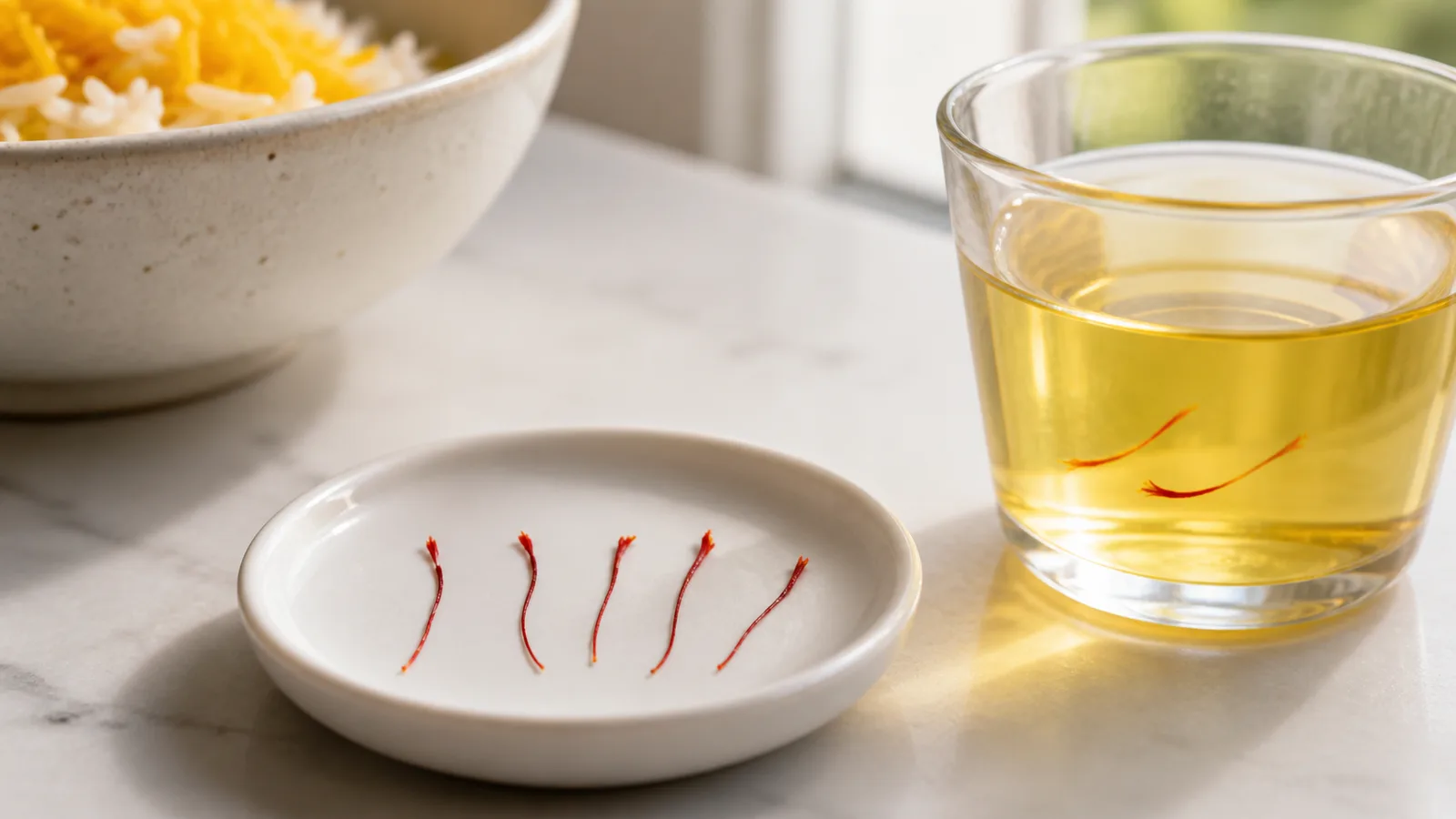
Good whole saffron should have a clean, characteristic aroma, deep red filaments and no obvious excess of yellow style or foreign material. Its flavour is complex—floral and hay-like, gently bitter and earthy rather than sugary. When bloomed in warm water, genuine threads release colour gradually. Laboratory methods are more dependable than a single home test, so traceability and honest labelling remain important.
Can saffron grow at home?
Yes, where the climate or container conditions suit the plant. Start with healthy Crocus sativus corms, use sharply drained soil and allow the corms a dry summer rest. Flowers generally appear in autumn, although the first crop can be modest and timing varies by climate. Our guide to growing your own saffron covers the practical setup.
A few pots are valuable for seeing how the plant grows, but they also make the commercial economics clear. Three stigmas per flower do not fill a kitchen jar quickly.
From field to the kitchen
Iran produces 90% of the world’s saffron in the familiar shorthand, and current FAO estimates place its share around 85–90% or more. Khorasan sits at the heart of that production because suitable growing conditions are matched by centuries of practical knowledge and an established harvest and processing system.
Origin gives useful context, not a guarantee. Choose traceable Crocus sativus threads, protect them from heat, light and moisture, and use a small amount well. For a practical starting point, see how much saffron to use for one cup of rice.