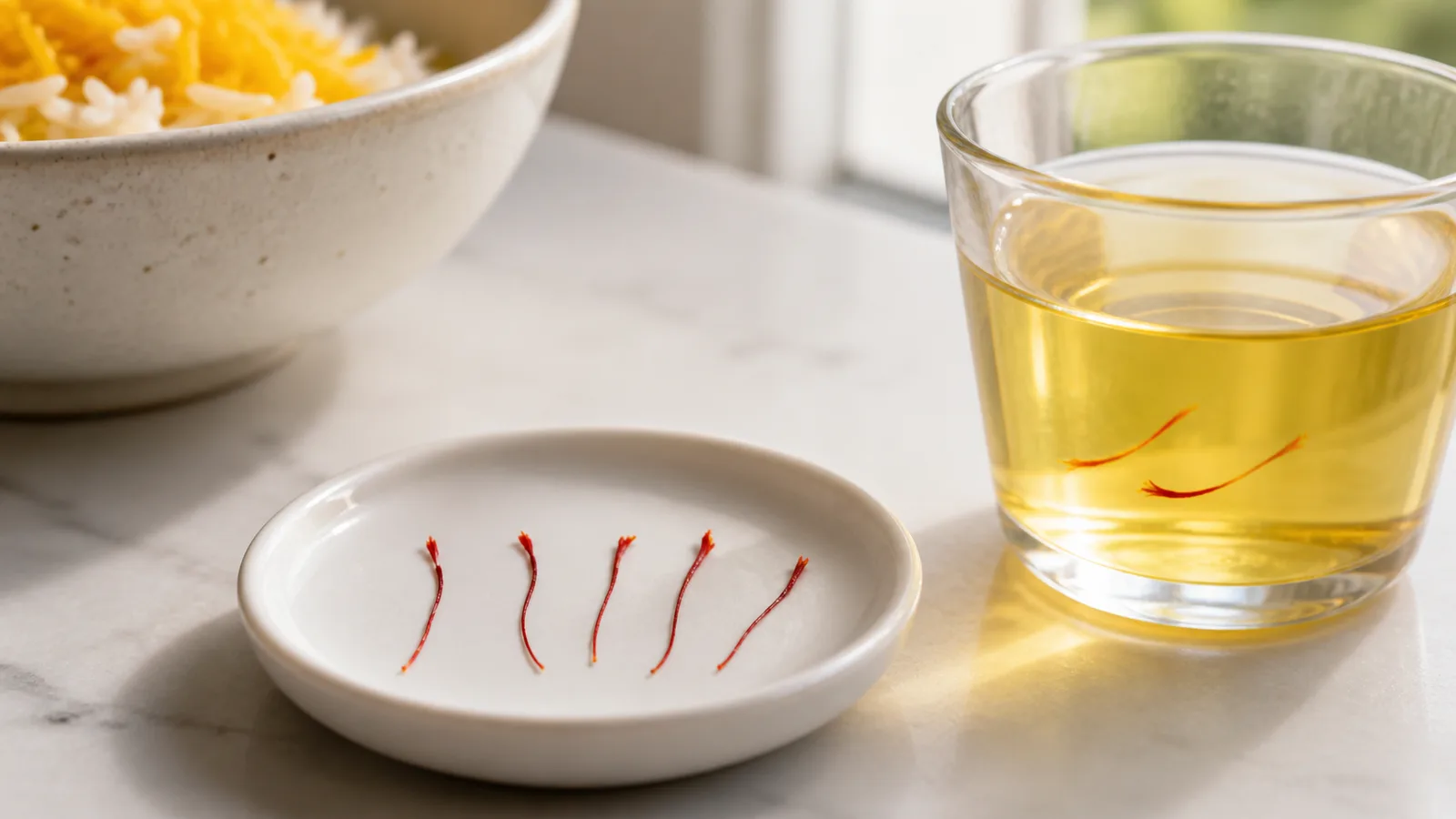
Why is Saffron So Expensive? Understanding the Key Factors
Why is saffron so expensive? Because every gram begins as thousands of fragile flower parts that must be harvested in a short season, separated, dried, sorted and protected. The plant can be grown in several countries, so saffron is not costly simply because it exists in only one place. Its price comes from low yield, concentrated handwork, crop risk, quality control and the long chain between a field and a small retail pack.
Why Saffron is So Expensive: The Labor-Intensive Harvesting Process
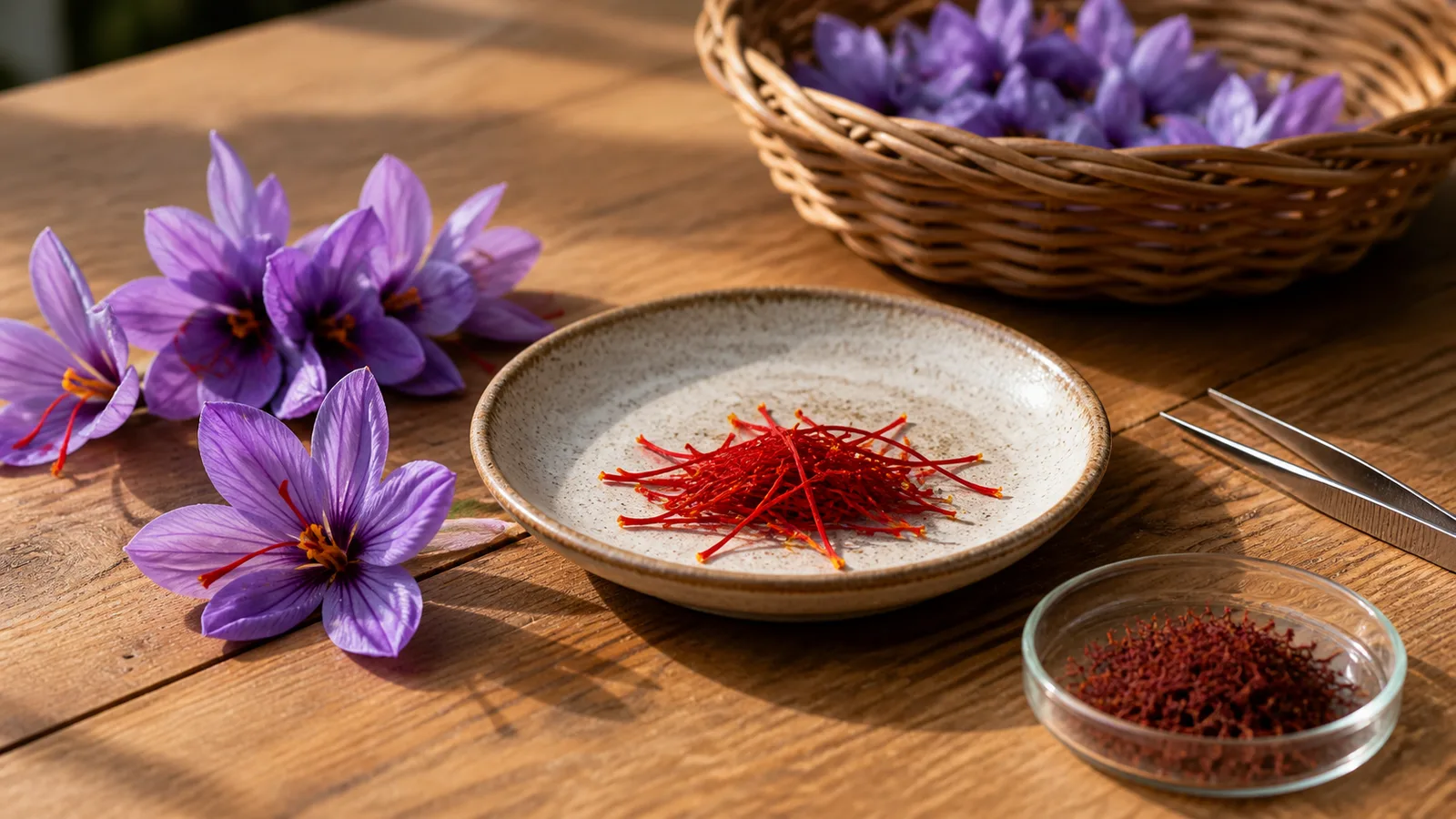
Each Crocus sativus flower has three red stigma branches. The flowers are commonly picked by hand, then the stigmas are separated before they deteriorate. The spice must be dried carefully: water is removed, so the final weight is much lower than the fresh harvest, while poor drying can damage colour and aroma.
A Food and Agriculture Organization publication gives an estimate of roughly 150,000–170,000 flowers for one kilogram of dried saffron. That is about 68,000–77,000 flowers per pound, which is why the familiar figure of 75,000 flowers for a pound is a reasonable midpoint rather than an exact biological rule.
The work is compressed into flowering days. Growers cannot postpone an open flower until a convenient week, and a machine has difficulty distinguishing the delicate red stigma from petals and yellow stamens without loss. Labour is needed for picking, separation, inspection and packing, even when farms use equipment for soil preparation, irrigation or other parts of production.
Why does one field produce so little finished spice?
Saffron is propagated from corms rather than seed. A field needs planting material, suitable soil, water management, weed and disease control, and repeated labour before the spice reaches a buyer. Flower and stigma yield vary with corm size, planting density, crop year, weather and field management. Field research on corm size and crop cycle shows why a fixed flowers-per-gram number cannot describe every harvest.
The plant is not “rare” in the sense of being impossible to cultivate outside one valley. It is grown in Iran, India, Spain, Greece, Morocco, Afghanistan and other regions. What is scarce is the finished dried stigma relative to the land, flowers and labour required. A large display of purple blooms turns into a surprisingly small amount of saleable spice.
The High Cost of Saffron: Geographical Scarcity and Limited Growing Regions
Climate and local knowledge still matter. Saffron needs conditions that support corm growth, flower initiation and a workable autumn harvest. A region also needs experienced labour, drying facilities, testing, storage and routes to market. That agricultural and commercial ecosystem takes time to build.
Origin alone does not set the price. “Spanish saffron,” “Iranian saffron” or “Kashmiri saffron” can refer to different grades, cuts, harvests, pack sizes and supply chains. A product packed in one country may contain saffron grown elsewhere, so credible origin information and traceability matter more than a romantic label.
Is saffron cheaper in Iran? A farm-gate or local wholesale price may be lower than a small export pack, but that is not an equal comparison. Export handling, testing, compliant packaging, currency conversion, tax, payment fees and delivery all affect the final amount. Compare products of the same net weight, grade, form and date.
Does a saffron shortage make it more expensive?
A poor crop, labour shortage, weather event, transport problem or trade disruption can tighten supply and raise prices. However, an evergreen article should not declare a current saffron shortage without dated market evidence. Harvest volume changes by place and year, and stock from earlier harvests may soften or delay a retail response.
Demand matters too. Food manufacturers, restaurants, retailers and households compete for different cuts and grades. A temporary surge in one market does not mean all saffron worldwide has the same shortage or price.
Why Saffron is Costly: The Importance of Quality and Careful Handling
Saffron is sold as long threads, shorter all-red pieces, styles mixed with red stigmas, broken material and powder. These are not automatically equivalent. Colouring strength, bitterness, aroma-related measures, moisture and foreign matter can be assessed under recognised testing standards. The grade name on a website is useful context, but it is not a laboratory result by itself.
Dry threads must be kept away from moisture, excessive heat, light and strong odours. Testing, sealed food-safe packaging and controlled storage add cost because they protect a product that can lose value through careless handling. Very small retail packs also cost more per gram: the container, label, picking, order processing and delivery are spread across less saffron.
Adulteration risk adds another layer. Dyed fibres, excess yellow style, fillers or an anonymous powder can create a low headline price without equal value. A trustworthy seller invests in identity, traceability and clear net-weight information. That work is less visible than the flower, but it belongs in the price.
Is saffron more expensive than gold?
The comparison is memorable but unreliable without a date and unit. Gold has a transparent market price that moves continually. Saffron ranges from bulk agricultural lots to tiny premium retail jars, and its price per kilogram changes with grade, origin, quantity, currency and seller. At some retail prices saffron can look dearer by weight; in other comparisons it will not. “More expensive than gold” is a headline, not a quality test.
For a cook, cost per dish is more useful than cost per kilogram. A modest amount can flavour several servings, so the portion cost may be manageable even when the per-kilogram figure is striking. Use a unit-price calculation and the amount your recipe actually needs.
How to compare saffron prices fairly
A 1 kg saffron price usually belongs to wholesale trade, while a one-gram jar includes retail handling and packaging. Do not compare those headline numbers without converting to the same grade, form, currency, date and delivered basis.
- Convert every offer to the same currency and price per gram.
- Compare the same form: whole threads, broken threads or powder.
- Check the grade or cut, net weight, origin claim and harvest or batch information.
- Add shipping, tax and payment conversion to the delivered cost.
- Look at the pack date and storage, not only the colour of a photograph.
- Be cautious when a price is far below comparable offers and traceability is absent.
For dated market context, use our saffron price page. For a live retail comparison, check the available weights in our all-red saffron selection; the product page and checkout are the final sources for the payable amount.
Conclusion: Why Saffron’s Price is Worth It
Saffron is worth its price when the product is authentic, suitable for the recipe and used with care. The cost reflects thousands of flowers, a narrow harvest window, manual separation, drying, quality control, storage and retail handling. It does not guarantee health benefits, prestige or quality simply because the number is high.
The best value is not automatically the cheapest or most expensive jar. Buy the cut and quantity you will use, compare unit and delivered cost, and choose traceability over a dramatic label.