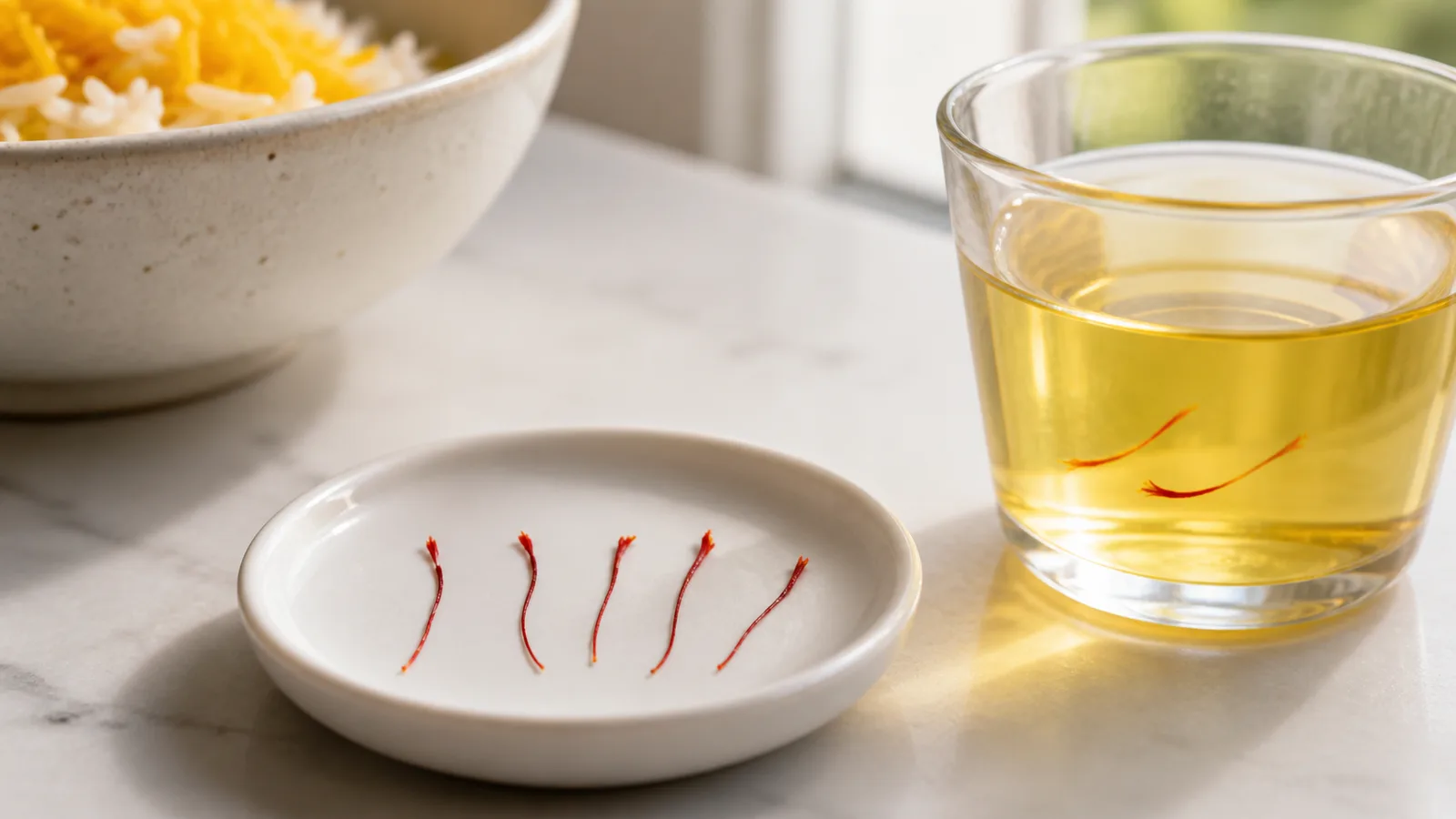
Can saffron be grown anywhere? Not successfully in every climate or soil, but it can grow far beyond Iran, India, Spain and Greece. The deciding factors are a sunny site, excellent drainage, a suitable seasonal cycle and healthy Crocus sativus corms. Wet ground during dormancy is often a bigger problem than winter cold.
Where can saffron be grown?
Saffron grows best where autumn is cool enough to trigger flowering, winter supports leaf growth, spring allows the new corms to develop, and dry summers protect the plant during dormancy. That pattern is common in Mediterranean and semi-arid regions, but gardeners can reproduce it in many temperate locations.
Iran remains the leading commercial producer, and well-known saffron growing regions also exist in Kashmir, Spain, Greece, Morocco and parts of Italy. Commercial history is useful evidence of suitability, but it is not a boundary. Smaller plantings are grown in the United Kingdom, the United States and other places with quite different climates.
The University of Nebraska Extension guide to saffron crocus places the plant in USDA hardiness zones 5–8 and recommends a protected site with at least five or six hours of direct sun. The Royal Horticultural Society’s growing guidance likewise calls for a bright, sunny position and rich but well-drained soil.
The four conditions that matter most
1. Fast-draining soil
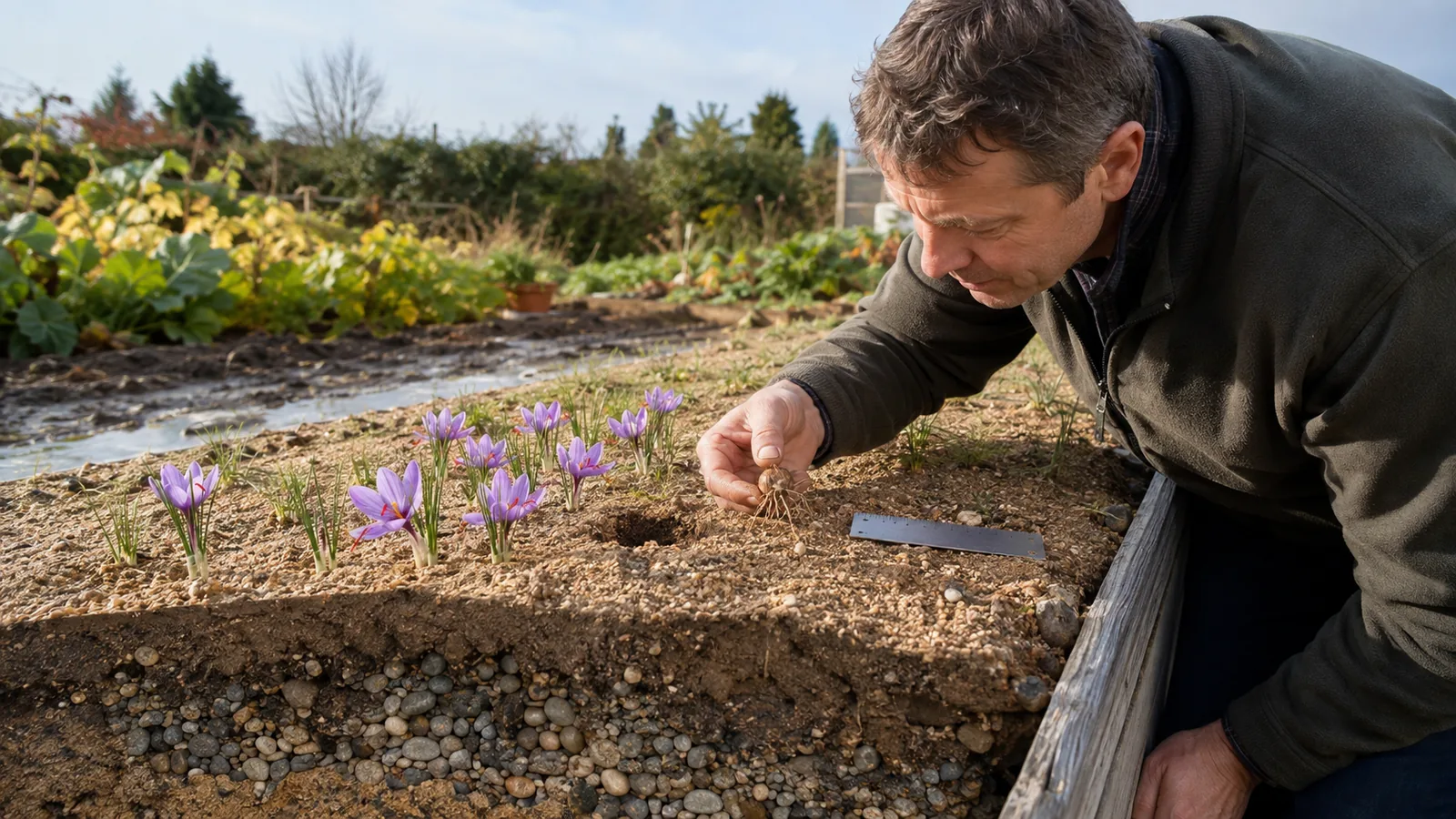
Crocus sativus grows from a corm, an underground storage stem often casually called a bulb. A corm sitting in waterlogged ground is vulnerable to rot. Sandy loam or a gritty, amended soil is easier to manage than compacted clay.
Drainage is not the same as infertility. Saffron still needs a soil that can support leaf growth and replacement corms. Organic matter may help structure, but it must not turn the planting hole into a wet pocket. On heavy ground, a raised bed or container is often more dependable than adding a little sand to a poorly drained hole.
2. A sunny position
Saffron performs best in full sun. Aim for at least six hours of direct light during active growth. Winter shade from buildings or evergreen trees can leave foliage weak and soil slow to dry. In very hot regions, afternoon protection may reduce stress, but deep shade is not a substitute for climate control.
3. The right moisture at the right time
The claim that saffron needs minimal rainfall throughout its growing season is misleading. Autumn moisture helps growth resume, and the leaves remain active through winter and spring. The critical point is to avoid prolonged saturation, especially around the corms, and to let the site become drier during summer dormancy.
Rain during flowering can damage delicate blooms and make harvest harder, while a completely dry growing period can limit corm development. Local rainfall, soil texture and drainage must be considered together.
4. A workable seasonal cycle
Saffron is more cold-hardy than its “Mediterranean crop” label suggests. Established corms can survive substantial winter cold in well-drained soil. Very mild tropical climates present a different challenge: heat, humidity and the lack of a clear cool season can disrupt flowering and increase disease pressure.
In borderline areas, a local microclimate matters. A south-facing wall, raised bed, unheated greenhouse or movable container can change soil temperature and moisture enough to make a small trial succeed.
Can saffron grow in the UK?
Yes. Saffron has a long English cultivation history, and the RHS rates Crocus sativus as hardy through very cold UK conditions. The challenge is usually wet soil rather than frost. Choose the sunniest free-draining spot available, or use a raised bed, alpine trough or container that can be kept from winter waterlogging.
Planting is normally done in late summer so roots and flowers can develop in autumn. First-year flowering may be modest or late. Keep the foliage in place after flowering; it feeds the new corms until it dies back naturally in late spring.
Where can you grow saffron in the US?
Many temperate parts of the United States can support a home planting. Extension recommendations vary: a University of Vermont saffron factsheet uses zones 4–8, while Nebraska Extension uses zones 5–8. Snow cover, soil drainage, summer rain and local microclimates differ, so treat a zone map as a starting point rather than a guarantee.
Cold inland gardens may benefit from mulch after the ground cools, provided it does not trap water. In humid eastern areas, raised beds and generous spacing improve drainage and airflow. In dry western areas, irrigation must support active autumn-to-spring growth without keeping dormant corms wet all summer.
Can saffron grow in a tropical climate?
A persistently hot, humid tropical climate is difficult for outdoor saffron. The plant needs a seasonal rhythm, and corm rot becomes harder to control where warm rain continues through dormancy. A high-altitude tropical site with cooler nights and a dry season may be more promising than a humid lowland site.
Containers can help because the grower controls the medium and can move dormant corms under cover. Even then, successful leaves do not guarantee flowers. Trial a small number of corms through at least two flowering cycles before investing in a commercial area.
What soil does saffron need?
A neutral to mildly alkaline, free-draining loam or sandy loam is a useful target. The exact pH is less important than avoiding compaction, standing water and a hard layer beneath the planting depth. A soil test can reveal pH, salinity and nutrient problems before expensive corms are planted.
Do not place fresh manure against the corms. Prepare the bed in advance, correct drainage across the whole root zone and use mature compost only where it improves structure. Our broader guide to choosing land for saffron cultivation covers field-scale soil, water and site checks.
Planting a small suitability trial
- Buy correctly identified Crocus sativus corms from a reputable supplier. The plant is sterile and is propagated by corm division, not ordinary seed.
- Choose two small sunny, well-drained test plots or containers rather than committing the whole site.
- Plant in late summer at the spacing and depth recommended for the corm size and local climate; guides commonly use about 10 cm spacing and 10–15 cm depth.
- Record planting date, rainfall or irrigation, emergence, flower count, harvest date and any rot or pest loss.
- Leave the leaves until they yellow naturally, then keep the dormant bed comparatively dry.
- Compare flowering and corm multiplication over two or three seasons before scaling up.
This trial answers “where does saffron grow best?” more reliably than a country name. Productive commercial cultivation also depends on labour, drying facilities, quality control and a market, not just whether a flower appears.
Do greenhouses make every location suitable?
A greenhouse can protect flowers from rain and give the grower more control over temperature and water. It can also overheat, hold humidity and add costs that the harvest never repays. Saffron does not need a warm tropical greenhouse; in many cool regions, an unheated structure used mainly to control wetness is more appropriate.
Indoor racks or controlled-environment systems can force corms to flower, but flowering uses reserves built previously in the corm. A complete production system must also support leaf growth and renewal corms. Count the entire cycle, energy use, labour and disease risk before calling greenhouse saffron profitable.
Harvesting is the final suitability test
Each Crocus sativus flower produces three red stigmas. Flowers open over a short autumn period and should be picked and processed promptly. The RHS estimates that about 150 flowers are needed for one gram of dried saffron, which explains why even a healthy garden patch produces a small harvest.
Commercial growers need enough trained labour for picking, separation and gentle drying on the days the crop flowers. A climate may suit the plant while the business still fails because that short labour window was ignored.
Safety and legal checks before planting
Growing saffron is generally lawful as ordinary horticulture, but rules for importing corms, plant health certificates, protected land and commercial food sales vary by location. Check the agricultural or plant-health authority where you live before ordering corms from another country.
Correct identification matters too. True saffron is Crocus sativus. Do not confuse it with Colchicum autumnale, often called meadow saffron or autumn crocus, which is poisonous. Buy named stock rather than collecting look-alike plants.
Can saffron be grown where you live?
Probably, if your site has strong sun, free drainage, a cool-season growth period and a drier dormancy. If those conditions are missing, containers, raised beds or rain cover may help—but they do not erase the plant’s seasonal needs.
Begin with a small trial and keep records. If the goal is culinary saffron rather than cultivation, the saffron products page offers ready-dried threads; for a site-specific commercial enquiry, use the contact page without changing either page.