


A historical plan proposed cultivation of saffron on 30 hectares for the first time in Zahedan. The land had not yet been reported as planted: the programme was presented as a water-efficiency measure alongside 50 hectares of cumin and existing nursery capacity.
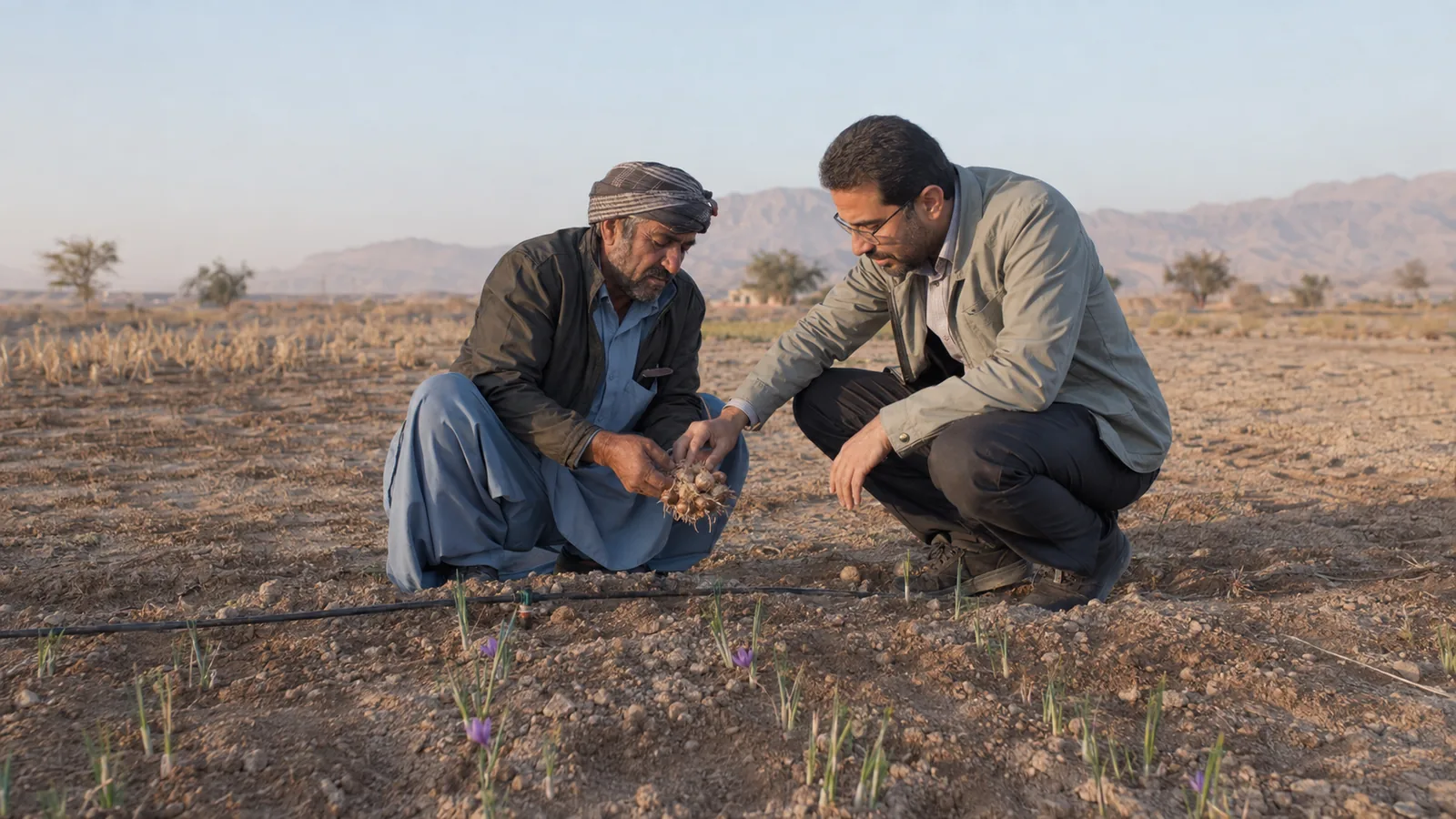
What the 30-hectare figure represents
Abbas Ashkani, identified as the director of Zahedan city’s Agricultural Jihad office, said 30 hectares of agricultural land could be planted with saffron during the year. The awkward “this 12 months” wording in the old translation means this year, not a twelve-month growing cycle.
This distinction matters. The report announced a programme and potential area; it did not publish a completed planting record or harvest result. The title is retained as a historical description, while the article makes the planning status explicit.
Why saffron entered Zahedan’s crop plan
Ashkani said the programme aimed to improve water efficiency. In a dry region, the timing and total demand of a crop influence whether it fits the available supply, but “low water use” should never be read as no water requirement.
Saffron’s summer dormancy and autumn-to-spring growth cycle can place much of its irrigation outside the hottest period. That calendar is useful only when the proposed field has suitable soil, drainage, temperature and dependable water at the necessary times.
Is saffron automatically the best alternative?
The historical report calls saffron the best alternative to crops with high agricultural water consumption and describes it as highly economical. Those are attributed programme claims, not guarantees for every farmer.
A sound comparison needs expected yield, corm and labour costs, irrigation efficiency, processing capacity and a realistic sale price. A crop can use less water than another option yet still be unsuitable for a particular field or household.
Later official evidence from the province
An official 2018 report described an 11-hectare saffron programme across several Sistan and Baluchestan counties, including Zahedan. It forecast 5 to 8 kilograms per hectare and estimated annual water needs at about 5,000 cubic metres per hectare.
Those later figures confirm regional interest in the crop, but they do not prove that the earlier 30-hectare Zahedan plan was fully planted. Dates and geographic scope must remain attached to the numbers.
Field suitability around Zahedan
Before planting, growers need to assess soil texture, drainage, salinity, frost pattern and irrigation-water quality. A plan made at city level cannot reveal whether one parcel will support healthy corms through a multi-year bed cycle.
A small trial area can provide better local evidence than immediately committing the full planned acreage. Records of planting material, irrigation, flowering and dried yield allow the next decision to be based on field performance.
The separate 50-hectare cumin programme
Ashkani also announced cumin cultivation on 50 hectares as another part of the local crop-pattern change. Cumin and saffron were separate programmes; the areas should not be added and presented as one saffron total.
The inclusion of both crops shows that the policy was broader than a single product. Diversification can spread production timing and risk, but each crop still requires its own agronomic and market assessment.
Five nursery units in Zahedan
The article identifies five seedling-production units as an important local agricultural capacity. Two were pistachio nurseries, while three produced seedlings for fruits suited to colder conditions.
These units were not saffron nurseries. Saffron is propagated from corms, not seedlings, so their role was to serve other farmers and demonstrate existing horticultural infrastructure rather than supply the proposed saffron fields.
The two 100,000 capacity figures
Ashkani placed the two pistachio nurseries at a combined capacity of 100,000 seedlings. The three cold-fruit units were described as producing more than 100,000 seedlings.
The old translation breaks down around “a seedling plot,” but the intended unit is plainly seedling production. The figures are preserved as reported capacities, without claiming that every available plant was sold or planted in that year.
What a saffron programme needs beyond planting
Thirty hectares would create a concentrated need for corm inspection, skilled planting, weed management and harvest labour. Flowers must be picked and processed quickly, so expansion without clean separation and drying space can shift the bottleneck from the field to post-harvest handling.
Traceability is important as well. Keeping lots tied to their farm and harvest date allows buyers to evaluate the actual product rather than relying on a broad claim about Zahedan origin.
Measuring water efficiency honestly
Water efficiency is not demonstrated by calling a crop low-consumption. It requires a measured volume of irrigation and a clearly defined result, such as dried saffron yield or net farm value, over the same period.
The official regional estimate of about 5,000 cubic metres per hectare provides context, not a fixed Zahedan prescription. Rainfall, soil and irrigation system losses all affect the actual amount applied and the benefit obtained.
How to read this first-time Zahedan plan
The historical article’s useful core is a proposed 30-hectare saffron programme led by Abbas Ashkani to improve agricultural water efficiency. It sat beside a separate 50-hectare cumin proposal and a local network of two pistachio and three cold-fruit seedling units.
Calling it a plan rather than a completed harvest preserves the source accurately. Later official reporting shows that saffron cultivation continued to be considered in Zahedan and neighbouring counties, but it cannot retroactively confirm that every hectare announced here was planted.

![Exporting Saffron to Turkey + Price Guide [Complete 0 to 100]](https://img.rowhanisaffron.com/20260827003933/saffron-export-turkey-quality-inspection.webp)



