


Torbat-e Jam saffron cultivation reached a reported 3,100 hectares after expanding by 550 hectares in the historical crop year covered here. Average yield was stated as 4.5 kilograms per hectare, and total harvest volume was said to be 16% higher than in the prior year. A separate Sirjan report shows a smaller program growing from 60 to 93 hectares.
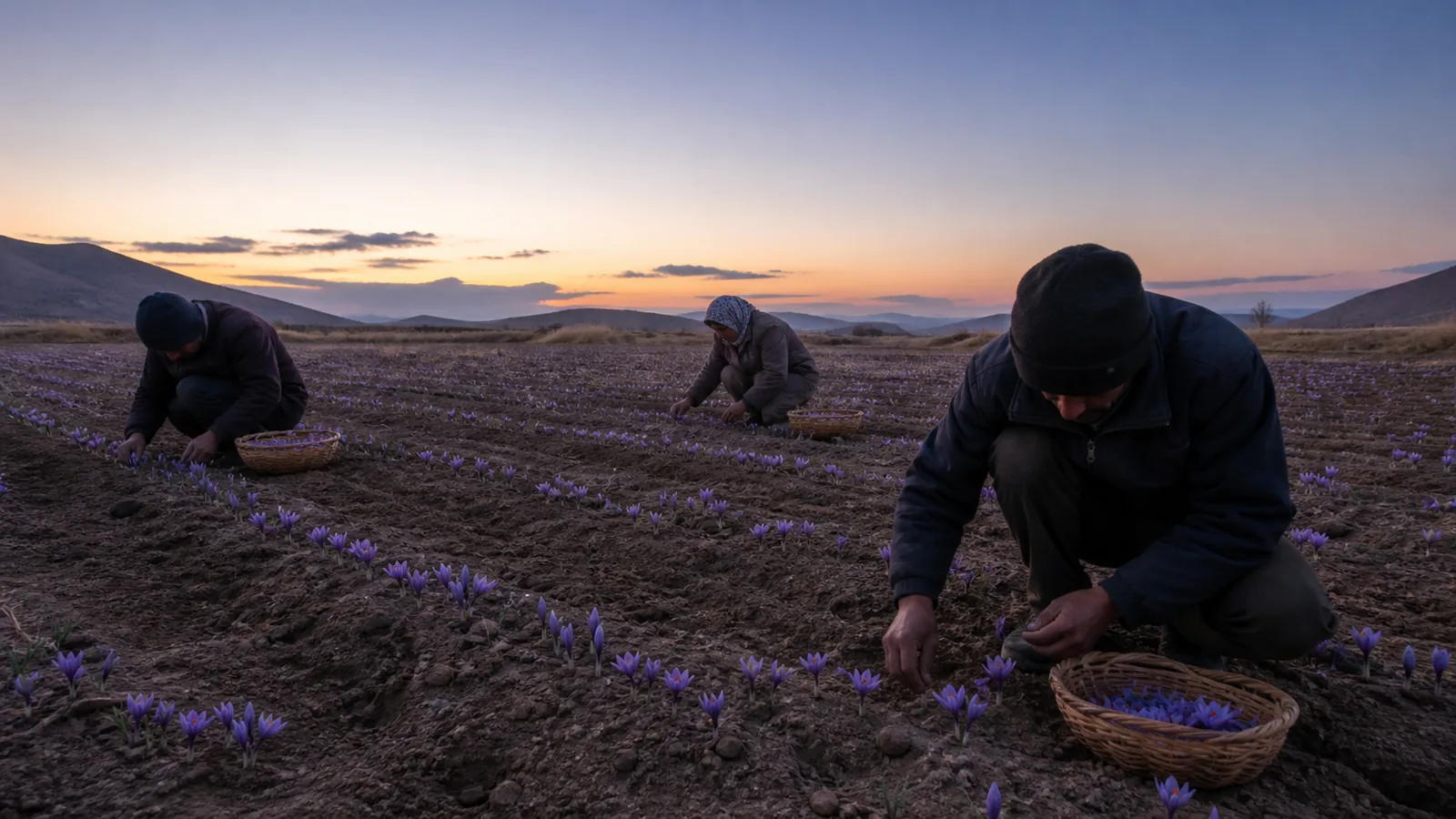
The two reports cover different provinces and scales. Torbat-e Jam is in Khorasan Razavi, within Iran’s main saffron-growing region. Sirjan is in Kerman province, where semi-desert conditions encouraged another local expansion. Their acreage and yield figures are historical snapshots, not current totals.
Torbat-e Jam added 550 hectares
Jafar Javadi, then director of the Torbat-e Jam Agricultural Jihad office, said cultivated area had increased by 550 hectares from the same point in the previous crop year. If the 3,100-hectare total and 550-hectare addition use the same definition, the earlier base was about 2,550 hectares. That represents acreage growth of roughly 21.6%.
The reported average harvest was 4.5 kilograms per hectare. Applying that average to all 3,100 hectares would imply about 13,950 kilograms, but the source does not publish a final total or separate mature productive land from younger fields. The multiplication is useful for checking scale; it is not a substitute for an official harvest result.
Javadi also said harvest volume in crop year 94–95 was about 16% above the previous year. The abbreviated year appears to refer to the Iranian calendar, but the translation does not provide enough context to assign a reliable Gregorian date.
Planting, harvest, and water context
The Torbat-e Jam report places planting in the first half of July and harvest in the second half of October. Javadi said most growers planted in water-scarce areas and described saffron as efficient because of relatively low costs and water demand.
That is an attributed program assessment, not a profitability guarantee. A crop can use less irrigation than some alternatives and still face high corm, labor, drying, quality-control, storage, and marketing costs. Site-level water requirements also vary with soil, temperature, rainfall, field age, and irrigation method.
The original page includes a short city history, population, and an area unit translated as 8,184 square metres—an obviously unusable figure for a city or county. Those details do not help a reader understand saffron production and are not repeated.
Sirjan grew from 60 to 93 hectares
Akbar Mahmoudabadi, then director of Sirjan’s Agricultural Jihad office, reported that saffron area had risen from 60 hectares to 93. The source headline calls this a 30-hectare increase, but the displayed figures differ by 33 hectares. On those figures, the year-on-year increase was 55%.
Sirjan produced a reported 190 kilograms from the 93 hectares. That works out to about 2.0 kilograms per hectare if all planted land is included. The result is less than half Torbat-e Jam’s stated 4.5-kilogram average, but it does not prove that Sirjan’s mature fields were less productive. New plantings, field age, weather, and how each report defined cultivated area can change the province-wide ratio.
The crop was valued at 11.5 billion rials. Dividing by 190 kilograms gives an implied average near 60.5 million rials per kilogram. That is a source-period gross value, not a current price or farm profit. The report gives no grade mix, costs, buyer terms, or payment timing.
The Sirjan labor figures do not reconcile
The source says harvesting employed “200 people per hectare” over six weeks and “18,000 people every day.” Multiplying 200 by 93 hectares gives 18,600, not 18,000. More importantly, it does not define whether 200 means individual workers, worker-days, shifts, or a cumulative seasonal labor requirement.
A literal claim of 18,000 people working every day on 93 hectares would mean nearly 194 workers per hectare at the same time, an extraordinary density that the article does not substantiate. The safe conclusion is that the report intended to emphasize substantial seasonal employment, but its translated unit and daily total cannot support a precise workforce count.
Sirjan lies on a broad plain between mountain ranges in western Kerman province and was described as having a semi-desert climate with cold, dry winters and mild summers. Mahmoudabadi attributed adoption to local climate, lower water demand, and expected farmer returns. The actual 190-kilogram harvest provides stronger evidence than the general profitability claim.
What the comparison shows
Torbat-e Jam operated at roughly thirty-three times Sirjan’s reported area. It also reported a higher average yield. Sirjan, however, showed faster proportional acreage growth, moving from 60 to 93 hectares in one reporting period.
Neither report contains enough cost, water, grade, or final-sales data to rank profitability. A reliable regional comparison would need mature productive hectares, dried output, laboratory quality, irrigation volume, corm and labor costs, sale value, and the same crop year.
Together, the reports document two different paths within saffron production in Iran: large-scale expansion in an established Khorasan center and rapid percentage growth from a smaller Kerman base. Keeping scale, maturity, and data quality visible makes the comparison useful.

![Exporting Saffron to Turkey + Price Guide [Complete 0 to 100]](https://img.rowhanisaffron.com/20260827003933/saffron-export-turkey-quality-inspection.webp)



