


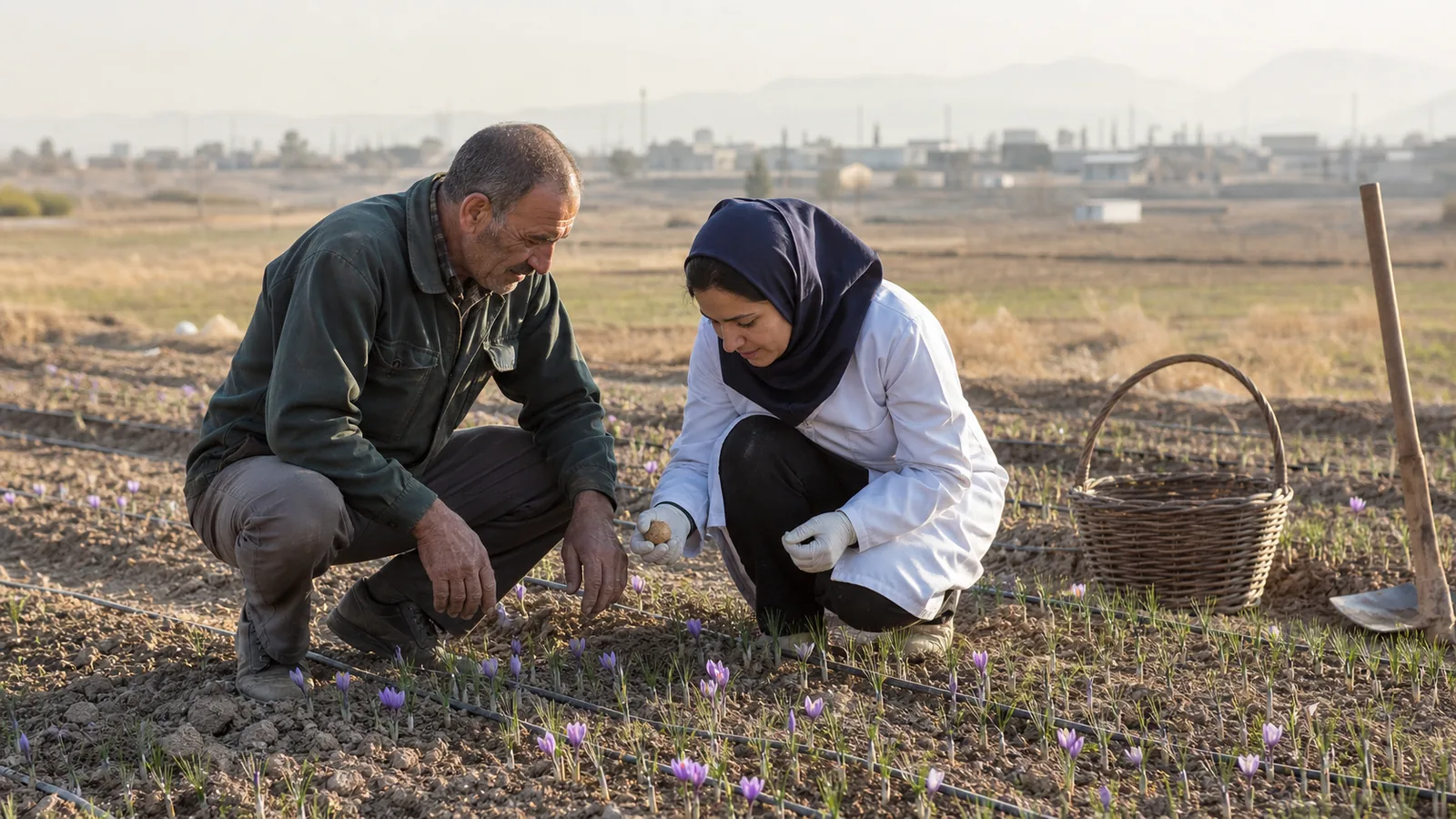
A 50% increase in saffron cultivation in Rey city lands took the reported area from 10 hectares to 15 hectares in the crop’s second local season. Fields in Hassanabad, Fashafoyeh and Kahrizak were included in the expansion, which was presented as a response to water limits and farmer interest. These are figures from the original seasonal announcement, not a current acreage count.
What changed in Rey’s saffron fields
Jibril Baradari, then director of Rey Agricultural Jihad, announced the start of saffron harvesting across 15 hectares. He said the area had increased by about 50% from the 10 hectares planted in the previous year.
The arithmetic supports that headline: adding five hectares to a 10-hectare base is a 50% increase. It was still a small trial within Rey’s much larger agricultural economy, but the second-year expansion showed that growers were willing to test saffron beyond its best-known production centres.
The reported fields were spread across Hassanabad, Fashafoyeh and Kahrizak. Keeping those district names attached to the figures matters because “Rey” covers varied land, water access and local conditions; a result from one farm should not be assumed for the whole county.
Why farmers considered saffron for Rey
Baradari described saffron as a productive option with relatively low water demand and a useful fit for Rey’s climate. The plant’s summer dormancy was especially relevant: the announcement said it did not require irrigation during the warm May-to-September period when many other crops place pressure on available water.
That point needs a little precision. Saffron is not a no-water crop. The FAO’s account of Iran’s qanat-based saffron system says it requires comparatively little water, while dependable irrigation remains part of the farming system. Rainfall, soil, corm development and pre-flowering conditions determine what a particular field needs.
Its seasonal pattern can still be helpful in a dry area. Demand is concentrated outside the hottest months, and the harvest has high value relative to its physical weight. Neither advantage guarantees a profit. Growers must also account for planting stock, field preparation, labour, drying, testing and access to a trustworthy buyer.
A perennial crop, not an annual replanting job
The original report said saffron corms did not need to be replanted for up to three years. That is plausible as a local management cycle, though it should not be treated as a universal limit. FAO’s Crocus sativus crop profile describes saffron as perennial and notes that corms can remain in the field for several years.
Each season, the planted mother corm produces replacement corms below ground. Over time the stand can become crowded, which is why growers eventually lift, grade and replant healthy material. The right interval depends on planting density, disease pressure, soil drainage, corm size and the farm’s production plan.
Baradari also said the crop became economically profitable from its third year. That was an observation about the local development programme, not a promise to every grower. A field may flower earlier, but the cost of establishing it and the time needed for the stand to mature affect when the initial investment is recovered.
The labour constraint arrives at harvest
Harvesting in Rey was expected to begin in early November. Flowering happens in a short window, and a field needs repeated visits because new blooms can emerge each morning. The original announcement identified the need for many skilled harvest workers as one of the main limitations on expansion.
Picking is only the first step. Fresh flowers have to be moved gently, and the red stigmas must be separated without carrying excess yellow style into the finished product. Drying must then reduce moisture promptly without scorching the saffron or dulling its aroma. A grower who adds hectares without arranging enough labour and clean processing space can lose quality at the busiest point of the season.
For a 15-hectare programme, labour planning is therefore as important as planting. Farms need realistic estimates for daily flower volume, trained pickers, transport, separation capacity and drying equipment before flowering starts.
Export potential without an automatic market
Baradari called saffron an export product and argued that expanding it could raise farm income while earning foreign exchange. “Export-oriented” is the more accurate description. Saffron can be sold domestically, and growing it does not by itself secure an export order.
Export value depends on the finished lot: cleanliness, moisture, colour strength, aroma, traceability, packaging and compliance with the buyer’s specification. Farmers also need to know who will purchase the crop, how grade will be determined, when payment will be made and which party carries the processing and testing costs.
Rey’s Agricultural Jihad said it would support farmers with advice and production inputs. Those services were part of the historical announcement. Anyone seeking current assistance should confirm the programme, eligibility and available inputs directly with the local agricultural office rather than relying on the old notice.
How the 15 hectares fit Rey’s agricultural scale
The report placed the saffron trial within approximately 29,000 hectares of agricultural land in Rey and annual production of around 850,000 tonnes of agricultural goods. Against that background, 15 hectares was not a replacement for the county’s established crops. It was a modest diversification effort.
That scale is useful when interpreting the 50% headline. The percentage was large because the starting area was only 10 hectares; the absolute increase was five. The project still mattered as a practical test of climate fit, labour availability and grower economics across Hassanabad, Fashafoyeh and Kahrizak.
The lasting lesson is not that every Rey farm should plant saffron. It is that a lower-water perennial can earn a place in local planning when the field is suitable, labour is secured and the route to market is clear. The original 10-to-15-hectare expansion recorded the beginning of that evaluation, not its final result.

![Exporting Saffron to Turkey + Price Guide [Complete 0 to 100]](https://img.rowhanisaffron.com/20260827003933/saffron-export-turkey-quality-inspection.webp)



