


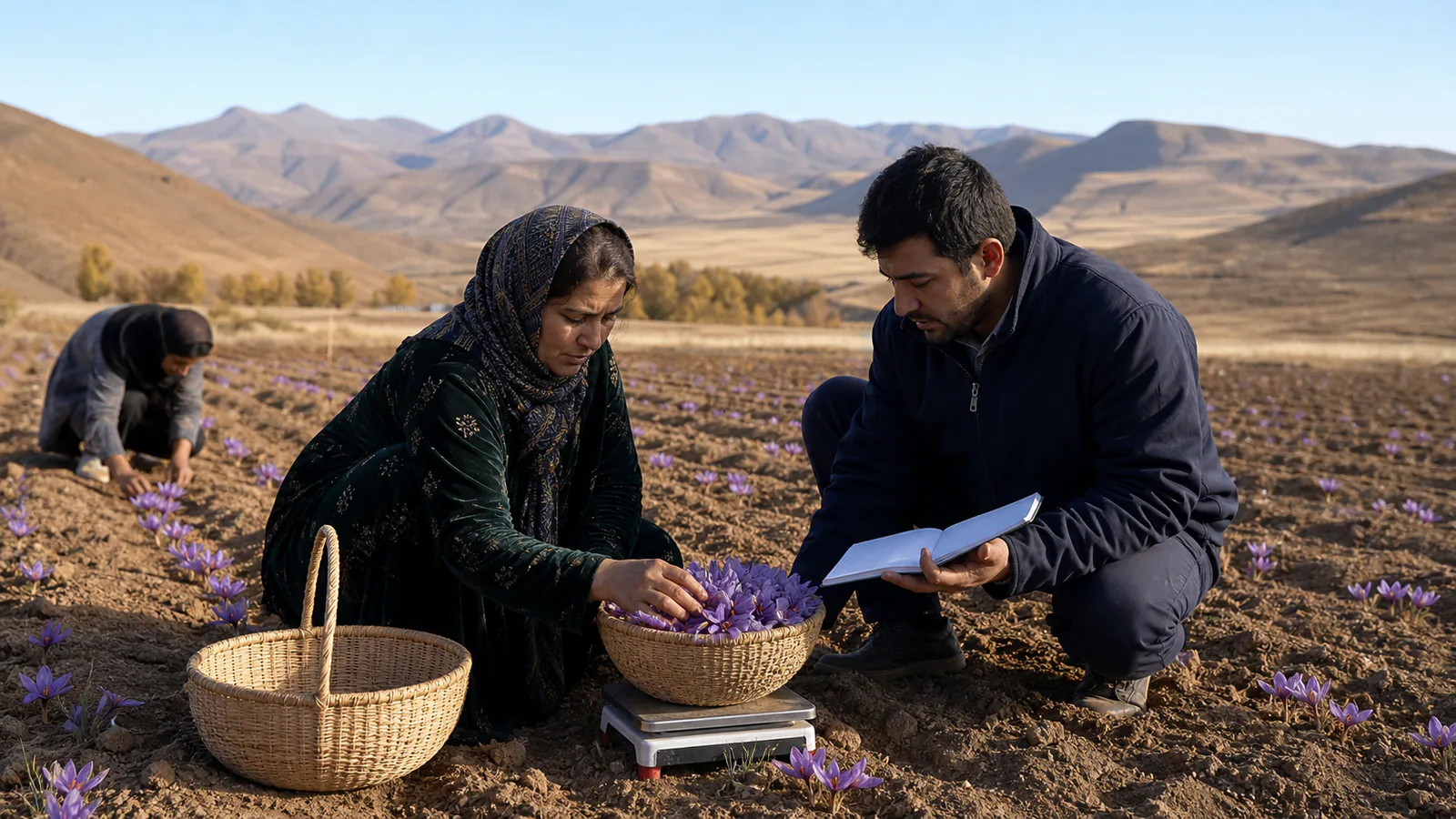
A historical Fars agriculture report forecast more than 3.8 tonnes of saffron at a provincial average of five kilograms per hectare. It identified Estahban, Sepidan, and Eghlid as leading cool-climate production areas. The assigned South Khorasan source adds a useful comparison—but its title says 37 kg/ha while its body clearly reports three kg/ha. There is no evidence in the source for a 37-kilogram result.
Both articles mix forecasts, averages, producer experience, and promotional claims. This unified account keeps their useful figures while separating what was measured, what was expected, and what cannot be reconciled from the surviving text.
What the five kg/ha Fars figure represented
Mehrzad Kherad, identified as the head of Fars Agricultural Jihad, predicted that the province would harvest more than 3,800 kilograms of dry saffron in the reported year. He gave five kilograms per hectare as the average yield.
Those rounded figures imply roughly 760 productive hectares when 3,800 kilograms is divided by five. The article does not state total provincial saffron area, however, so 760 hectares is an arithmetic implication—not an independently reported land figure.
The figures are also forecasts rather than final harvest records. A complete result would state measured dry weight, harvested area, field ages, and whether damaged or nonproductive plots were included.
Estahban’s numbers do not match the provincial average
Mohammad Mehdi Sharafi, identified as Estahban’s governor, said 450 hectares in the county were dedicated to saffron and expected 1,500 kilograms of dried spice.
That forecast equals about 3.33 kilograms per hectare, not five. The stored article also contains a sentence suggesting five kilograms was harvested from the Estahban land, but 450 hectares at five kilograms would yield 2,250 kilograms.
The likely possibilities are that five kilograms was the Fars-wide average, that not all 450 hectares were productive, or that one figure was rounded or mistranslated. The source provides no field-level table, so choosing one explanation would be speculation. The safest account preserves 450 hectares and the 1,500-kilogram forecast while showing the arithmetic openly.
Where Fars saffron production was concentrated
Kherad named Estahban, Sepidan, and Eghlid among the province’s main saffron centers, describing the leading areas as cooler cities. The report placed Fars fifth in saffron production after Khorasan Razavi, South Khorasan, North Khorasan, and Isfahan.
That ranking belongs to the report’s period. It cannot be treated as current without the same-year production totals and consistent boundaries for every province.
Sharafi said 70% of Estahban saffron was consumed within Iran and the balance was exported to Persian Gulf markets, China, South Korea, Japan, Germany, and Spain. No customs data, weights by destination, or reporting year are supplied, so the split and market list remain historical local statements.
The “37 kg/ha” South Khorasan title is unsupported
The assigned source is titled “Harvesting 37 kg of dry saffron per hectare in South Khorasan.” Its first paragraph instead says producer Habibeh Almani harvested three kilograms of dry saffron per hectare while facing drought and other difficulties.
Nothing in the body reports 37 kilograms, 3.7 kilograms, or a calculation that could produce 37. The title is therefore best treated as an editorial or translation error. A visitor arriving from that old headline should find the correction immediately: the article supports three kg/ha, not 37.
The three-kilogram producer result is lower than Fars’s reported five-kilogram provincial average, but the two cannot rank the provinces. One is an individual South Khorasan account under drought; the other is a forecasted provincial average with no farm distribution.
Drought increased the reported irrigation frequency
Almani identified water shortage as the leading challenge and said saffron-field irrigation had increased from five to seven rounds during successive drought. The machine translation also contains an unclear rainfall phrase, so no precipitation amount or trend should be inferred from it.
More irrigation rounds do not automatically mean more total water or better yield. Timing, depth, soil storage, rainfall, evapotranspiration, corm development, and irrigation efficiency determine the response. A two-year Iranian experiment found that irrigation schedule and mother-corm size affected flower yield, quality measures, daughter corms, and nutrient uptake.
That research supports careful local management, not a universal seven-irrigation prescription. A grower should use soil, crop stage, weather, and qualified local advice rather than copying the count from a historical interview.
Prices were said to cover little beyond planting cost
Almani said market prices had improved somewhat after consultations but still covered planting costs only to a limited degree and left growers with little profit. The source gives no price, grade, cost ledger, harvest year, or definition of “planting costs.”
This remains an attributed historical account rather than a current margin estimate. Profit depends on saleable dry yield, quality, corm and land costs, irrigation, hand labor, drying, testing, packaging, finance, and the actual price and payment terms.
Yield alone cannot resolve the problem. A five-kilogram field with high labor and weak price may return less than a three-kilogram field with better quality, lower costs, or a stronger buyer contract.
What the Torbat-e Heydarieh exchange claim meant
The South Khorasan source said saffron had been listed on an exchange in Torbat-e Heydarieh and that this helped packaging companies participate. It also referred to consultations intended to introduce South Khorasan saffron and support exports.
The article does not name the instrument, contract terms, traded volume, delivery standard, date, or measurable effect on farmer prices. The statement can be preserved as a market-development effort, but it does not prove that exchange access solved profitability or guaranteed sales.
Transparent grading, lot identity, testing, settlement, storage, and delivery rules matter more than the existence of a trading venue alone. Current decisions require current exchange and buyer documentation.
Corm movement does not determine quality by itself
Almani was concerned that South Khorasan corms were being sent around Iran and suggested saffron grown elsewhere would not match regional quality and could lower the national average. This is a regional producer’s view, not a conclusion established by the article.
Provenance can influence performance, but it interacts with environment and management. A three-year study of corms from nine Iranian regions found differences in yield and bioactive compounds, with no single provenance leading every trait.
Moving corms also raises plant-health and traceability questions. Buyers and growers need healthy, inspected planting material and records of origin. Province alone cannot guarantee yield, purity, color, aroma, or freedom from disease.
Regional quality claims need batch evidence
The Fars report called its saffron’s flavor and overall quality superior, while crediting Khorasan for strong color. Sharafi also described Estahban saffron as high quality compared with other Iranian origins.
No matched samples, moisture results, grade distribution, laboratory measurements, or blinded sensory panel are supplied. These claims should remain attributed. Current FAO work on Iran’s saffron sector emphasizes testing, post-harvest control, authenticity, and traceability because regional reputation is not a substitute for batch evidence.
A useful comparison would test representative lots from the same season under consistent sampling, drying, storage, and analytical methods. Without that design, “better flavor” is marketing language rather than a verified ranking.
Multi-year fields require a replacement plan
Sharafi said one saffron planting could be harvested for up to seven years, after which crowded corms would be lifted and moved by growers. The description captures the multi-year nature of saffron but should not become a fixed replacement rule.
Field longevity depends on corm density, daughter-corm multiplication, soil, disease, water, and economics. Crowding can reduce flowering and complicate health management. Growers should track yield and corm condition annually, then decide whether to thin, lift, or replant based on evidence rather than the calendar alone.
Our review of a Khomein high-yield claim lists the field records needed to substantiate kilograms per hectare and compare a result over time.
What the combined Fars and South Khorasan record shows
The Fars report supports a historical 3.8-tonne provincial forecast, a stated five-kg/ha average, three named production centers, 450 hectares in Estahban, a conflicting 1,500-kilogram Estahban forecast, and an attributed domestic/export split.
The South Khorasan source contributes an actual three-kg/ha producer statement—not the 37 in its title—along with drought, increased irrigation frequency, weak profitability, exchange-market efforts, export promotion, and concern about corm movement.
Neither article establishes a current provincial yield or a quality hierarchy. Their practical lesson is to reconcile area and weight, label forecasts, verify striking headlines, document water and costs, test representative batches, and follow corm health wherever cultivation expands.

![Exporting Saffron to Turkey + Price Guide [Complete 0 to 100]](https://img.rowhanisaffron.com/20260827003933/saffron-export-turkey-quality-inspection.webp)



