


A historical Khomein report described 14.68 kilograms of dry saffron per hectare as roughly twice its stated national average, while 16 kilograms per hectare was presented as a possible result for a supported sample farm. The distinction matters: the surviving English versions sometimes turn the 16-kilogram projection into a completed harvest, but the fuller account identifies it as an expectation under favorable weather and timely rain.
The report is valuable as a case study, not as a current regional average or a yield promise. It connects one farmer’s field management with local finance, harvest labor, packaging ambitions, and a public cultivation program. It does not provide the field records, dry-weight method, quality tests, or statistical sample needed to generalize the headline result.
Was 16 kg of saffron per hectare actually harvested?
The most defensible reading is that 14 kilograms and 680 grams per hectare was the reported result and 16 kilograms was the next target or forecast. Beheshti, identified as the Khomein construction-mobilization official, said timely rainfall and weather could allow the sample farm to reach 16 kilograms.
The destination profile opens as if farmer Mohsen Kazemi had already harvested 16 kilograms per hectare. Later, however, its machine-translated text says his previous result was lower and would increase to 16. The assigned source supplies the clearer 14.68-kilogram figure. Without a dated weigh ticket or final season report, the article should not convert the projection into an accomplished yield.
Both numbers remain historical claims. The quoted national average of seven kilograms per hectare belongs to the same report and period; it is not a current benchmark for all of Iran. Area, weather, field age, corm density, and reporting methods can make a simple national comparison misleading.
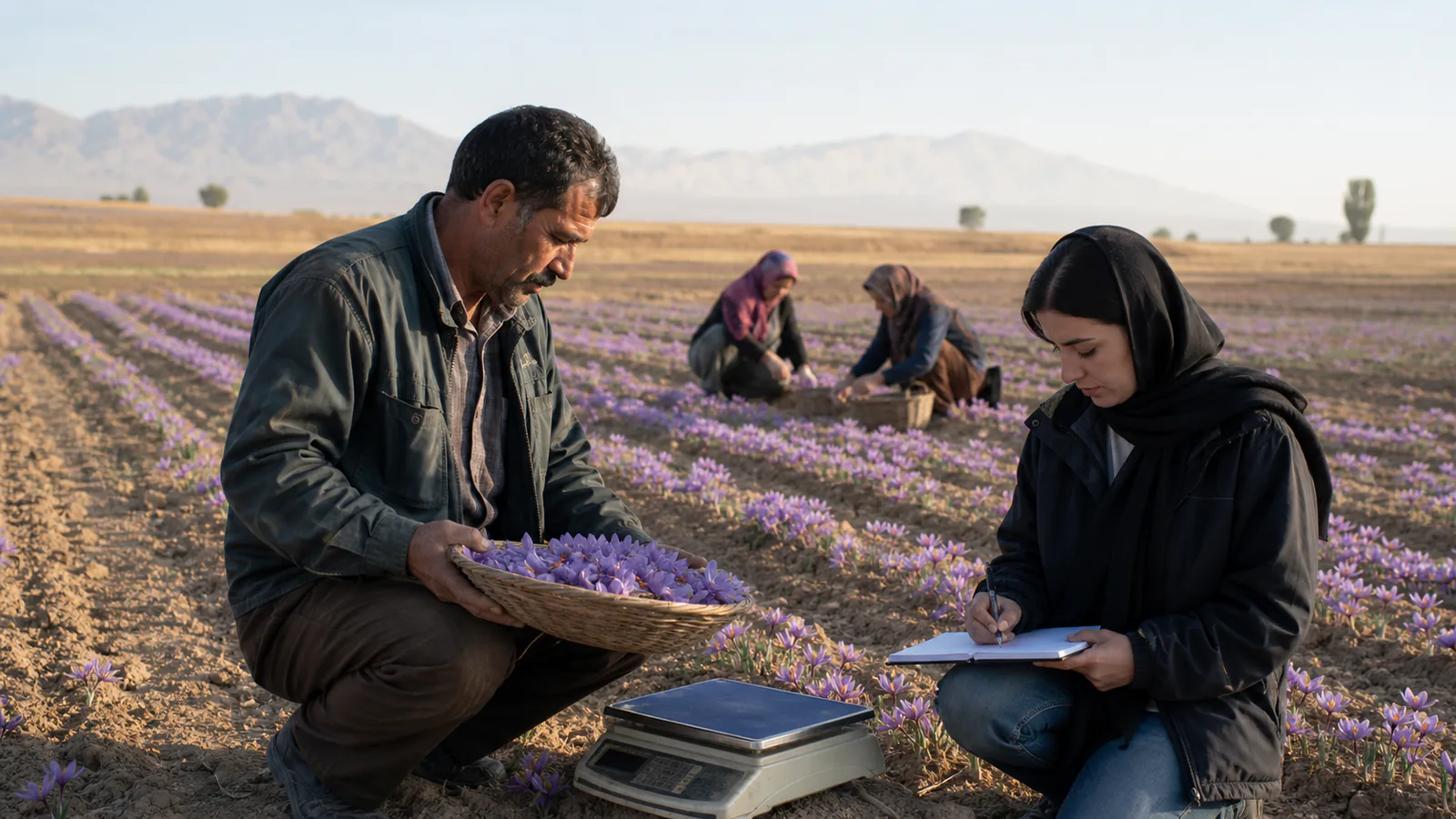
Mohsen Kazemi’s Khomein farm
Kazemi said he cultivated saffron on 13,000 square metres, equivalent to 1.3 hectares, and had more than five years of experience. He credited assistance from the local construction-mobilization program and a bank facility connected to what the articles called a “resistance economy” plan.
The story does not state the farm’s total dry-saffron weight. Applying 14.68 or 16 kilograms per hectare to all 1.3 hectares would create an estimate, not a reported result, because the productive area and uniformity of the field are unknown. A responsible farm record would identify the exact harvested area and the dry weight from that same area.
For comparison, a separate local account of a saffron harvest in Buin Zahra shows how district totals can hide differences in field age and management. A headline yield is only useful when its denominator and measurement method are clear.
What the farmer said drove the result
Kazemi attributed performance to timely crop care, suitable irrigation, livestock manure, weed control, and advice from agricultural specialists. These are plausible management categories, but the article gives no rates, timings, soil analysis, treatment comparison, or control field. His explanation should remain an experienced farmer’s account rather than a transferable recipe.
Peer-reviewed Iranian research supports the broader point that management variables interact. A two-year experiment on irrigation rounds and mother-corm size found effects on flower yield, quality measurements, daughter-corm behavior, and nutrient uptake. Another study of 110 Gonabad farms found that planting density and field age influenced technical efficiency.
That evidence does not verify the Khomein number; it explains why “do what this farmer did” is not enough. Manure should be based on soil and nutrient needs, irrigation on local conditions, and corm selection on health and suitability. Excessive density can produce early gains while shortening productive field life.
The city average and the sample farm were different claims
The source described 14.68 kilograms per hectare as Khomein’s reported average and called it twice the seven-kilogram national average. It then said 16 kilograms might be possible on the construction campaign’s sample farm. Those statements should not be blended into “Khomein harvested 16 kilograms per hectare.”
A city average also requires more context than the source provides. It does not state the number of farms measured, total harvested area, whether low-yielding young fields were included, or how dry saffron was weighed. If 14.68 kilograms truly represented a whole-city average, the underlying aggregate data should reconcile with it.
The safe conclusion is narrower: a local official reported unusually strong performance and expected the supported demonstration field to approach 16 kilograms under favorable conditions. Current growers need current, auditable local data before using either figure in a budget.
Harvesting and stigma separation required daily labor
Kazemi reported that 15 people worked each day on harvesting and 20 on cleaning or separating the saffron. The same sentence appears twice in the old destination; it represents one labor statement, not two separate teams reported at different times.
The wording does not define whether the workers were employed for the entire flowering season, for peak days only, or for how many hours. It nevertheless shows an important constraint behind high yields: flowers must be picked and their stigmas separated promptly during a short, concentrated season.
Labor productivity should be recorded alongside yield. Kilograms per hectare can look impressive while the net return remains weak if picking, separation, drying, transport, or rejected material consumes too much value. The relevant comparison is saleable, specification-compliant saffron against all field and post-harvest costs.
The cultivation program began with an economic study
Beheshti said the local program followed discussions and operational research by an economics working group. The source presented saffron as a lower-water crop suited to Khomein’s climate and as an alternative within a regional development plan.
“Lower water” should not be read as water-free. Saffron’s cool-season cycle can reduce competition with summer crops, but yield still responds to irrigation, rainfall timing, soil, and corm development. Site suitability must be tested, especially where drainage, salinity, or disease pressure creates risk.
The old report does not publish the working group’s study, assumptions, prices, or comparison crops. Its conclusion can explain why support was offered, but it cannot substitute for a current farm budget or water plan.
What the loan figures do and do not tell us
The source said the supported amount rose from five million to 10 million per hectare. It also reported a change from a 4% facility fee in the previous year to a 16% commission after a change in participating banks.
The surviving translation does not consistently identify the currency, repayment period, security, grace period, or whether “commission” meant interest, a fee, or another financing charge. One corrupted sentence also inserts an unexplained 300-million figure. Repeating that fragment would create false precision, so it is excluded.
These are historical program terms, not an available offer. The useful lesson is that subsidized finance can change a project’s economics substantially. A current applicant would need the lender’s written principal, currency, annual percentage cost, payment schedule, collateral, insurance, and default conditions before comparing cultivation options.
Quality and packaging were goals, not proven outcomes
Kazemi attributed good quality to Khomein’s land and hoped that packaging, branding, official support, and export access would improve. The articles provide no laboratory measurements, grade distribution, moisture results, sensory comparison, or export transaction.
Local origin can be meaningful, but quality must be demonstrated batch by batch. Color strength, aroma-related characteristics, bitterness, moisture, purity, foreign matter, and traceability all matter to buyers. Packaging protects a verified product and communicates its identity; it cannot repair weak drying or contamination.
The same distinction applies to yield. More kilograms create opportunity only if the crop is dried consistently and sold to a market that rewards its specification. Our review of Isfahan saffron farming explains why reported output, quality, water, and economics should be assessed together.
What would substantiate a 16 kg/ha result
A strong verification record would include:
- the mapped and measured area actually harvested;
- flower and dry-stigma weights by harvest date;
- the drying method and final moisture condition;
- field age, planting density, corm size and health;
- irrigation, rainfall, soil amendments, and weed or disease management;
- labor hours for picking, separation, drying, and packing; and
- a representative quality test plus saleable weight and realized price.
Those records would allow a buyer, grower, or extension specialist to distinguish a genuine high-performing field from a rounded claim, a forecast, or a result affected by inconsistent area measurement.
The lasting lesson from the Khomein report
The report does not establish that 16 kilograms per hectare was harvested across Khomein. It records a 14.68-kilogram local claim, a 16-kilogram sample-farm target, one farmer’s management account, substantial daily labor, and a public finance program intended to encourage cultivation.
That is still useful. It shows the conditions a high-yield claim should prompt readers to examine: what was measured, over what area, in which field year, with which inputs, at what labor cost, and with what final quality. Yield becomes meaningful only when those parts remain attached to the number.

![Exporting Saffron to Turkey + Price Guide [Complete 0 to 100]](https://img.rowhanisaffron.com/20260827003933/saffron-export-turkey-quality-inspection.webp)



