


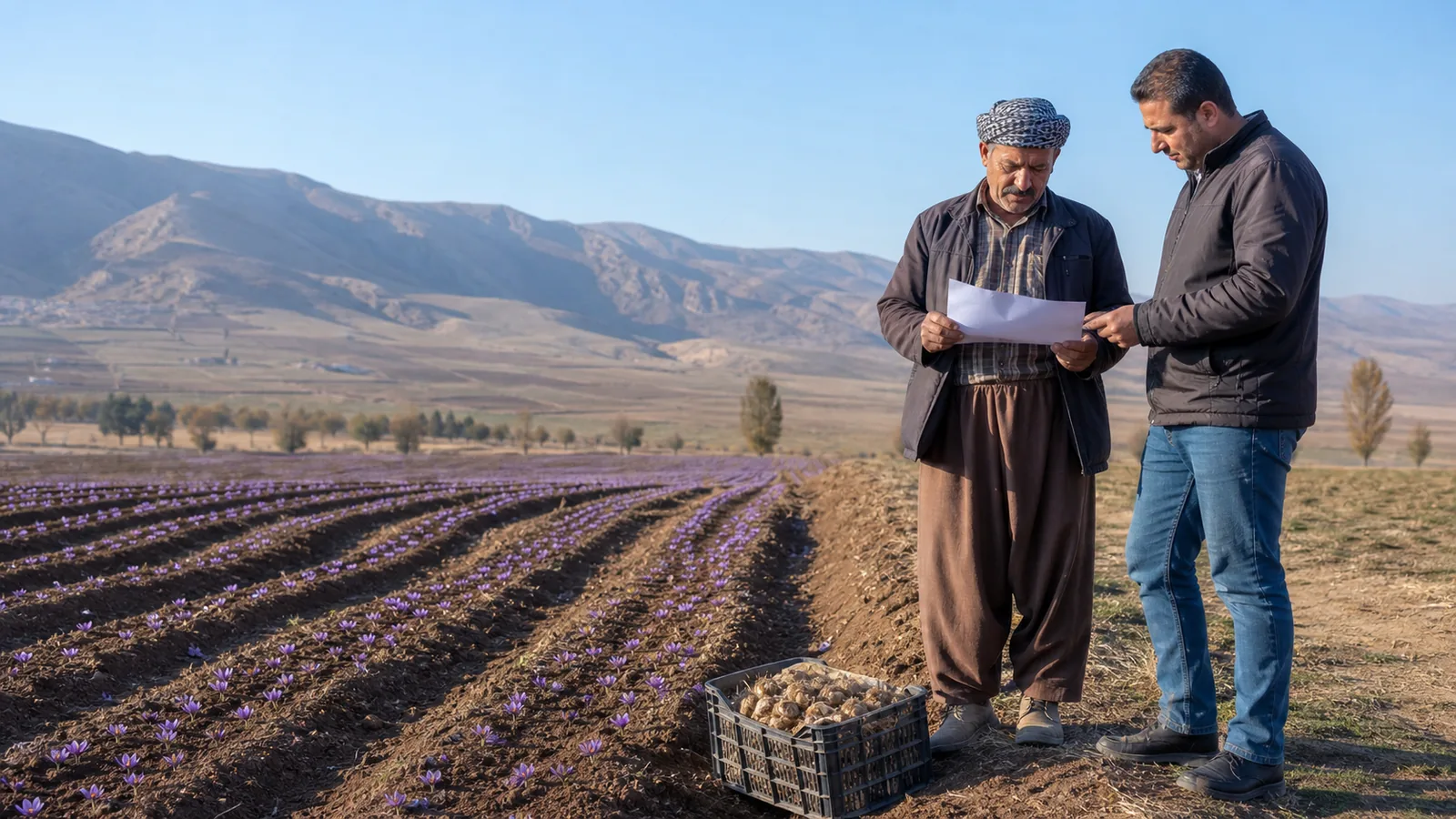
The proposed 250 hectares of saffron in Kermanshah was an expansion target, not a completed planting. In the historical report, provincial horticulture director Hamidreza Jahangiri said the area could grow from 80 hectares to 250 hectares if promised funding arrived in time.
That condition is the most important part of the story. The title records the scale of the plan, while the body shows that the additional 170 hectares still depended on budget allocation, field preparation, planting material, and a workable schedule.
Kermanshah had 80 hectares under saffron
Jahangiri, speaking through the Kermanshah Agricultural Jihad Organization in a report carried by Mehr News, said the province then had 80 hectares under saffron and produced about 200 kilograms. Taken together, those figures imply an average of roughly 2.5 kilograms per hectare for the reported area.
That calculation is only a reading of the archived numbers. It is not a current yield estimate, and it does not show how much of the 80 hectares was mature and productive. Saffron is a perennial crop whose output can differ with field age, corm size, site, weather, irrigation, and management.
Jahangiri described Kermanshah as suitable for saffron and said its crop was of very high quality, sometimes better than premium saffron from other regions. The article supplied no laboratory results, grading method, or comparison samples for that statement. It should therefore be read as the official’s assessment, not as a verified quality ranking.
The 250-hectare target depended on funding
The report linked saffron expansion to the policy language of Iran’s “resistance economy.” It said a visit by Mohammad Bagher Nobakht had produced a decision to allocate 30 billion rials from Note 20 of the budget law for the Iranian year 1394. The purpose was to establish saffron cultivation more firmly in Kermanshah.
According to Jahangiri, however, the funds had not reached the provincial programme despite repeated follow-up. He warned that unless the allocation was announced by the middle of Khordad, there would not be enough time to plan the proposed expansion.
This turns the article from a planting announcement into a record of a delayed programme. It does not establish that the money was later paid, that 250 hectares were planted, or that production made the projected jump. Those outcomes require later records.
What a responsible expansion would have required
Moving from 80 to 250 hectares is more than supplying corms. A credible programme would need to match each proposed field with suitable soil, drainage, water quality, and a local irrigation plan. It would also need healthy graded corms, trained labour for the brief flowering season, drying capacity, quality control, and buyers for the additional crop.
Before planting, planners would normally want answers to five questions:
- Which districts and fields make up the extra 170 hectares?
- How much traceable planting material is available, and in what condition?
- Which costs would the public allocation cover, and which would growers carry?
- Who would train growers and monitor establishment and yield?
- Where would the saffron be dried, tested, packed, and sold?
The timing problem raised in the report was therefore real. Late funding can leave too little time for field selection, procurement, training, and planting. Spending quickly to meet a target can create weak fields that cost farmers more over several seasons.
Lower water demand still needs local evidence
Saffron is often considered for regions seeking alternatives to more water-intensive crops. That does not mean every Kermanshah field is suitable or that saffron needs no irrigation. Rainfall pattern, summer conditions, drainage, and the timing of water around flowering and vegetative growth all matter.
A cautious programme would begin with measured field performance rather than treating the province as one uniform growing zone. Yield, grade, labour hours, corm multiplication, and selling price should be recorded by field and season. Those results are more useful than a province-wide quality claim when growers are deciding whether to expand.
Was 250 hectares of saffron planted in Kermanshah?
This archived report does not prove that it was. It documents an official aim to expand Kermanshah saffron cultivation to 250 hectares, from a reported base of 80 hectares, if 30 billion rials in funding became available before the planning deadline.
The distinction protects the historical record. The proposal showed confidence in Kermanshah’s potential, but the missing allocation was not a minor detail. Until a later agricultural census or provincial report confirms the achieved area, 250 hectares should remain described as the target, not the result.

![Exporting Saffron to Turkey + Price Guide [Complete 0 to 100]](https://img.rowhanisaffron.com/20260827003933/saffron-export-turkey-quality-inspection.webp)



