


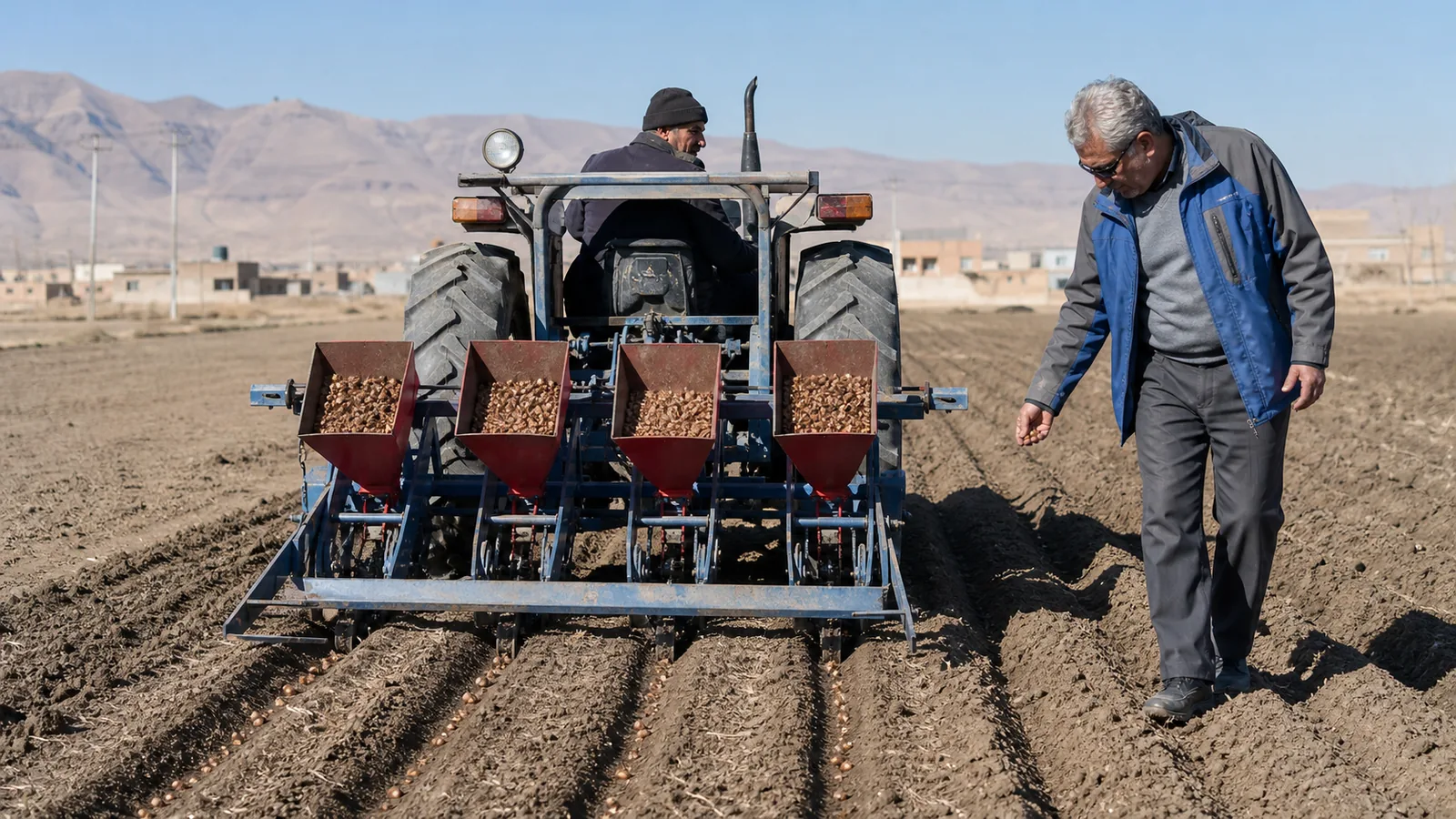
A mechanised saffron planter was demonstrated on 2,000 square metres of farmland in Qaleh village, in Isfahan Province’s Tiran and Karvan County. Agricultural director Mohsen Hajabedi said the machine could plant 16 rows at once, cover about two hectares a day, and place roughly 70% of the corms with their growing point facing upward.
The historical report presented the equipment as a way to speed planting and make rows more consistent. Those claims describe the demonstration and the official’s account; they are not a substitute for measuring establishment, flowering, labour, fuel, and total cost in the field.
What happened in the Isfahan planting demonstration
According to the ILNA item, the machine planted saffron across a 2,000-square-metre plot in Qaleh village. The earlier translation turned Tiran and Karvan into “Tiran Vakrun,” making the location difficult to recognise.
It also described machine capacity as “two octopus per day.” In agricultural context, the reported measure was two hectares per day. The machine was said to open and plant 16 rows simultaneously.
A demonstration area of 0.2 hectares can show whether the machine operates, but it does not establish its normal daily output across every soil and field shape. Turning time, refilling, breakdowns, corm grading, slope, stones, and operator experience all affect practical capacity.
Why corm orientation was measured
Hajabedi said the machine placed about 70% of saffron corms in an upward orientation. Saffron corms have a growing point, and a planter that drops them randomly may leave some upright, sideways, or inverted.
The useful question is not orientation alone but what happened afterward. A field trial should compare emergence, flowering, daughter-corm development, gaps, and final yield with a suitable manual or conventional planting method. If a sideways corm establishes successfully, a lower orientation percentage may have less practical importance than depth or row consistency.
What mechanised planting needs to control
A saffron planter has to handle irregular living corms rather than uniform seed. Before evaluating the machine, the planting material and field should be prepared to a consistent standard.
- Corm condition: remove injured, decayed, or visibly unhealthy material and record the source.
- Size range: wide variation can disrupt metering, spacing, and planting depth.
- Soil preparation: clods, stones, and uneven moisture can prevent clean furrows and closure.
- Depth: check actual placement along every unit, not only the machine setting.
- Spacing and density: count planted corms over measured row lengths.
- Damage: inspect corms after they pass through the hopper and delivery system.
- Coverage: confirm that furrows close without leaving exposed or compacted sections.
A sixteen-row machine can magnify a setup error quickly. Calibration at the start of a field and checks after turns or refills are essential.
Speed should be compared with the whole job
Planting two hectares per day can reduce the time spent opening rows and placing corms, especially when labour is limited. The comparison should include more than forward speed.
A fair cost record covers field preparation, tractor and operator time, fuel, transport, calibration, people filling the machine, downtime, maintenance, missed corms, double placements, and any corrective work. It should also compare plant survival and later yield. Saving a day at planting is not economical if poor placement reduces a multi-year stand.
Mechanisation may also make records easier. Defined rows and measured inputs can help a grower track corm weight, density, irrigation, emergence, and yield by plot. That information is valuable when deciding whether to use the machine again.
Tiran and Karvan’s reported saffron production
Hajabedi described conditions for saffron cultivation in Tiran and Karvan as favourable. He said the county had harvested more than 500 kilograms from over 100 hectares in the preceding year.
These are historical county figures, not current production data. They imply an average in the broad range of five kilograms per hectare, but the source did not provide exact productive area, field ages, grade, or a plot-level breakdown. The article therefore preserves the two totals without presenting a calculated yield as an official result.
How to judge the machine after planting
The strongest evaluation begins before the tractor enters the field and continues for several seasons. The grower should retain a manually or conventionally planted comparison area using corms from the same graded batch.
Useful checkpoints include placement accuracy on planting day, emergence and gaps, flower number and weight, dry-saffron yield, corm multiplication, irrigation access, weeding, lifting, and cumulative labour. Costs should be reported per successfully established hectare, not merely per hectare crossed by the machine.
What the demonstration established
Mechanized Planting of Saffron in Isfahan Province Cities documented a practical field trial: 2,000 square metres, 16 rows, a stated two-hectare daily capacity, and about 70% upward corm placement. It also recorded an established local crop of more than 100 hectares and 500 kilograms in the prior year.
The demonstration showed that mechanised planting was possible in Tiran and Karvan. Whether it was better depended on the evidence that followed: uniform establishment, undamaged corms, reliable yield, lower total cost, and a healthy stand that remained productive beyond planting day.

![Exporting Saffron to Turkey + Price Guide [Complete 0 to 100]](https://img.rowhanisaffron.com/20260827003933/saffron-export-turkey-quality-inspection.webp)



