


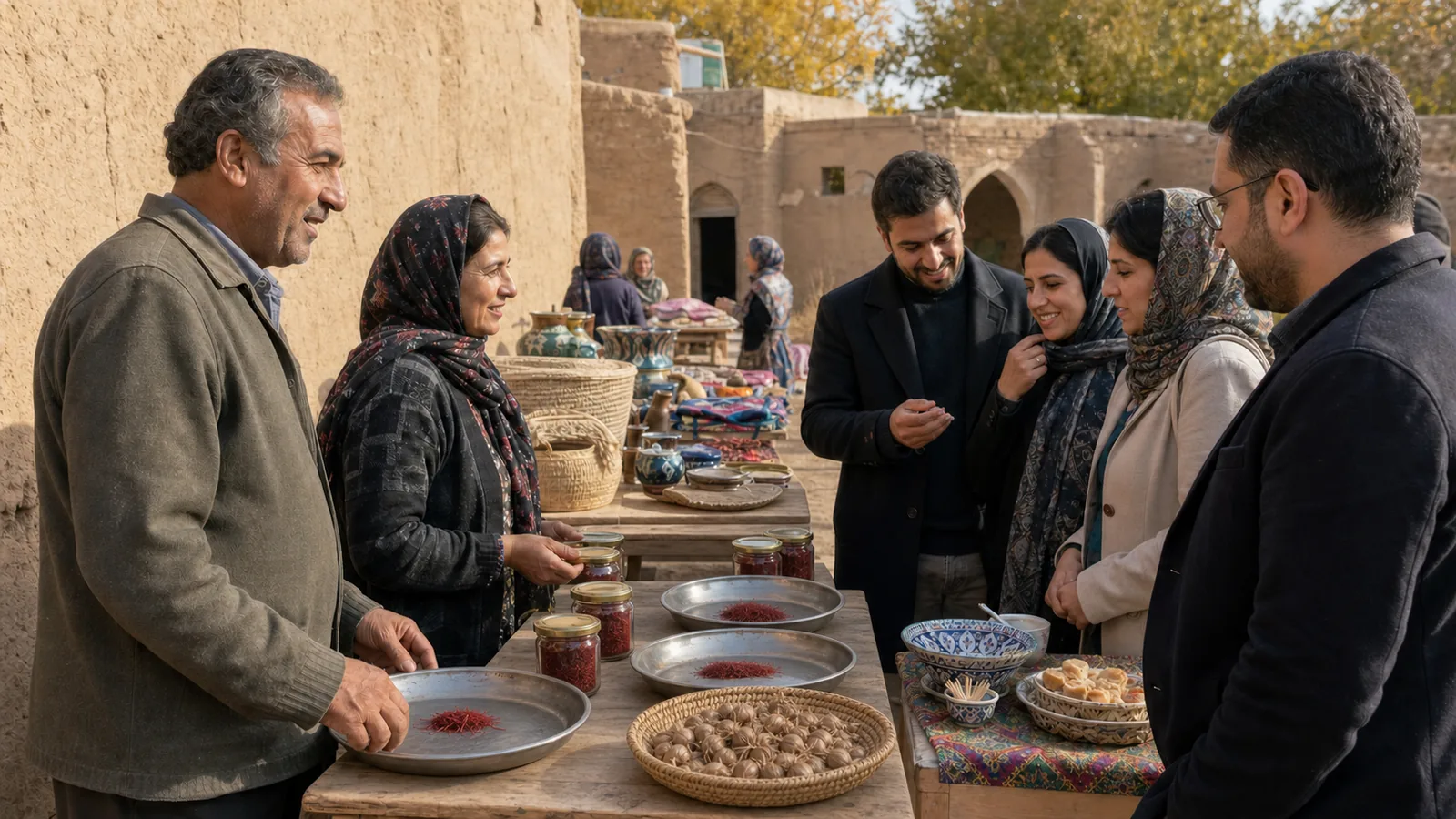
The Saffron Festival in Isfahan brought farming, village tourism and local trade together in Azan, near Meymeh. A parallel festival and grower-support programme in Bahabad, Yazd, pursued many of the same goals through training, saffron-corm distribution and a proposed heritage registration.
These were historical events, not current festival announcements. The details below preserve what each report documented, correct mistranslated agricultural terms and separate promotional quality claims from measurements a buyer can actually assess.
The Azan saffron festival near Meymeh
The one-day Isfahan festival was held in Azan village in Shahin Shahr and Meymeh County. Javad Chehrazi, head of the local Cultural Heritage, Handicrafts and Tourism office, said its main goal was to support registration and recognition of the Azan saffron brand. Organisers also wanted to present the village’s landscape and heritage to visitors.
They promoted saffron as an alternative crop for the area and hoped to improve both the quality and quantity produced in Azan. That was a local development objective, not proof that saffron is the best replacement crop for every farm. Water supply, soil, corm health, labour at flowering and access to buyers still determine whether a planting is suitable.
The report says the region had two internationally registered heritage assets, but the surviving translation identifies only an Islamic-era historical hill. Without the registration names, the statement cannot be checked or used as a travel listing.
Farm figures behind the Isfahan event
Alireza Salem, the local agricultural official, reported about 54 hectares of saffron in the Meymeh district and a harvest of more than 220 kilograms that year. Those rounded figures imply a district yield a little above 4 kilograms per hectare.
For Isfahan Province, the article records 617 hectares in Iranian year 1393 and 758 hectares by 1395. That is an increase of about 22.9% across the two stated endpoints. It also says the area rose more than 15% in 1394, but does not give that year’s exact hectare total.
The festival itself brought together 30 stands offering saffron, local foods, herbal infusions and handicrafts. Organisers reported about 2,500 attendees. Azan was described as a village of roughly 3,000 people, which helps explain why tourism and local employment featured so strongly in the speeches.
What can be said about Azan saffron quality?
Festival speakers attributed the quality of Azan saffron to fertile soil and qanat water and said it could compete with saffron from Qaenat. They also cited “purity above 86%” and superior aroma. No laboratory, method, unit, sample date or comparison lot is named, so neither claim can be treated as an objective grade.
Current quality assessment uses defined physical and chemical criteria. The ISO 3632-1:2025 specification addresses dried saffron requirements, while the Codex saffron standard CXS 351-2022 sets product, quality, packaging and labelling provisions. A festival claim becomes useful to a buyer only when a representative lot has a traceable test report against a defined specification.
The Bahabad festival and 70-tonne corm programme
In Bahabad, Yazd Province, Agricultural Jihad director Mehdi Abdolhosseinzadeh reported that 70 tonnes of saffron corms had been distributed to growers alongside training courses. The source calls them “onions,” but saffron is propagated commercially from corms.
The same report says Bahabad had 370 hectares under saffron in the preceding year, that the area increased by about 30%, and that the current total was “over 400 hectares.” Those statements do not reconcile precisely: adding 30% to 370 gives about 481 hectares. Because “over 400” is open-ended and the report provides no registry total, both claims are retained as rounded official remarks rather than collapsed into a new number.
Abdolhosseinzadeh described Bahabad as the provincial production leader and claimed its saffron ranked first nationally for quality. The first statement needs a defined year and provincial comparison; the second needs a test method and dataset. They are evidence of local ambition, not an independent national ranking.
Why Asfich sought heritage recognition
The Bahabad programme focused on villages in the Asfich district, where saffron was said to support household livelihoods and local cultural life. Organisers wanted cultural-heritage recognition to strengthen regional identity, branding and sustainable employment.
The festival involved the district administration, Agricultural Jihad, cultural-heritage and tourism bodies, and the Bahabad governorate. The source says it was scheduled to continue until the end of December, but that is the end date of the historical event described on the page, not an annual timetable for future visitors.
What a saffron festival can realistically achieve
A well-run festival can put growers in direct contact with consumers, give local food and craft businesses a sales opportunity and help visitors understand the work behind a small amount of dried saffron. It can also make an origin name more recognisable.
A festival cannot establish a protected origin, prove national quality leadership or guarantee farm income by itself. Those outcomes require documented governance, consistent production standards, traceable lots, reliable market access and evidence over time.
How to evaluate saffron sold at a festival
Visitors and trade buyers should ask simple, specific questions:
- Where was this lot grown, and what crop or packing date does it carry?
- Is it filament, cut filament or powder, and what does the seller’s grade name mean?
- Can the sample be traced to the sealed pack or commercial lot?
- Is a recent analysis available, and which methods and units were used?
- Does the label identify net content, producer or packer, lot and storage guidance?
The Isfahan and Bahabad reports show two ways communities used saffron to connect farming with place. Their strongest legacy is not an unverified “best saffron” claim. It is the attempt to make local production visible, understandable and commercially useful without losing its village context.

![Exporting Saffron to Turkey + Price Guide [Complete 0 to 100]](https://img.rowhanisaffron.com/20260827003933/saffron-export-turkey-quality-inspection.webp)



