


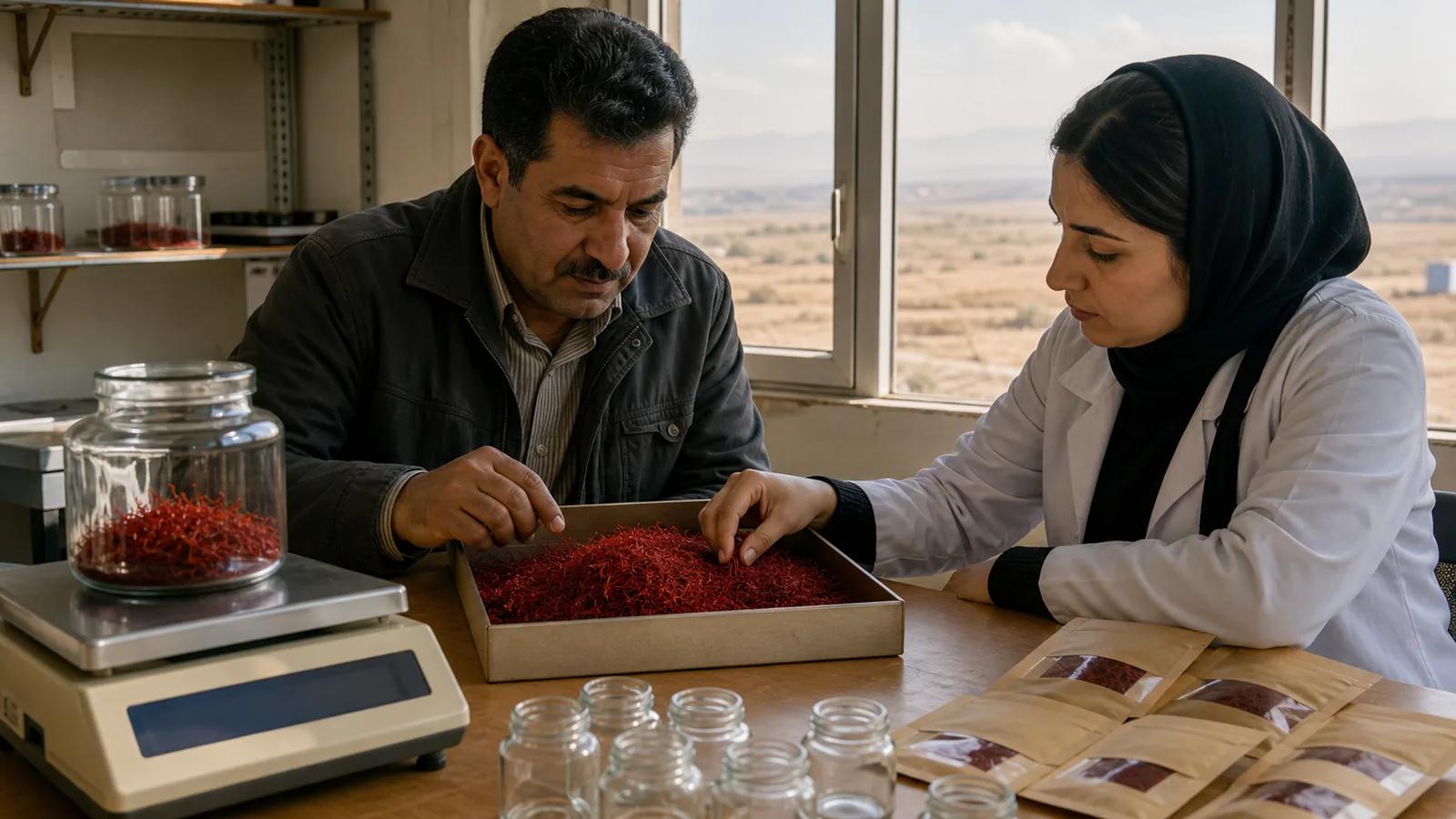
The original question behind this page was whether Isfahan saffron could support its own brand and dedicated processing factory. In the historical Mehr News interview, agricultural committee head Mojtaba Maghool argued that the province’s output was then too small to justify a factory devoted only to Isfahan saffron, even as he encouraged lower-water cultivation in the province’s east.
The page title says “Is Is It Possible to Bringing Saffron to Isfahan?” This is a broken translation of “Is branding Isfahan saffron possible?” The issue was not bringing saffron into the province; it was whether local production, processing, marketing, and origin identity could work at an economic scale.
Why the official questioned a dedicated factory
Maghool, who led the agricultural production and processing industries committee at the Isfahan Chamber of Commerce, cited a national crop of 300 tonnes. He said 250 tonnes came from Khorasan, 50 tonnes from other provinces, and only about three tonnes from Isfahan.
On that basis, he did not consider a factory built solely to brand Isfahan saffron economically justified. These are the quantities he gave at the time, not current production statistics.
A processing business has fixed costs for space, equipment, quality control, staffing, compliance, packaging, storage, and sales. If local supply is small or highly seasonal, a facility may sit underused. The alternative need not be selling everything anonymously: growers can share services, contract with an existing compliant processor, or develop a facility that handles multiple traceable products.
The Spain and bulk-sale argument
The interview responded to a question about Iranian saffron being sold under European names, including Spain. Maghool said some Isfahan saffron was sold within the province and some in bulk to Khorasan. He also argued that weak branding and limited government support allowed Iranian export saffron to be sold under Spain’s name.
The article did not provide customs records, buyer documents, or a supply-chain audit for that claim. It should be understood as the speaker’s criticism of the market, not proof that every Iranian or Isfahan export followed that route.
Origin is protected by evidence, not by a more attractive box. An Isfahan saffron identity needs:
- farm and harvest records tied to each batch;
- separate handling so local lots are not mixed without disclosure;
- clear grade definitions and appropriate testing;
- processing and storage that protect quality;
- accurate origin and packer information; and
- rules for who may use a collective regional name.
Eastern Isfahan and the water crisis
Maghool said the chamber was seeking saffron cultivation in agricultural land in eastern Isfahan. He linked the proposal to the water crisis and to saffron’s lower irrigation needs. He suggested that the crop could give farmers another income source without requiring the same April water allocation as some existing cultivation.
This is a comparison, not a claim that saffron needs no water. Suitability depends on soil drainage and salinity, water quality, climate, corm health, irrigation timing, labour, and a viable route to market. A water-stressed field is not automatically a good saffron field.
The article raised the right commercial objection: if production expands before sales and export routes exist, farmers may be left holding a crop, as had happened with potatoes in western Isfahan. Maghool acknowledged that no market action had yet been taken and called for coordination between the responsible authorities on production and sales.
Cultivation should follow demand, not precede it blindly
Before asking a farmer to switch crops, planners should know who will buy the saffron, which grade is required, how samples will be assessed, where it will be processed, and when payment will be made. A small trial can test agronomy, but market preparation needs to happen at the same time.
A credible development plan can begin with:
- mapping suitable fields and available water;
- testing corm sources and field performance at trial scale;
- training for harvest, separation, and drying;
- agreeing grade, testing, and traceability rules;
- estimating reliable local volume; and
- choosing shared, contracted, or dedicated processing only after volume is known.
Greenhouse saffron was another proposal
The interview said greenhouse saffron cultivation was another Chamber of Commerce programme and was already being attempted. The source did not report a method, scale, yield, cost, or result.
Growing corms under controlled conditions does not remove the need for healthy planting material, a complete crop cycle, field or substrate management, labour, and transparent economics. Claims about greenhouse performance should be based on measured multi-season results, not promotional projections.
The local position later changed
Conditions did not stand still. A 2019 report from Iran’s Agricultural News Agency described 1,280 hectares of saffron in Isfahan and called for a provincial brand, union or cooperative coverage, processing investment, training, and suitable planting material. That later checkpoint does not make the earlier economic concern wrong; it shows why decisions about facility scale must use current supply data. See the Isfahan agricultural report.
Can Isfahan saffron build a brand?
Yes, a regional identity is possible when current production, shared standards, traceability, processing capacity, and genuine buyer demand support it. Whether Isfahan needs a dedicated factory is a separate engineering and business question that should be recalculated from present volumes, not answered permanently by an old three-tonne estimate.
The historical interview’s strongest point remains useful: planting, branding, and market development must move together. Farmers should not carry the risk of expansion while institutions postpone the work of quality control, processing, and sales.

![Exporting Saffron to Turkey + Price Guide [Complete 0 to 100]](https://img.rowhanisaffron.com/20260827003933/saffron-export-turkey-quality-inspection.webp)



