


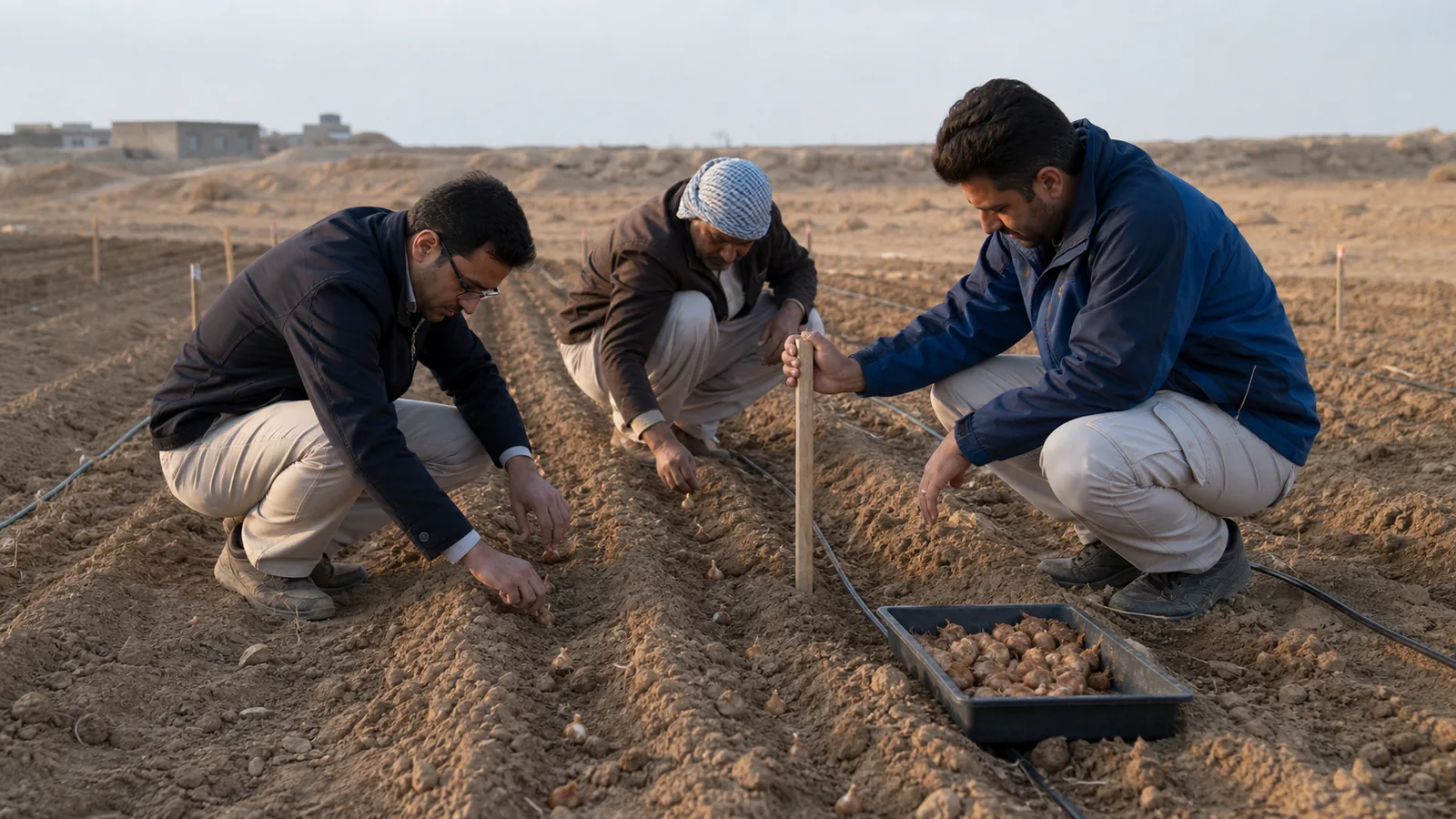
A five-hectare pilot introduced saffron cultivation across the five northern counties of Sistan and Baluchestan. The historical project used corms brought from Birjand and tested the crop in Zabol, Zahak, Hirmand, Hamun, and Nimruz, where two decades of water scarcity had placed severe pressure on agriculture.
Baharami, an agricultural extension official in Zabol, said the fields had been selected in July and the corms were planted in prepared ground at a depth of 20 centimetres, spaced three to five centimetres apart. The pilot was an experiment, not proof that saffron would succeed everywhere in the region.
Where the first pilot saffron was planted
The report described planting in five hectares across northern Sistan and Baluchestan. The old English version called these “five northern provinces of the province.” They were five counties: Zabol, Zahak, Hirmand, Hamun, and Nimruz.
A pilot spread across several locations can reveal differences that a single field misses. Soil texture, salinity, water quality, heat, wind exposure, and farm management may vary within the same region. Each site therefore needs its own records rather than being treated as one uniform five-hectare field.
Corms came from Birjand
The planting material was brought from Birjand after candidate land was identified. Saffron grows from corms, sometimes loosely called bulbs or “onions” in translated reports. Moving live planting material over a long distance makes source and handling especially important.
Before planting, corms should be checked for firmness, injury, decay, visible pests, excessive soil, mixed sizes, and damage from heat or poor storage. A record should connect each batch with its source and destination plot. The report did not provide the corm grade, quantity, health documentation, or transport conditions, so those details should not be invented.
How the pilot was planted
Baharami said individual corms were planted 20 centimetres deep and three to five centimetres apart. These are the dimensions reported for this project, not universal instructions for every saffron field.
Planting depth and spacing interact with soil, climate, corm size, cultivation method, equipment, and the length of time a stand will remain in place. A pilot should document the actual layout and measure establishment, flowering, daughter-corm development, labour, and water use over more than one season.
At minimum, each trial plot needs records for:
- soil and irrigation-water analysis;
- corm source, size range, weight, and condition;
- planting date, depth, spacing, and density;
- irrigation timing and measured volume;
- weather and visible stress;
- flower count or weight and dry-saffron yield;
- harvest and processing labour; and
- quality, storage, buyer, and realised price.
Water scarcity was the reason for the trial
The official connected saffron with the region’s limited water and the need for an economically useful lower-water crop. Northern Sistan and Baluchestan had faced serious agricultural problems from water shortages over the previous two decades.
Saffron can require less water than some alternatives, but it is not waterless. A new field needs moisture for establishment and correctly timed irrigation through its crop cycle. In a dry and potentially saline environment, water quality, soil drainage, evaporation, and even distribution matter as much as the number of irrigations.
A crop helps livelihoods only if the whole system works. Farmers need healthy corms, suitable fields, reliable water at the necessary times, harvest labour, clean drying, storage, and a buyer. Low water demand cannot compensate for a field that fails to establish or a product that cannot be marketed.
The ten-kilogram forecast was not a result
Baharami predicted that the pilot could produce 10 kilograms of saffron per hectare. The old translation reversed the units and said “10 hectares of saffron” would be obtained from each hectare.
Ten kilograms per hectare was a forecast, not a measured harvest. Yield varies with field age, corm reserves and density, soil and water conditions, weather, agronomy, flower handling, the grade being produced, and final moisture. First-year flowering can also differ sharply from the performance of an established stand.
A credible evaluation should publish what was actually harvested at each site and in each year. It should also distinguish fresh-flower weight from dry saffron and record the cut or grade. Without those results, the pilot shows that planting occurred, not that the predicted yield was achieved.
What the Sistan and Baluchestan pilot meant
Planting the first saffron in Sistan and Baluchestan was a cautious attempt to test another livelihood option under severe water constraints. The project’s core facts remain important: five hectares, five northern counties, Birjand corms, 20-centimetre depth, three-to-five-centimetre spacing, and a ten-kilogram-per-hectare forecast.
The most responsible conclusion is the one a pilot is designed to support. Saffron was worth testing, but expansion should depend on measured multi-season results for survival, water, yield, labour, quality, and farm income at each location.

![Exporting Saffron to Turkey + Price Guide [Complete 0 to 100]](https://img.rowhanisaffron.com/20260827003933/saffron-export-turkey-quality-inspection.webp)



