


China’s role in the saffron market is often described as if a new competitor suddenly arrived and changed everything. The trade record tells a more useful story. China was already one of Iran’s important direct saffron customers by 2015, while Iran remained the dominant producer. What changed was not a single moment of “entry,” but a gradual rise in competition, buyer expectations and the value placed on testing, packaging and traceable origin.
The original version of this article carried the mistranslated title “How is the saffron in market since China?” and then reproduced two long newspaper pieces about Iran’s wider economy. It barely discussed saffron or China. This revision answers the question the title promised and keeps the useful part of that older discussion: policy, tariffs, private-sector participation and export structure can all influence what farmers and exporters receive for saffron.
What the historical export record shows
An Iranian submission to the Codex Committee on Spices and Culinary Herbs recorded 121.573 tonnes of saffron exports in 2015, worth about US$165.3 million. It listed China as Iran’s third-largest direct destination by weight, after the United Arab Emirates and Spain: 11.557 tonnes worth about US$17.58 million, or 9.5% of the reported export volume. Hong Kong appeared separately with another 2.584 tonnes.
Those figures come from Iran Customs and were reproduced in the 2017 Codex saffron discussion paper. They show that China was not an unknown newcomer when this post was published in 2018. It was already a substantial market for Iranian saffron.
The figures should not be read as a complete map of where every gram was finally consumed. Saffron can pass through trading and packing centres before reaching its retail market. In the same 2015 data, the UAE and Spain together received more than half of Iran’s reported saffron export volume. A destination in customs data may therefore be a final consumer market, a processing and packaging location, a re-export hub, or a mixture of all three.
Did China replace Iran as the leading saffron producer?
No. China’s importance as a buyer—and its ability to cultivate saffron—should not be confused with Iran’s production position. In November 2025, the Food and Agriculture Organization described Iran as producing 85–90% of the world’s saffron and noted the crop’s importance to smallholders in Razavi Khorasan and South Khorasan. FAO also identified climate pressure, water scarcity and growing international competition as challenges for the sector.
That distinction matters. A new or expanding producer can add competitive pressure without coming close to Iran’s total output. A growing customer can also strengthen demand while developing domestic cultivation. “China entered the market” is therefore too simple to explain price movements in Iran.
What actually moves the Iranian saffron market
Saffron prices do not respond to one country alone. Several forces meet between the flower field and the retail jar:
- Harvest supply: flowering conditions, corm health, labour availability, drying losses and the amount growers release after harvest affect short-term supply.
- Export demand: orders from China, the UAE, Spain and other markets can change by season, stock level and consumer demand.
- Exchange rates and settlement: currency movements alter the local-currency return on an export sale and the cost of imported equipment and packaging.
- Tariffs and border procedures: an otherwise competitive shipment can lose its advantage through duties, delays, documentation or changing import requirements.
- Quality and authenticity: moisture, foreign matter, floral waste, colour, aroma, flavour strength and adulteration risk affect whether a lot reaches a premium market.
- Packaging and branding: bulk saffron and a verified retail-ready product occupy different places in the value chain. The country that grows the spice does not automatically capture all of its final retail value.
This is why a high production figure does not guarantee a high farm-gate price, and why rising exports do not necessarily mean that every grower benefits equally. For a historical view of Iran’s destination mix, see our article on the UAE’s role in Iranian saffron exports.
What the original market interview contributed
The old post’s first newspaper extract was an interview with Kaveh Zargaran about Iran’s food and agricultural markets. It covered overlapping responsibilities between the ministries of Agriculture and Industry, late guaranteed-purchase announcements, import-tariff changes and the place of the private sector in market regulation. Wheat, meat, rice, sugar and cooking oil—not saffron or China—were the interview’s main examples.
Its useful lesson for saffron is narrower than the original translation suggested. Agricultural businesses need rules early enough to plan. Exporters need predictable documentation and border procedures. Growers need transparent quality criteria and timely market information. A policy change can affect costs and confidence, but it is not evidence that government action or private management always produces a particular price result.
The second extract, attributed to Iran’s Young Journalists Club, ranged across oil dependence, imports, taxation, economic growth and government budgets. Those subjects provide background to Iran’s economy, but they do not establish what happened in the saffron market after China became a buyer. Treating them as saffron evidence would be misleading, so they are not reproduced as if they answered that question.
Quality is the durable competitive advantage
Iran cannot control every rival’s production or every exchange-rate movement. Producers and exporters can control more of the quality chain. FAO’s current saffron work in Iran focuses on authenticity, traceability, post-harvest handling, safety, quality assurance and modern marketing. That emphasis connects field practice to the buyer’s confidence in the finished lot.
International specifications give this work a common language. The Codex standard for dried saffron covers identity, quality, contaminants, hygiene and labelling. ISO 3632-1:2025 specifies requirements for saffron filaments, cut filaments and powder, while ISO 3632-2 provides test methods.
These standards do not make every tested batch identical, and a standard number should never be used as an unsupported marketing badge. They do make it easier for a buyer and seller to define what is being supplied. That becomes more important as additional producing regions and trading routes enter the market.
What China’s role means for buyers and growers
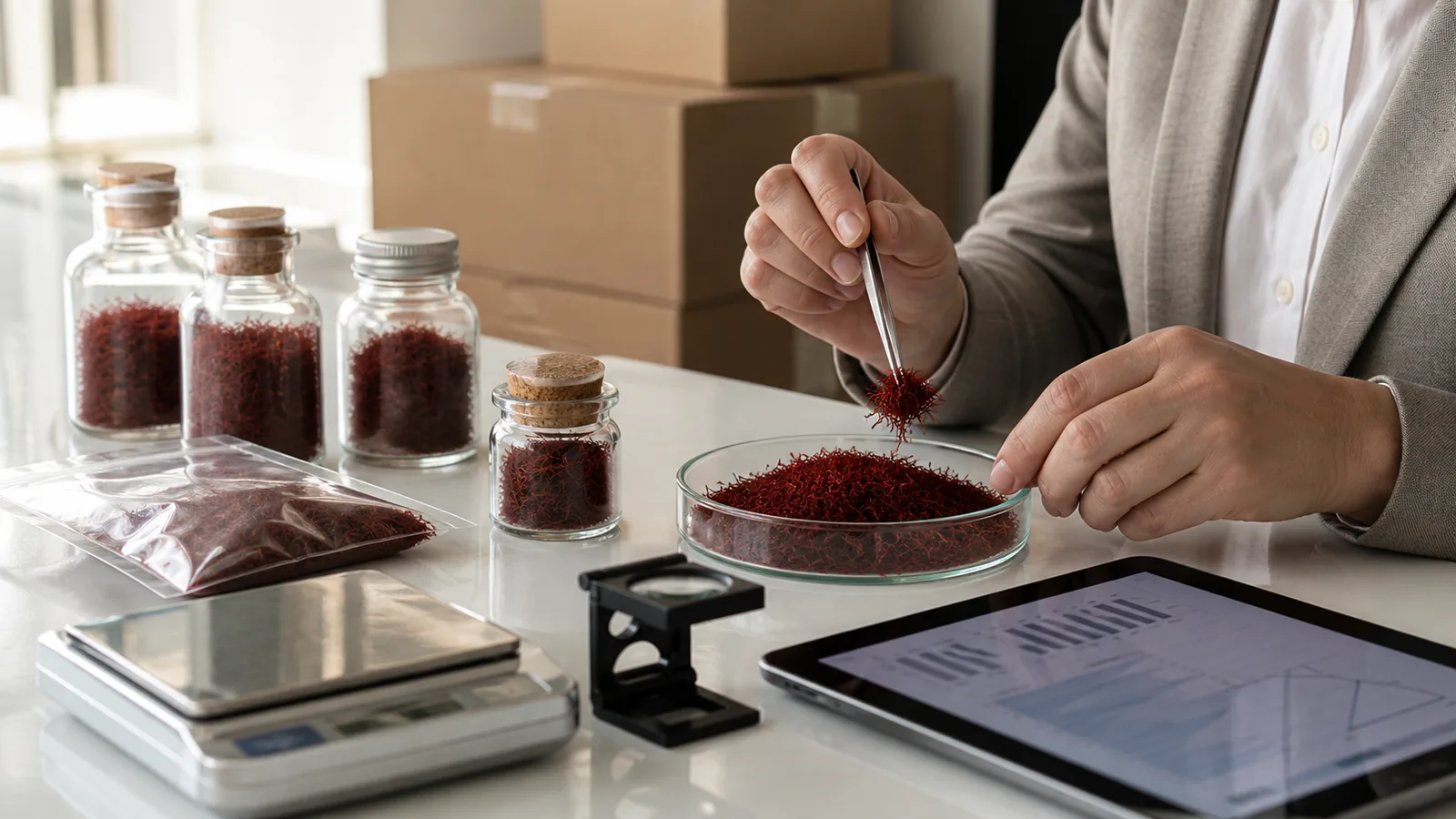
For a buyer, country-of-origin claims should be supported by traceability rather than appearance alone. Ask who harvested and packed the saffron, whether the lot has been tested, which standard or specification was used, and whether the documentation belongs to that exact batch. Whole threads are generally easier for a customer to inspect than powder, although laboratory analysis remains the stronger check.
For Iranian growers and exporters, China is both a customer market and part of a more competitive global landscape. The sensible response is not to rely on Iran’s production share as a guarantee of future sales. It is to protect colour, aroma and flavour through careful harvesting and drying, document origin, test consistently, package for the intended buyer and avoid losing the product’s identity in an opaque bulk-export chain.
China did not suddenly take over the saffron market. The more consequential change is that buyers now have more routes, more suppliers and higher expectations. Iran retains an exceptional production base; keeping its market position depends on turning that agricultural advantage into verified quality and a product whose origin remains visible all the way to the customer.
Sources reviewed: Iran’s 2017 Codex submission using 2015 customs data; FAO Iran’s 2025 saffron value-chain reports; Codex CXS 351-2022; ISO 3632-1:2025. The market interview and YJC material in the original post are retained above only as clearly labelled historical context.

![Exporting Saffron to Turkey + Price Guide [Complete 0 to 100]](https://img.rowhanisaffron.com/20260827003933/saffron-export-turkey-quality-inspection.webp)



