


Iranian saffron exports rose by a reported 16% in the national nine-month period covered by this historical briefing, with the United Arab Emirates named as the largest buyer. Two related reports add important context: Khorasan Razavi recorded especially rapid growth in 10–30 gram packages, while a later National Saffron Council forecast linked a larger harvest and export target to lower policy barriers and better farm productivity.
The percentages are not competing versions of one statistic. They cover different scopes, package sizes, and reporting periods. Keeping those boundaries visible is the only responsible way to understand the figures.
The reported 16% rise in Iranian saffron exports
Ali Hosseini of the National Saffron Council said 89 tonnes and 178 kilograms of saffron had been exported during the nine months discussed in the original report, an increase of 16%. He identified the UAE as the leading buyer and placed Spain and China among the three largest trading partners. Together, those markets were said to account for about 70% of the product in that period.
The report also listed a package-size distribution: 6.3%, 90.9%, and 2.8% for the under-10-gram, 10–30-gram, and over-30-gram bands respectively. The translated source is awkward, but those values total 100%, and the surrounding text associates the dominant share with 10–30 gram packages. They should still be treated as attributed figures from that report rather than a current customs table.
Hosseini’s concern was that export incentives favored the 10–30 gram band, even though packs below 10 grams were more likely to reach consumers with an Iranian name and identity intact. Small retail packs require more design, filling, labeling, testing, and distribution work, but they can also preserve origin and create more value than bulk sales.
Why the UAE mattered in this trade pattern
The UAE’s position as the largest buyer does not necessarily mean every shipment was consumed there. Dubai and other regional trading centers also work as redistribution hubs. The original report did not separate final consumption from re-export, so this page does not infer that split.
That distinction matters for branding. Saffron sold in bulk to an intermediary may later appear in another company’s packaging, while a finished, traceable Iranian pack keeps the producer’s identity closer to the customer. Spain and China were also described as major buyers, and India, the United States, and Europe were named as important consumer markets.
Khorasan Razavi’s 72% growth in 10–30 gram packs
A separate provincial report from Mohammad Ali Amirfakhrian, head of Khorasan Razavi’s Foreign Trade Department, focused specifically on packages weighing 10 to 30 grams in the first nine months of 1396 (2017–18). It recorded a 72% year-on-year increase by weight and a 69% increase by value.
The reported shipment rose from 26,000 kilograms worth $39.5 million to 44,616 kilograms worth $67 million. Packages above 30 grams followed a different pattern: volume increased 12%, from 86,558 to 97,000 kilograms, with the later period valued at $135 million.
Those provincial numbers cannot be added directly to the national 89-tonne figure without checking dates, geography, package definitions, and whether the datasets measure the same customs flow. Their useful message is comparative: the small-package category was growing much faster than the larger-package category within the Khorasan Razavi series.
Historical export figures at a glance
| Scope | Reported result | What it means |
|---|---|---|
| National nine-month report | 89,178 kg; exports up 16% | UAE named as largest buyer |
| Khorasan Razavi, 10–30 g packs | 44,616 kg / $67m; weight up 72%, value up 69% | Compared with 26,000 kg / $39.5m a year earlier |
| Khorasan Razavi, packs over 30 g | 97,000 kg / $135m; weight up 12% | Compared with 86,558 kg a year earlier |
| Later national crop-year forecast | About 300 tonnes produced; 200 tonnes projected for export | A forecast, not a completed customs result |
The later 20% harvest and 200-tonne export forecast
After another harvest, Hosseini estimated that Iranian production had increased about 20% to roughly 300 tonnes. He projected exports could reach 200 tonnes during that crop year. The distinction between an estimated harvest and a forecast export total is important: neither should be presented as a final audited outcome.
He connected the optimistic outlook to the removal of saffron export duties and the possible lifting of a foreign-exchange return commitment that had caused difficulty for exporters. The earlier national report had also complained that exporters were required to deliver currency through designated exchange channels. Together, the accounts show how policy could either support or constrain trade even when the exchange rate appeared favorable.
Because customs, currency, and sanctions rules change, these remarks are historical context rather than instructions for a shipment today. Anyone planning a transaction should verify current requirements for origin, food safety, packaging, payment, and destination-country import controls. Our overview of saffron exports and market considerations is a better starting point than treating an old percentage as current advice.
A five-year goal based on productivity
Hosseini also described a five-year goal of 500 tonnes of production without expanding the cultivated area. The proposed route was to raise productivity by one gram per square metre, equivalent to 10 kilograms per hectare.
That was an ambition, not a guaranteed yield. Reaching it would require healthy corms, appropriate field age and density, reliable irrigation, soil management, weather resilience, timely labor, and better post-harvest handling. A target based on output per hectare is more disciplined than assuming growth must always come from new land, but it still needs measured farm results.
Packaging, employment, and Iranian identity
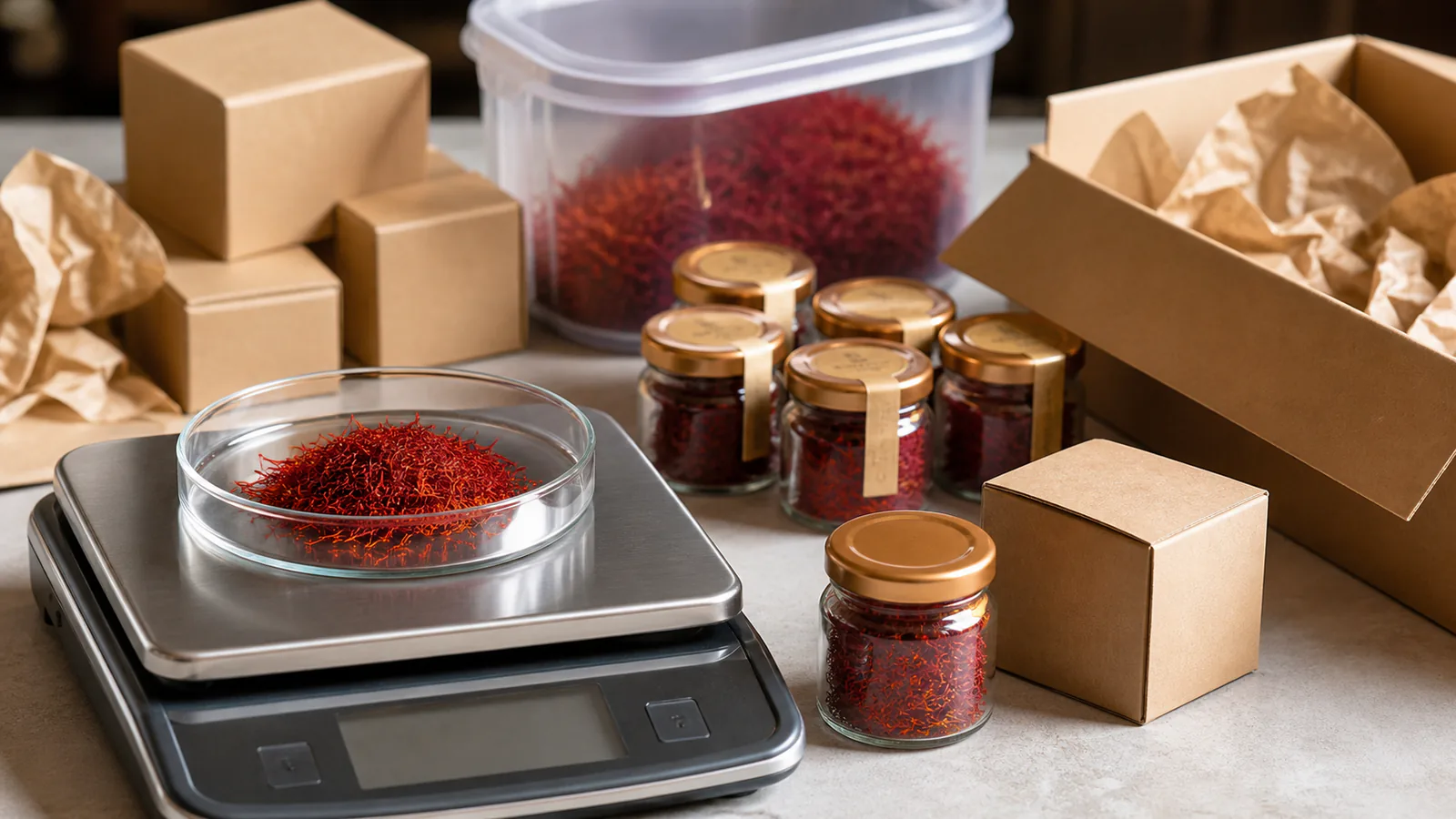
Both export reports return to the same argument: selling more saffron in consumer-ready packs can create work and retain value in Iran. The activities extend beyond making a box. They include grading, laboratory checks, moisture control, weighing, tamper evidence, labeling, batch records, storage, and sales support.
Packaging alone does not guarantee a strong brand. The product inside must match its grade, the label must comply with the destination market, and the supply chain must deliver consistent aroma, color strength, cleanliness, and weight. If those basics fail, a premium-looking pack simply makes the disappointment more visible.
Competition in a changing saffron market
The original national report described Iran as supplying about 90% of world saffron needs at the time and listed Greece, Morocco, Afghanistan, Spain, Azerbaijan, Italy, France, and Turkey among other producers. It gave historical production estimates of about 8 tonnes for Greece, 3.5–5 tonnes for Morocco, more than 3 tonnes for Afghanistan, and 1 tonne for Spain.
Those country totals are dated, attributed estimates and should not be used as a current league table. The strategic point remains sound without exaggeration: buyers have alternatives, and a dominant production share is not permanent protection. Reliable quality, transparent documentation, direct market relationships, and recognizable origin are the defenses that matter.
What the three reports show together
The 16%, 72%, and projected 20% increases describe different layers of the saffron economy: national exports, one province’s small-package trade, and a later harvest forecast. Combined, they show why a single headline percentage is not enough.
Iranian saffron exports depend on what farms produce, how accurately the crop is graded, which package sizes leave the country, whether the Iranian identity survives resale, and whether policy lets exporters quote and settle business predictably. The UAE’s role was important, but the longer-term opportunity was to move from supplying saffron to supplying a trusted, finished product.

![Exporting Saffron to Turkey + Price Guide [Complete 0 to 100]](https://img.rowhanisaffron.com/20260827003933/saffron-export-turkey-quality-inspection.webp)



