


In 2013, Iran’s National Saffron Council proposed a purchasing and storage mechanism intended to steady saffron prices and give farmers timely cash. The translated report called it a “saffron bank.” It was closer to a reserve or inventory-finance proposal than a normal deposit-taking bank.
The plan centred on buying and storing about 70 tonnes of high-quality saffron, financing producers against each accepted kilogram and releasing stock through an organised market. Its stated goal was to reduce forced selling and abrupt price movements. The article’s currency figures are contradictory, so the headline’s “100 million dollars” must remain a historical claim rather than a verified investment total.
What the National Saffron Council proposed
Farshid Manouchehri, speaking to the Iranian Students News Agency as a National Saffron Council representative, described an earlier proposal for funds to be injected into a saffron purchasing system. The body of the translated report first says “100 billion dollars” and later says “about 100 million dollars.” The title also uses US$100 million.
Those amounts cannot all describe the same transaction. The translation may have replaced rials or tomans with dollars, dropped a conversion, or combined different figures. Without the Persian source and an official funding record, we cannot responsibly choose one and present it as fact.
The operational details are clearer. The proposed reserve would purchase and store roughly 70 tonnes of selected saffron. Growers or sellers would receive a loan or guaranteed-purchase facility linked to each kilogram delivered. The report prints “one million dollars” per kilogram, another currency phrase that is not credible as translated and should not be used as a price.
Why a saffron reserve was considered
Saffron arrives during a concentrated harvest period, while sales continue throughout the year. Farmers and processors face immediate labour and handling costs. Buyers, by contrast, may have the capital and storage needed to wait.
A reserve can offer another option at harvest. If it buys against a published grade and pays promptly, producers are not forced to accept the only bid available that day. Stored saffron can then be offered to buyers later, provided that quality, ownership and release rules are reliable.
Manouchehri argued that this would help stabilise both domestic and export markets and allow farmers to keep more value. He also criticised the influence of dealers. That was an industry-policy position, not evidence that every intermediary was unnecessary or that a reserve would automatically improve every farmer’s return.
Buying 70 tonnes is not the same as controlling the price
A reserve can change the timing of supply, but it cannot decree what every buyer will pay. Its effect depends on how large the purchased quantity is relative to the market, the grades held, storage losses, financing costs, buyer demand and the rules for releasing stock.
The original article claimed that regular buying and selling could prevent sudden price jumps or declines. More continuous trading can improve price discovery because participants see recent bids and completed transactions. It does not remove changes caused by harvest size, exchange rates, export demand, regulation or quality.
A stable market should not mean a price that never moves. It should mean that buyers and sellers can see the basis of the price, understand the grade and settle transactions without avoidable delay or surprise.
The earlier storage project that stopped
Manouchehri referred to a previous attempt to prepare buildings and finance for saffron stockholders or brokers. According to the translation, that work eventually stopped and there was no current news of the stock.
The passage does not identify the buildings, stock owner, amount stored or reason the project ended. Those missing details matter. A reserve is only as trustworthy as its inventory records, custody and ability to prove that each promised kilogram exists and remains in acceptable condition.
What a credible saffron warehouse needs
Modern warehouse-receipt systems connect stored goods with a document or electronic record that represents the depositor’s rights. The UNCITRAL–UNIDROIT Model Law on Warehouse Receipts, adopted in 2024, provides an international legal framework that countries can use when designing such systems. It is a model law, not proof that the 2013 Iranian proposal followed it.
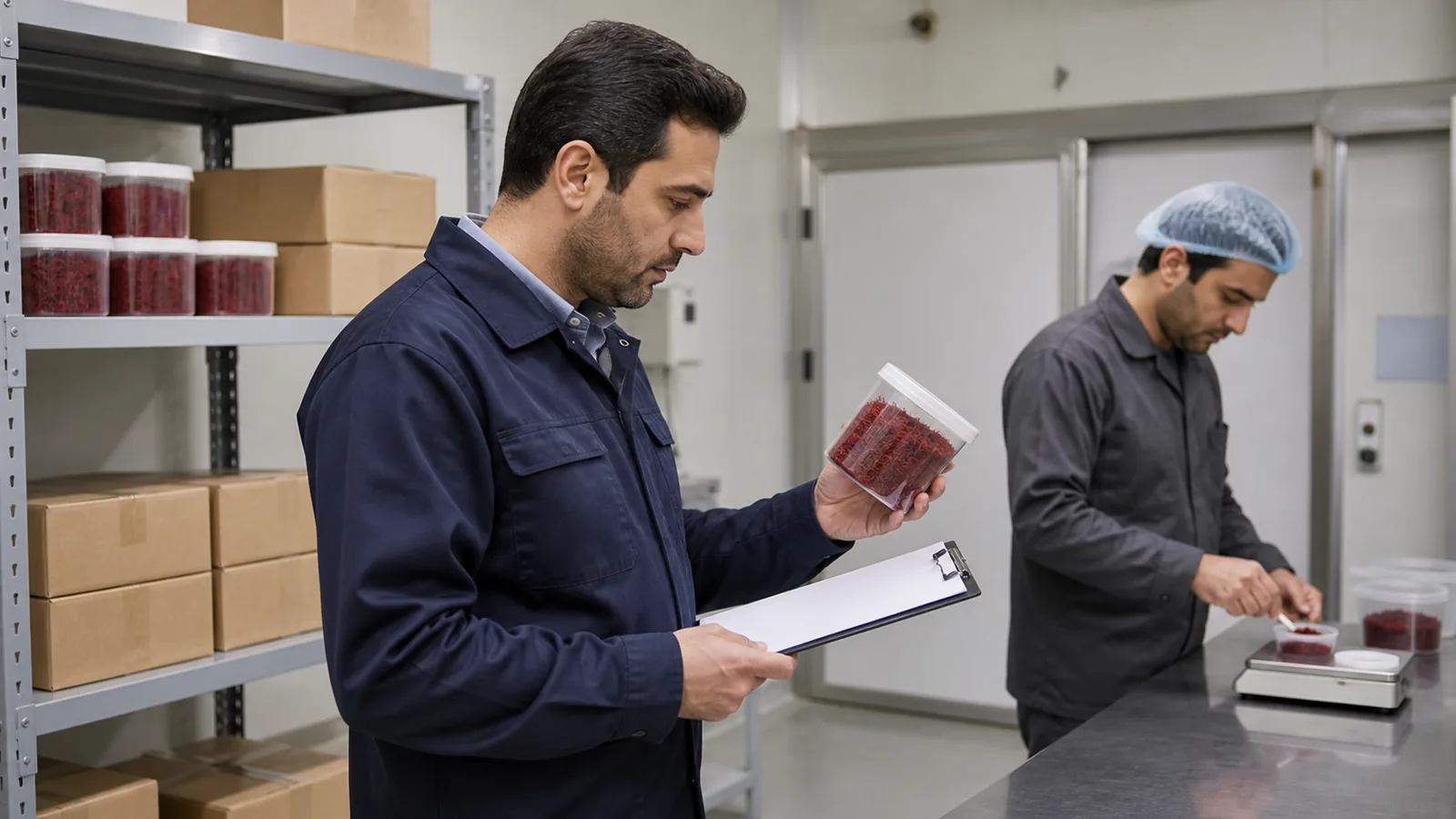
For saffron, a credible storage and finance programme would need:
- a defined list of accepted forms and grades;
- consistent sampling, weighing and independent testing;
- a lot number linking the depositor, quality result and stored container;
- sealed, food-suitable packaging and controlled storage conditions;
- insurance, security and regular inventory reconciliation;
- clear ownership and rules against pledging the same lot twice;
- published fees, interest, valuation and margin requirements;
- a process for rejecting or downgrading non-conforming saffron; and
- audited rules for selling, withdrawing or releasing stock.
These controls make a receipt useful to a lender or buyer. A building full of unverified packages does not create safe collateral.
How guaranteed purchasing differs from a loan
A guaranteed purchase sets conditions under which an organisation agrees to buy. A loan advances money while the farmer or depositor retains an obligation to repay, often with the stored crop as security. A reserve may use one mechanism or combine them, but the contract must say which.
For a purchase, the critical terms include grade, price, quantity limit, delivery point and payment date. For a loan, they include valuation, advance rate, interest, storage fees, maturity, the right to sell collateral and what happens if the market price falls.
The 2013 translation mixes loans, purchase guarantees and government cash buying. We preserve all three ideas, but it does not provide enough detail to conclude which legal structure was finally proposed.
Why an organised market was part of the plan
The council wanted saffron to be offered through a stock or commodity-exchange platform so quality and price could be visible. That requires standard contracts and deliverable grades. Without them, one quoted price may refer to Negin filaments, another to Pushal, and a third to a lot with different test results.
Our article on saffron futures and cultivation finance explains why an exchange contract is a risk-management tool rather than a guaranteed profit. The related history of saffron price stability also shows why a dated market claim must not be mistaken for today’s quotation.
Questions the 2013 proposal left unanswered
The report did not say who would own the proposed bank, which authority would supervise it, how the 70 tonnes would be graded, where the saffron would be stored, what purchase price would apply or when the reserve could sell. It also did not reconcile the currency figures.
Those are not minor administrative details. They determine who bears a loss, whether small growers can participate, whether a lender trusts the receipt and whether releasing stock steadies the market or surprises it.
Reading the “100 million dollars” headline safely
The headline preserves the wording under which this 2013 story was published. It should not be quoted as evidence that US$100 million was transferred, that a saffron bank still holds 70 tonnes, or that the government currently fixes the cash price.
The durable idea is the proposed connection between timely farmer finance, verified storage and an organised sales channel. Each part can support a healthier market, but only when the money, inventory and rules are transparent.
Source and review note
We reviewed this article on 28 August 2026. All names, quantities and policy statements from 2013 are attributed to the original translated National Saffron Council report. The modern warehouse-receipt context comes from the official 2024 UNCITRAL–UNIDROIT model-law page linked above. No current Iranian reserve, guaranteed price or funding amount is asserted without evidence.

![Exporting Saffron to Turkey + Price Guide [Complete 0 to 100]](https://img.rowhanisaffron.com/20260827003933/saffron-export-turkey-quality-inspection.webp)



