


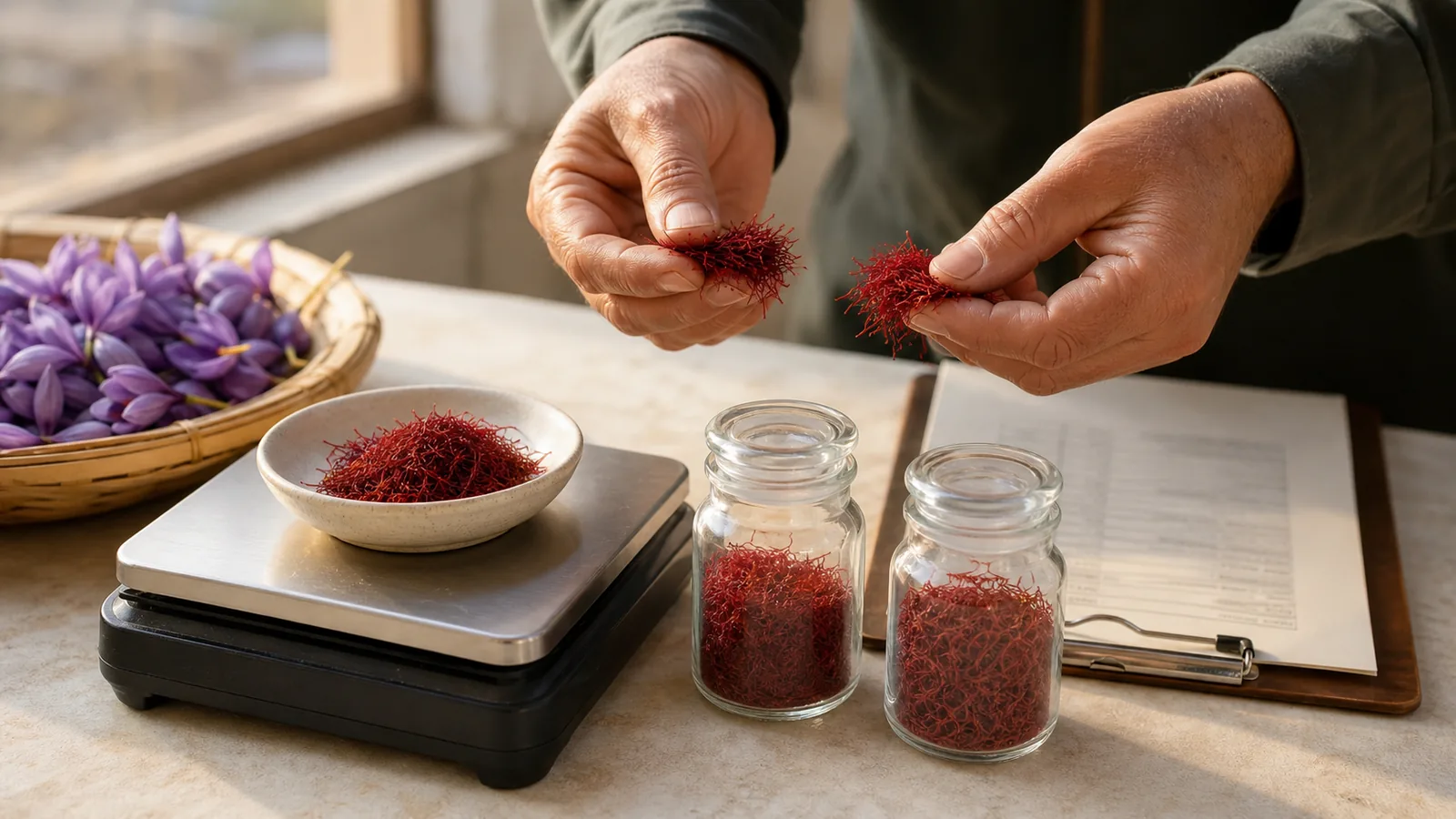
A saffron price may look stable for several weeks and then move sharply as harvest begins. That is not a contradiction. Saffron has a short flowering season, a labour-intensive harvest and a market in which the timing of supply matters almost as much as the size of the crop.
Four archived reports on this site followed different moments in that cycle. Together they show why prices fell during one harvest, rose on rumours before another, and later settled when supply and demand came back into balance. Their figures are historical, not live quotations.
What “stable saffron price” meant in the original report
In the destination article’s original interview, Gholam Reza Miri of Iran’s National Saffron Council said the market had been broadly balanced for about ten days. He described an export price range of roughly $1,500–$2,000 per kilogram at that time and expected production to increase after favourable April rainfall.
Miri did not give a precise production forecast. He said flowering should improve but acknowledged that the final increase could not yet be calculated. That distinction matters: rainfall before flowering can support a crop, but a price decision should not treat an early outlook as a final harvest total.
Why harvest season can push prices down
A later harvest-season report caught the market in a different position. About 30% of the crop in producing areas had reportedly been harvested. Miri expected production to finish around 20% above the previous year because of favourable conditions.
With fresh supply arriving faster than demand, the reported saffron price fell by 10–15% to approximately 4.5–5.5 million tomans per kilogram. These are old Iranian-market figures from the report’s period; inflation, exchange rates and later currency changes make them unsuitable for a present-day comparison.
The report also said exports were 7% ahead of the same period a year earlier and forecast growth of 20–30% if export conditions improved. Again, the larger number was an expectation, not a completed customs result.
The work behind each kilogram
Supply can peak suddenly, but producing dried saffron is never effortless. Flowers must be picked during a narrow window, the stigmas separated, and the material dried with care. A recent food-science paper reports that processing about 78 kilograms of fresh flowers yields roughly one kilogram of dried saffron. The study’s production context supports the older article’s estimate of 80–100 kilograms, while also showing why the figure should be treated as approximate rather than universal.
Labour, flower-to-stigma yield, drying loss and quality rejection therefore place a floor under production costs. A temporary glut at harvest can still reduce the price farmers are offered, especially when many growers need to sell at the same time.
How dealers and storage affect the market
One archived article described the familiar harvest pattern: supply rises, the farm-gate price softens, and traders with enough capital buy material for storage. That does not make storage improper. It becomes a concern when concentrated stocks or misleading claims are used to create an artificial sense of scarcity.
The same account said saffron prices had swung by about 20% during the season, disrupting exporters who needed to quote customers in advance. Sargol and Negin were identified as the most actively traded Iranian grades in that report, so changes in those categories were particularly visible.
Stored saffron also has to remain saleable. Poor control of light, air, moisture or heat can reduce aroma and colour quality. Our practical saffron storage guide explains how to protect threads and opened packs; warehousing does not preserve value by itself.
A price spike driven by rumours
An earlier interview with Miri recorded the opposite movement. Before that harvest, brokers were said to be circulating predictions of a steep production decline. The report described a rise of more than 800,000 tomans in a matter of days, with dry saffron reaching about 4.8 million tomans per kilogram before easing to around 4.6 million.
Miri argued that neither exporters’ purchases nor a proven shortage explained the jump; new crop had not yet reached the market in enough volume to confirm the rumours. His point was that price should be formed by verifiable supply and demand, not by an unsupported production story.
The exact numbers belong to that historical market. The lesson is still useful: when a quote moves sharply before harvest data exist, ask what evidence changed. A rumour about crop size is not the same as measured arrivals, completed harvest or official export volume.
The proposed saffron bank
The same interview revisited a “saffron bank” that had been discussed for years but, according to Miri, had not been implemented. The proposal was for an institution to buy product during the harvest, store it under controlled conditions and release stock when the market tightened.
In theory, such a reserve could reduce the pressure on farmers to sell into a short seasonal glut and give exporters a steadier supply. It could also create governance risks if buying rules, quality controls, stock levels and release decisions were not transparent. The archived report described the proposal and Miri’s frustration; it did not show that the scheme existed or prove how it would have performed.
What actually moves a current saffron quote
For a buyer, “the saffron price” is incomplete unless the quote identifies the product and transaction. The most important checks are:
- Harvest and quote date: a pre-harvest indication, a peak-harvest offer and a post-season contract reflect different supply conditions.
- Form and grade: whole Negin or Sargol threads, other cuts and powder should not be compared as if they were identical.
- Batch evidence: appearance alone cannot replace a representative sample, traceability and applicable quality testing.
- Quantity and delivery terms: bulk origin price, freight, insurance, customs, repacking, tax and retail margin are separate layers.
- Currency and validity: every offer needs a named currency, unit, expiry date and payment terms.
A useful comparison normalises all offers to the same net weight and delivery basis. It also checks whether the sample and test report belong to the lot that will actually ship.
How to read the four reports together
The reports do not support one permanent price. They document a cycle: an apparently balanced market, a harvest-season decline as supply arrived, an earlier rumour-led spike, and repeated concern about the effect of warehousing and volatility on growers and exporters.
Stable pricing is valuable because farmers, processors and buyers can plan. Stability should not be manufactured by hiding information or repeating an old quote. The sound basis is current evidence: crop progress, actual market arrivals, comparable grade, documented quality and clear commercial terms.

![Exporting Saffron to Turkey + Price Guide [Complete 0 to 100]](https://img.rowhanisaffron.com/20260827003933/saffron-export-turkey-quality-inspection.webp)



