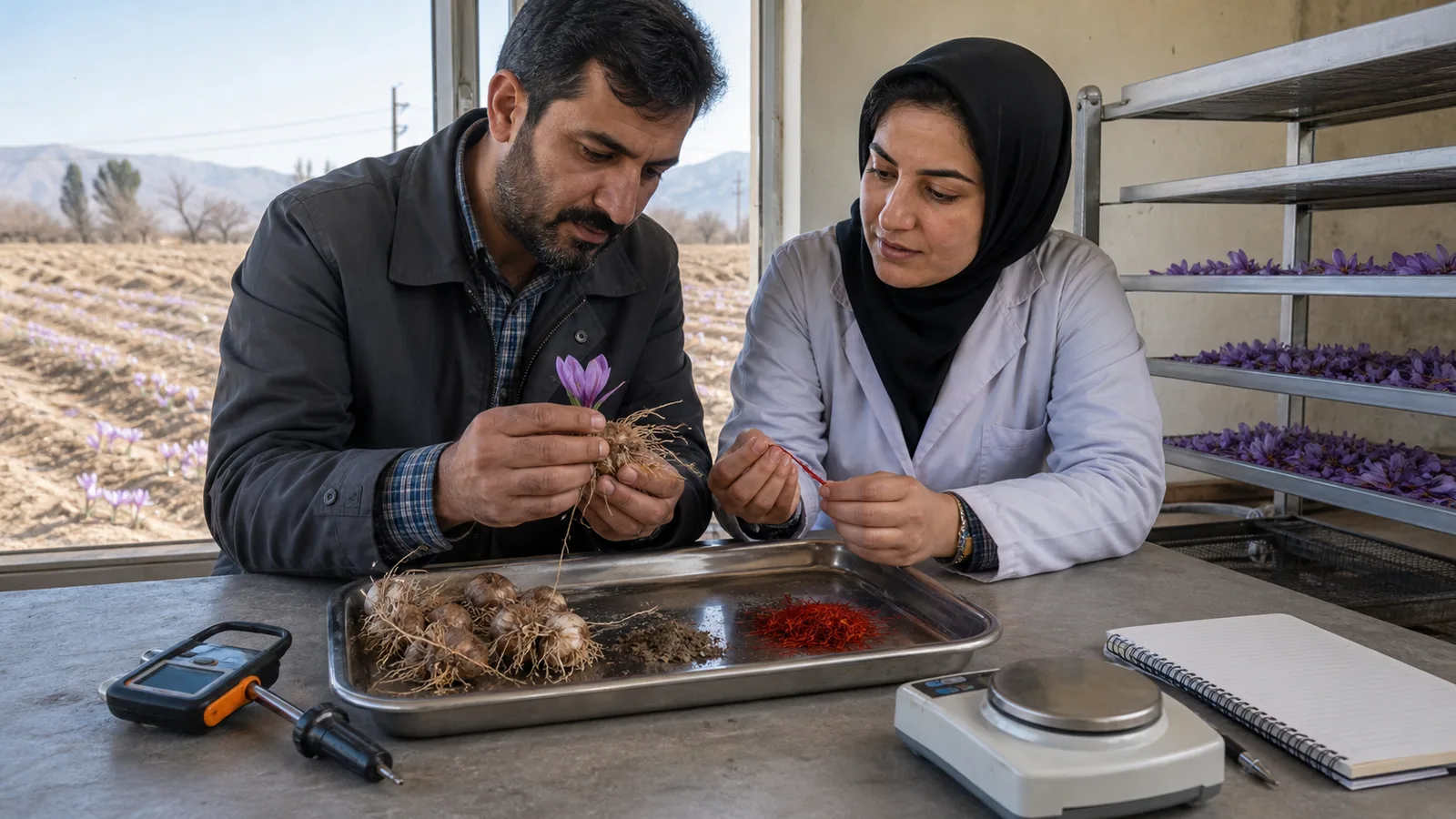


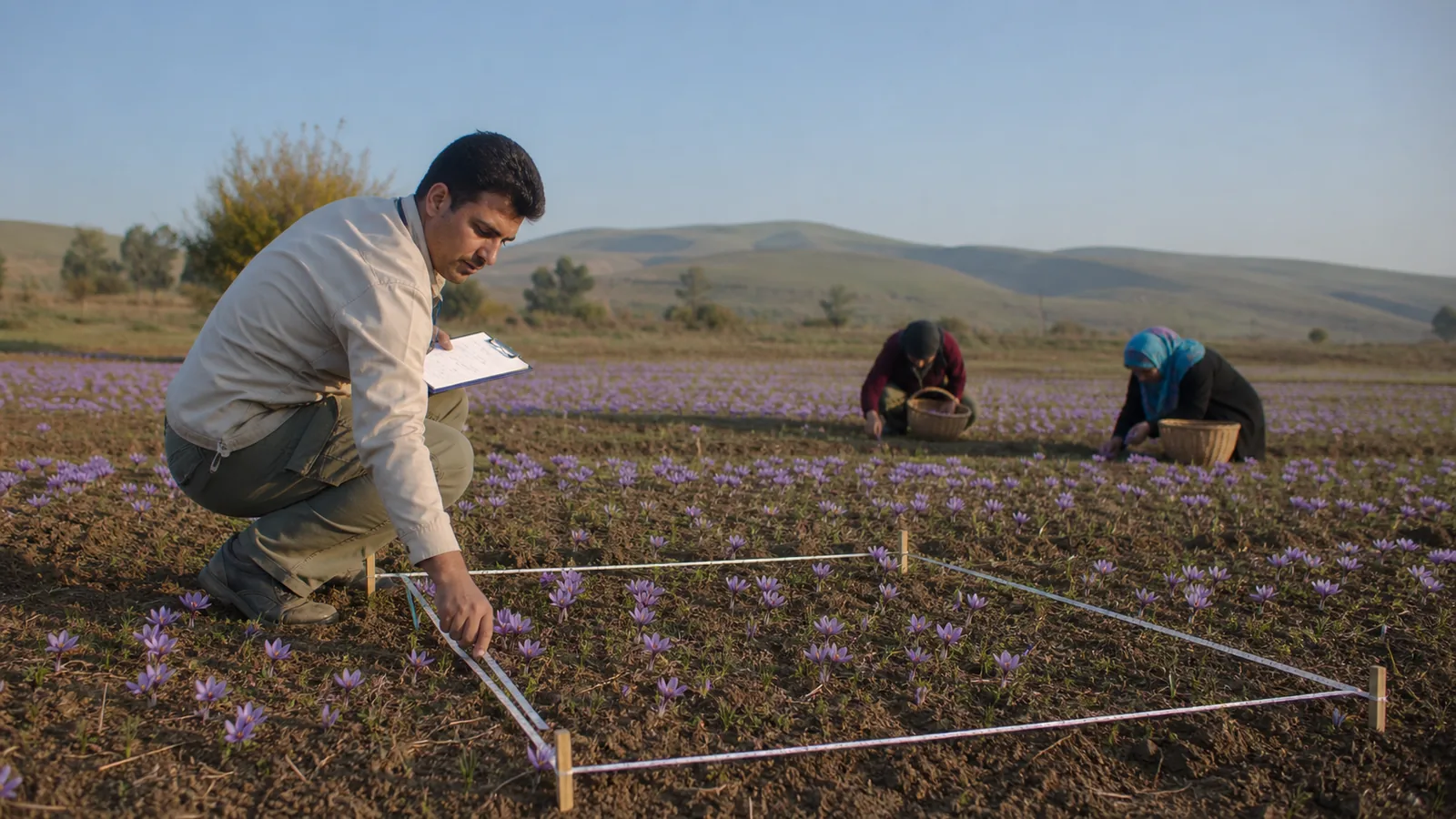
About 90% of the world’s saffron is cultivated in Iran, although “cultivated” and “produced” are not identical measures. The title of this 2013 report came from an acreage comparison: roughly 70,000 of an estimated 78,500 hectares worldwide were said to be in Iran. Recent research reaches a similar 90% figure for dried-saffron output, estimating about 439 tonnes per year from Iran.
Both figures support the same broad conclusion: Iran is the dominant saffron-producing country. They should not be combined as if they came from one global census. The original acreage and Golestan figures describe a 2013 regional presentation, while the 439-tonne estimate comes from research published in December 2025.
Where is 90% of saffron produced?
Iran produces roughly 90% of world saffron. A 2025 open-access study in Scientific Reports states that approximately 439 tonnes of dried stigmas per year, or about 90% of global supply, originate in Iran. The same paper identifies Razavi Khorasan and South Khorasan as the country’s principal growing areas.
That estimate is more recent than the report preserved on this page, but it is still a research estimate rather than a live annual register. Weather, harvested area, field age, corm condition, irrigation and labour can change output between seasons.
For a broader comparison of output, countries and data limitations, read our saffron production statistics guide.
How the original acreage claim was calculated
The translated 2013 report gives worldwide saffron acreage as 78,500 hectares, then prints Iran’s area as only “70 hectares.” That cannot support the headline. Seventy hectares would be less than one-tenth of one percent of the stated world total.
The intended Iranian figure was almost certainly 70,000 hectares. Dividing 70,000 by 78,500 gives about 89.2%, which explains the rounded 90% claim. This is a transparent arithmetic inference from the two printed figures, not a correction copied from an official acreage table.
The original presentation was attributed to a Golestan Province agricultural official in a Fars News report. The official’s name is damaged in the English translation and appears only as initials, so we do not expand it into a person’s name without evidence.
Golestan saffron production in the 2013 report
The report said about 62 hectares were under saffron in Golestan Province and that production was approximately 0.3 tonnes, or 300 kilograms. If those two numbers refer to the same season and harvested area, they imply an average close to 4.8 kilograms of dried saffron per hectare.
The speaker separately quoted a world practice or average of about four kilograms per hectare, a provincial figure of 3.7 kilograms, and yields of six to eight kilograms in Gorgan. Those statements may refer to different fields or measurement periods. They cannot all be treated as one provincial average.
The heading “eight kilograms of saffron yield in Gorgan” is therefore preserved as the upper end of a local range reported at the time, not presented as a guaranteed yield for Golestan or Iran.
Saffron yield per hectare in Iran
There is no single permanent saffron yield per hectare in Iran. A field may produce little while new corms establish, reach a stronger phase in later seasons and decline if crowding, disease or management problems develop. Temperature, water timing, soil, corm size, planting density and harvest labour also matter.
Yield comparisons need the same numerator and denominator. The useful calculation is kilograms of dried stigma divided by hectares actually harvested. Planted area, flower weight, wet stigma and export volume should not be substituted.
For that reason, the old four, 3.7 and six-to-eight kilogram figures remain regional historical claims. They are relevant to the search for saffron yield per hectare in Iran, but they are not a modern national benchmark.
The plan to expand Golestan cultivation
The agricultural organisation said saffron area had reached 120 hectares by Iranian year 1394, roughly March 2015 to March 2016, and forecast 250 hectares by year 1404, roughly March 2025 to March 2026. Since the article was published in October 2013, both numbers were targets rather than measured outcomes at the time.
The same passage projected an increase of 720 kilograms of dried saffron. It also mentioned 810 person-days of work per hectare per year and an employment equivalent of 250 jobs. The translation does not supply the calculation, area base or definition of a full-time job, so those labour numbers should be read as programme estimates.
A target date passing does not prove the target was met. This source contains no later survey of Golestan acreage, production or employment, and we have not turned the plan into a current fact.
Why Golestan wanted to grow more saffron
The 2013 presentation described saffron as a high-value crop with relatively low transport cost and export potential. It linked cultivation with rural employment, technology transfer, non-oil income and an effort to reduce migration from villages.
Those are potential advantages, not automatic outcomes. Saffron still needs suitable land, healthy corms, careful irrigation, concentrated harvest labour, drying skill, quality control and a buyer. A high price per kilogram does not by itself show profit per hectare.
The organisation concluded that any planting plan should follow agronomic principles. That qualification matters in a province outside the traditional Khorasan centre: expansion should be based on local field evidence, not only on the national market reputation of saffron.
Acreage share and production share can diverge
If one country holds 90% of planted area, it will usually dominate output, but the two percentages do not have to match. Yield differences, abandoned fields and whether the count covers planted or harvested land can change the production share.
This is why a page about “saffron production by country” should identify whether its figures describe hectares, dried tonnes or exports. Iran can lead all three measures without one dataset proving every number.
What remains reliable from the old report
The strongest points are the scale relationship and the regional intent. The 70,000-of-78,500-hectare comparison explains the 90% headline. Golestan was presented as a smaller but expanding region, with local yields that could exceed the quoted world average in some fields.
The weakest points are the dropped zeros, damaged official name and unexplained employment arithmetic. Keeping those limits visible is more useful than making the translation look precise after the fact.
Source and review note
We reviewed this article on 28 August 2026. The current output context comes from “Organic versus conventional saffron production: apocarotenoid content and heavy metal contamination in Iran”, published in Scientific Reports on 5 December 2025. The acreage, Golestan output, yield range, 1394/1404 targets, 720-kilogram increase and employment figures remain attributed to the original 2013 report, with translation errors and forecast status stated explicitly.