


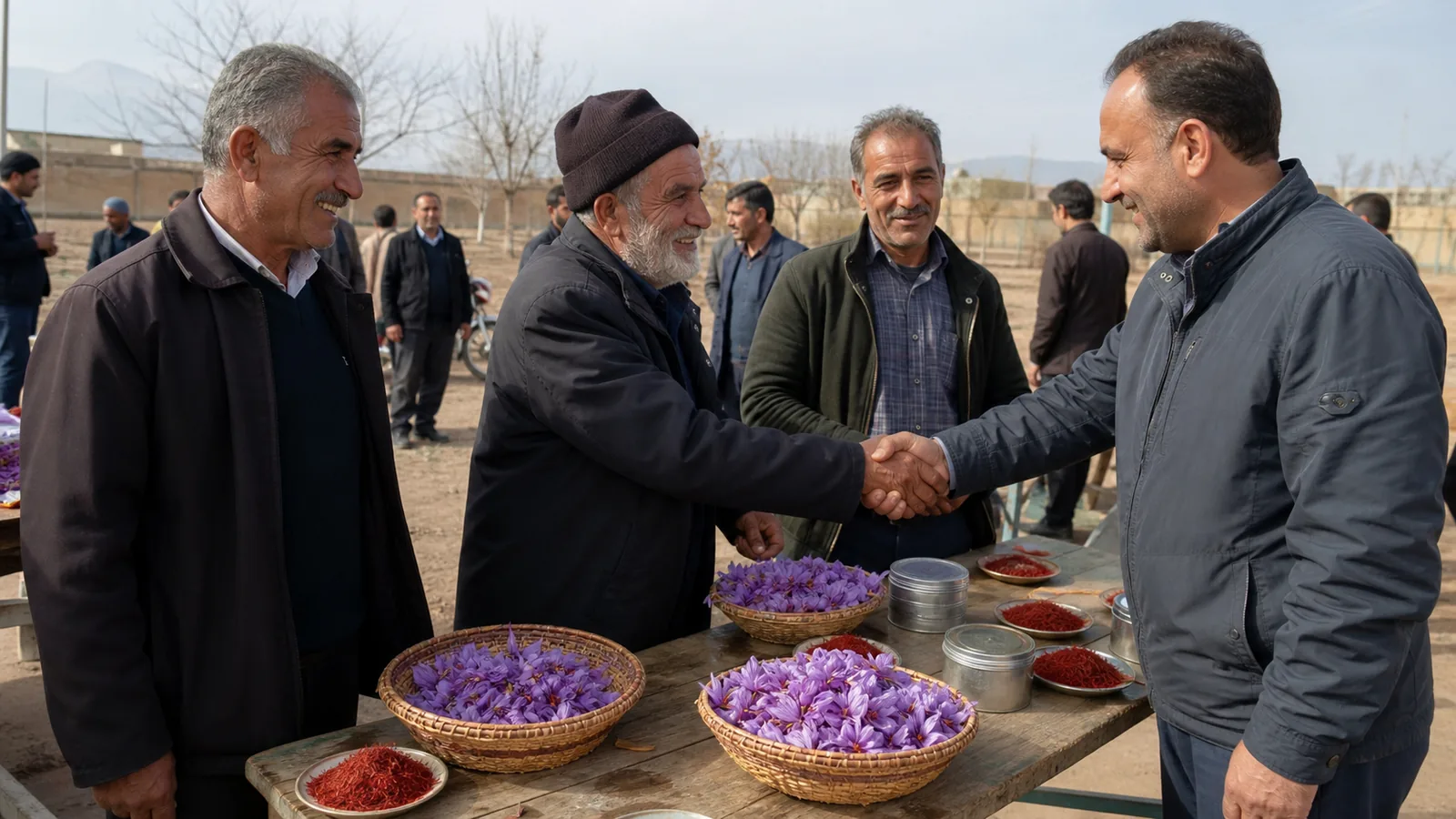
Robat Karim’s first saffron festival honoured local growers after a reported 400-kilogram harvest from 50 hectares. Later accounts described more than 80 hectares under cultivation, over 600 kilograms of dried saffron reaching the market each year, a planned “saffron house” and a cooperative intended to bring training, finance, packing and sales together.
The figures record different stages in the city’s saffron development. They are historical, rounded administrative reports rather than current production, yield or income guarantees.
The first Robat Karim saffron festival
The first festival gave growers a place to offer their crop directly and recognised several of the area’s leading saffron farmers. Attendees included representatives from Tehran Province’s management and planning organisation, the Robat Karim governorate and the local and provincial agricultural administrations.
At that stage, the city was reported to have produced about 400 kilograms from 50 hectares. Taken literally, those numbers imply an average near eight kilograms per hectare. The source did not provide field records, grade, moisture basis or the number of fully productive hectares, so the calculation should not be treated as a tested citywide yield.
The direct-sales element was more than ceremony. It allowed growers to present their own product, meet customers and retain a clearer connection between the farm and the sale.
Growth to more than 80 hectares
A later report from Robat Karim’s agricultural administration put saffron area above 80 hectares and annual dried output sent to market above 600 kilograms. These values suggest the sector expanded after the first 50-hectare festival report.
If 600 kilograms is divided by exactly 80 hectares, the implied yield is 7.5 kilograms per hectare. Because the source says “more than” for both area and output, the actual ratio cannot be calculated precisely. New fields may also take time to reach full production.
Mehdi Salehi, identified in that report as the city’s agricultural director, made further cultivation a priority. He described Robat Karim’s climate as suitable for a crop associated with hot, dry regions and emphasised saffron’s relatively low water requirement and labour demand.
The reported 35 million toman income
The later account placed average saffron income near 35 million tomans per hectare in its reference period. It did not specify whether that meant gross revenue, net farm income or an estimate based on a particular grade and yield.
For that reason, the number cannot serve as a present investment forecast. Corms, labour, water, drying, testing, packaging, inflation and sale price all affect the result. Its value is historical: local officials viewed saffron as a crop capable of supporting income and employment in Robat Karim.
A planned saffron house for grower support
The city also proposed establishing a “saffron house.” Salehi described its purpose as continuing extension work around cultivation. A useful centre of that kind could organise training, field advice and shared access to post-harvest knowledge.
The report announced a plan, not proof that the centre was built or remains operational. Its real value would need to be measured through growers served, courses delivered, field problems resolved and improvements sustained over more than one harvest.
Eighty producers exhibited their saffron
The later festival report said 80 saffron producers exhibited products. Governor Seyed Mehdi Sadati used the event to argue that Robat Karim could strengthen its place as an agricultural hub in Tehran Province and develop export opportunities.
An exhibition can open conversations, but international sales require more than a large stand count. Lots need consistent identity and quality, traceable handling, suitable packaging, accurate documentation and customers prepared to reorder.
The Robat Karim saffron cooperative
A separate announcement by Alireza Salehi described the formation of a growers’ cooperative. It followed a meeting involving the agricultural administration, governorate, growers, the labour/cooperation/social-welfare department and the technical and vocational organisation.
The cooperative was intended to provide bank facilities, cultivation training and support for improving production efficiency. It also planned to collect Robat Karim saffron and sell it in a unified package and brand, including through export.
Pooling small lots can create enough volume for consistent processing and larger orders. It can also reduce duplication in testing and packaging. The structure only works fairly when grading rules, fees, payment timing and member governance are transparent. A common package should not erase which farm supplied a lot or allow a weaker batch to trade on stronger growers’ work.
From local reputation to a credible brand
The cooperative announcement said Robat Karim saffron was becoming an international brand. No export volumes, registrations or destination-market evidence were given, so that should be understood as an ambition rather than an established global status.
The city’s historical progression is still clear: a 50-hectare festival harvest, growth beyond 80 hectares, participation by 80 producers, a proposed extension centre and an organised growers’ group. The next step is not another headline. It is consistent product, transparent cooperative operation and verified sales that turn local recognition into repeat business.

![Exporting Saffron to Turkey + Price Guide [Complete 0 to 100]](https://img.rowhanisaffron.com/20260827003933/saffron-export-turkey-quality-inspection.webp)



