


South Khorasan announced a branding initiative for its saffron and barberry products, with the historical report saying the mark had been registered through a Swiss protocol and would be introduced locally within 45 days. The aim was to protect the province’s name from being attached to inferior products from elsewhere and to help farmers retain more value.
The page’s title says “Brandy Saffron,” but the Persian headline meant branding saffron. This was a translation error, not a reference to an alcoholic drink or a type of saffron.
What the South Khorasan branding report said
Ehsan Beiki, identified as head of South Khorasan’s specialised barberry and jujube collection and processing terminal, said the brand covered the province’s barberry and saffron agricultural products and related derivatives.
He said the absence of a protected brand allowed some lower-quality products from other provinces to be offered under the South Khorasan name. A regional identity was intended to give buyers a clearer connection between the product, its claimed origin, and the people who produced it.
The old English version called Beiki “Ehsan Baki” and translated the terminal’s work as “recording” and “barberry seals.” In context, the facility was concerned with receiving, handling, and processing crops, not making audio recordings or seals.
What a regional brand can and cannot prove
A name or trademark can help distinguish a product in the market. By itself, it does not prove that every package contains saffron from South Khorasan, that the stated grade is correct, or that the product meets a particular chemical or food-safety standard.
For the name to carry meaning, each batch needs evidence behind it:
- the grower or supplying farm and place of production;
- harvest and processing dates;
- the saffron cut or grade;
- clean separation, drying, and storage records;
- batch or lot identification through packing and sale;
- appropriate authenticity and quality testing; and
- rules governing who may use the regional name.
Those controls turn a place name into a traceable claim. Without them, branding may improve appearance while leaving the original problem unchanged.
The “Swiss protocol” needs historical caution
The source stated that the barberry and saffron brand had been registered in a “Swiss protocol.” It did not provide a registration number, the legal owner, the exact system used, the territories covered, or the final certificate. The claim should therefore be preserved as Beiki’s reported announcement, not treated as independent proof of an international right that remains active today.
Trademark protection, a collective mark, certification mark, and geographical indication are different legal tools. Each can control a name in a different way. Buyers and producers need the exact registration and current rules rather than relying on a shortened news description.
Why processing matters to the brand
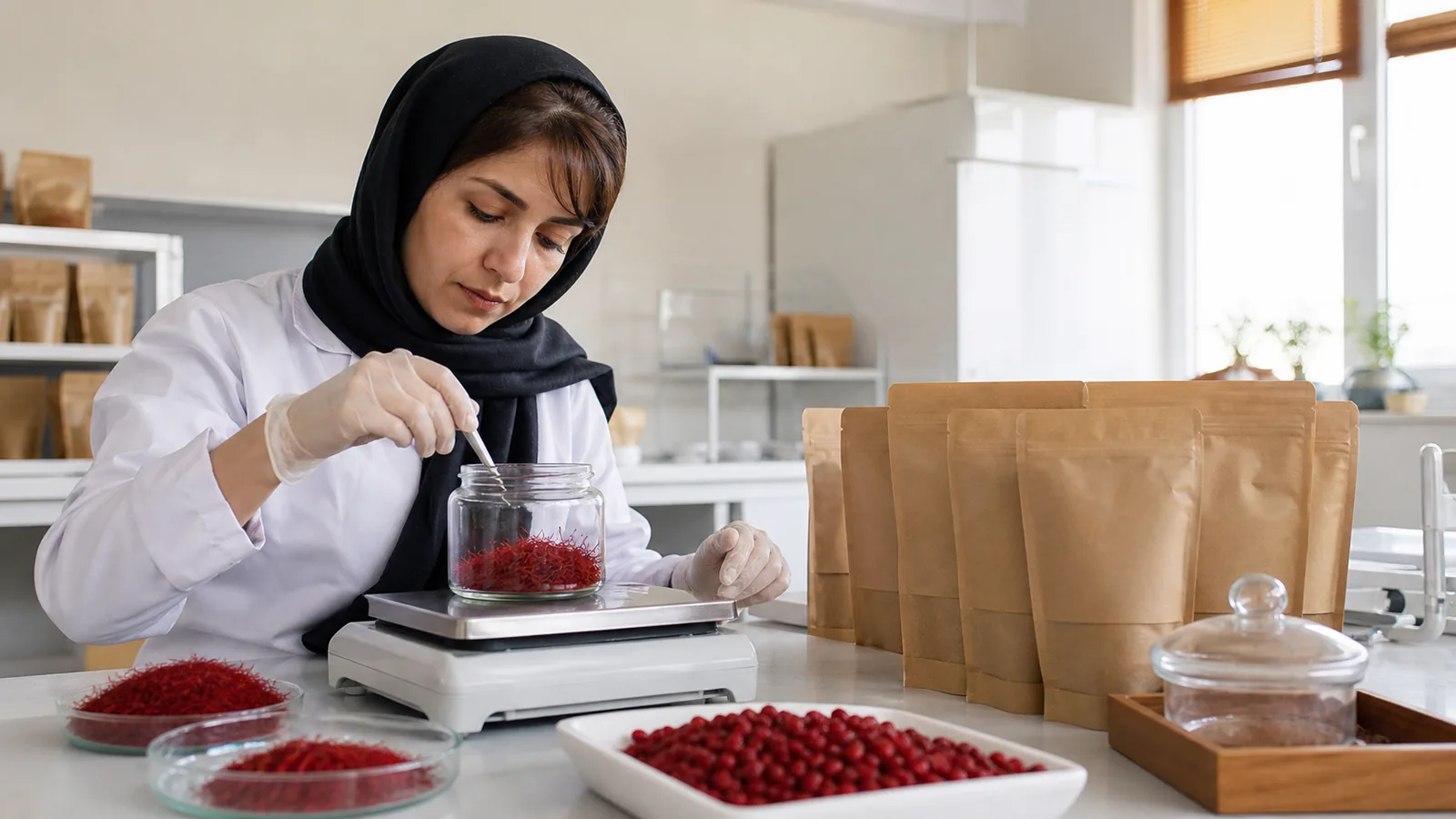
Regional identity is won or lost after flowers leave the field. If stigmas are separated on an unclean surface, dried inconsistently, mixed across unknown lots, or exposed to moisture and odours, attractive packaging cannot restore the result.
A credible South Khorasan saffron system should keep lots separate, specify how grades are named, use food-suitable packaging, and connect every unit to a batch record. Testing should support claims about quality and authenticity rather than be used as a vague marketing phrase.
The initiative also covered related products. A saffron derivative needs its own accurate ingredient list, saffron quantity where required, production controls, and shelf-life evidence. The regional brand should never imply that a flavoured product consists entirely of saffron.
Buying from growers and reducing dependence on intermediaries
Beiki said the specialised terminal had the capacity to buy part of farmers’ output and reduce their dependence on brokers. The report did not claim that the terminal could purchase every crop or guarantee a price.
Transparent buying requires published grade definitions, sampling procedures, deductions, payment timing, and a way for growers to understand why a lot received a particular result. Direct purchase is useful only when it gives the farmer a clearer and fairer route to market.
The news item also described a memorandum under which the Rural Cooperative Organisation would buy farmers’ barberries with approval from experts at the Birjand Chamber of Commerce. That detail relates primarily to barberry, but it shows the wider structure behind the proposed regional identity: collection, expert assessment, purchasing, processing, and marketing were being considered together.
Branding South Khorasan saffron responsibly
Brandy Saffron of South Khorasan is best understood as a historical story about safeguarding origin, not inventing a new saffron variety. The initiative sought a recognisable name for saffron, barberry, and related products while creating a stronger local route from growers to the market.
The most durable protection comes from evidence that travels with the name. Clear ownership, published use rules, farm and batch traceability, consistent processing, honest grades, and verifiable registration give a regional brand substance. They also make it harder for unrelated or inferior goods to borrow South Khorasan’s reputation.

![Exporting Saffron to Turkey + Price Guide [Complete 0 to 100]](https://img.rowhanisaffron.com/20260827003933/saffron-export-turkey-quality-inspection.webp)



