


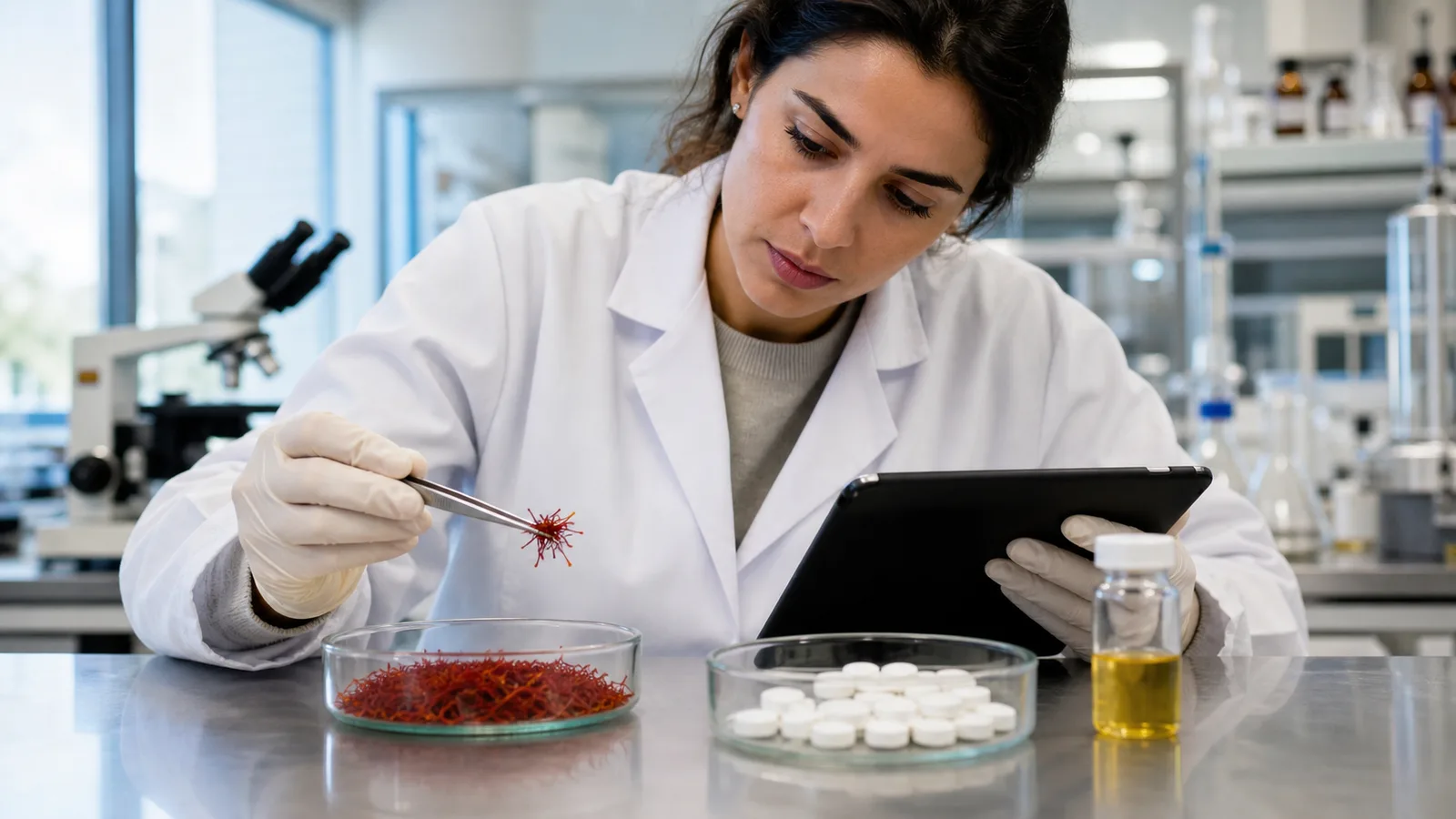
Krosina (also romanized Krocina or Croscina) is a saffron-derived tablet developed at Mashhad University of Medical Sciences in Iran and standardized around crocin, the main active compound in saffron. The university moved it toward production after laboratory work and clinical testing. This article reports what the developers and published studies have said about the product; it is not medical advice.
Please note: this article covers Iranian clinical research into Krosina, a saffron-derived crocin tablet — not a general health claim about saffron as a food or spice. Early studies describe promising results in small trials, but the researchers themselves call these findings preliminary and call for larger, independent replication. Saffron and crocin are not a proven substitute for the prescribed treatment of Alzheimer’s disease, diabetes, cancer, or depression. Speak to a qualified clinician before changing any treatment.
What is Krosina?
Krosina was designed by Dr. Seyed Ahmad Mohajeri, a faculty member of the Pharmacodynamics and Toxicology Department at the Faculty of Pharmacy, Mashhad University of Medical Sciences, within the Sina Drug Scan knowledge-based program. After approval, laboratory work and clinical testing, an initial batch of 20,000 tablets was distributed to pharmacies in Mashhad.
According to Dr. Mohajeri, each tablet contains crocin, one of saffron’s most active constituents and the compound to which many of saffron’s antioxidant effects are attributed. Much of the interest in the tablet comes from clinical studies of saffron and crocin carried out over the past two decades.
What the research reports
Dr. Mohajeri said crocin has been studied mainly as an add-on to antidepressant therapy. In one clinical study he described, crocin showed apparent effects on depression, anxiety and mood compared with placebo. Independent researchers have examined the same question: a randomized, double-blind, placebo-controlled pilot trial reported crocin to be useful as an adjunctive treatment in major depressive disorder.
He also pointed to saffron research on memory and mild-to-moderate Alzheimer’s symptoms, noting that some trials have compared saffron’s effect with that of commonly used medications. That comparison appears in a 22-week randomized trial in which saffron performed similarly to donepezil in mild-to-moderate Alzheimer’s disease. The trial’s authors describe such results as preliminary and call for larger studies.
Other areas the developer mentioned are still at an early research stage rather than established uses. These include age-related changes in vision, retinal disorders in people with diabetes, blood-sugar regulation, antioxidant activity relevant to heart and brain health, and inflammatory conditions such as osteoarthritis. In one reported study of people with diabetic retinopathy, taking the tablet over three months was associated with reductions in HbA1c and in retinal inflammation; Dr. Mohajeri presented these as study findings that need confirmation in larger, independent trials.
Krosina is not the same as culinary saffron
Krosina is a standardized pharmaceutical tablet made for clinical research, not the saffron threads used in cooking or sold as a spice. Everyday culinary amounts differ greatly from the concentrated crocin doses used in the trials above, so the food has not been shown to reproduce those effects. If you are interested in saffron as a food, see our overview of saffron’s health benefits and our range of pure saffron threads.
Dr. Mohajeri added that because saffron is grown in Khorasan, developing saffron-based medicines domestically could support Iran’s knowledge-based economy and closer collaboration between industry and universities. Research on the tablet’s pharmacological properties is continuing at Mashhad University of Medical Sciences.
Source: Mehr News Agency

![Exporting Saffron to Turkey + Price Guide [Complete 0 to 100]](https://img.rowhanisaffron.com/20260827003933/saffron-export-turkey-quality-inspection.webp)



